
Categories : Field-specific (academic)
Shii News – DFDS (Qom) 2022 Fellowship
Discussion Forum on Divine Scriptures invites applications in three levels for a one-year fellowship in Islamic historical Theology beginning in August 2022.
DFDS 1 fellowship (Eligibility: The fellowship is open to 5 PhD students in the Biblical or Islamic Studies)
DFDS 2 fellowship (Eligibility: The fellowship is open to 3 scholars who have competed their PhD within the past three years in the Biblical or Islamic Studies.)
DFDS 3 fellowship (Eligibility: The fellowship is open to 2 Assistant Professors in the Biblical or Islamic Studies.)
Teaching load is six courses for the academic year, three per semester. Course units includes Historical methodology; Method of analyzing the history of Islam; Comparative History of the Divine Scriptures; History of Islamic thought; The structure of the transmission of Islamic heritage civilization and Historical analysis of religious texts (TPET)
The fellow will be expected to participate in the activities of the DFDS Programs one semester-long course. A complete application includes: a letter of application, a curriculum vitae, and a letter of recommendation. Please send your application for review by May 20, 2022 to ahmadi_mh@ut.ac.ir (Dr. Mohammad Hasan Ahmadi, Asso. Prof. University of Tehran and Executive Director of Discussion Forum on divine Scriptures (DFDS).
The applications will be considered by DFDS steering committee and the Approval applications will be sent out by June 17.
More Information: https://zabanshenasitarikhi.ir
- April 11, 2022
- 0 Comment
Shii News – Register for Seventh Annual Conference on Shi‘i Studies
https://www.islamic-college.ac.uk/publications/shiistudies/seventh-shii-conference-2/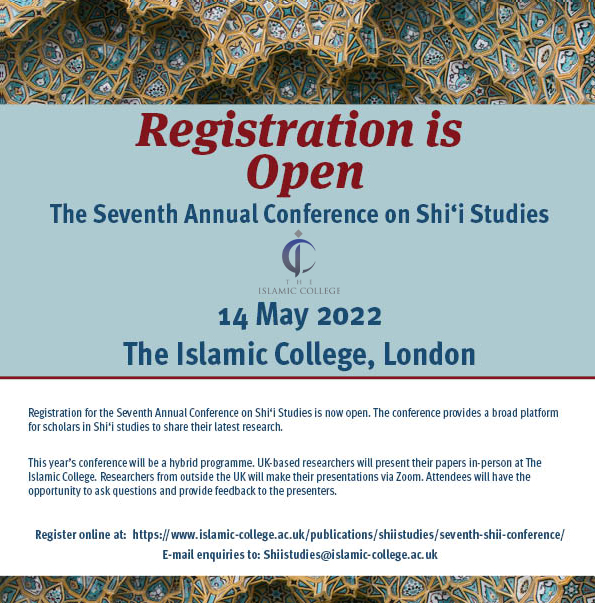
Register at:
https://www.islamic-college.ac.uk/publications/shiistudies/seventh-shii-conference/
- April 08, 2022
- 0 Comment
Shii News – Zoom: ‘Women and the Shaping of the Iranian Taʿziyeh’ – E L Deacon (21.4.22, 12.30 PM PT)
“More than Mourners: Women and the Shaping of the Iranian Taʿziyeh”
Eleanor Lucy Deacon (University of Edinburgh)
Apr 21, 2022
12:30pm-2:00 PM Pacific Time (US and Canada)
On Zoom:
https://ucsd.zoom.us/j/97438384705
Meeting ID: 974 3838 4705
- April 07, 2022
- 0 Comment
Shii News – ‘The City of Haidar as a Shiʿi Paradise’ – K Ruffle (April 29th at 2 PM London; 9 AM New York; 6:30 PM Mumbai)
Webinar Series – From Konkan to Coromandel: Deccan Heritage, Art and Culture – Spring 2022
For further information and to register, see the above site.
- April 06, 2022
- 0 Comment
Shii News – « Les oulémas chiites entre “quiétisme”, contrepouvoir et révolution (fin XIXe-XXIe siècle) » – S Mervin (5.4.22; 18.30 Paris time)
> À l’auditorium du Pôle des langues et civilisations de la BULAC et en live sur la chaîne YouTube pour ceux qui ne pourraient pas s’y rendre.
- April 04, 2022
- 0 Comment
Shii News – BIPS: ‘The City of Isfahan as Actor’ – K Babayan (Webinar, 27.4.22, 5pm UK Time)
This talk explores Isfahan through the lens of seventeenth century household anthologies (majmu’a). Thousands of manuscripts produced in Isfahan assembled urban objects ranging from portraits and letters from friends, to poems depicting the central square, to marriage contracts and talismans. Authors collected, curated, and bound together material generated by Isfahan’s culture of adab to learn how to act and relate to other residents of a diverse and ever-growing capital city. With these family collections, Professor Babayan tells a new history of Isfahan at the transformative moment it became a cosmopolitan center of imperial rule. Bringing into view people’s lives from a city with no extant state or civic archives, Kathryn Babayan reimagines the archive of anthologies to recover the dialogic relationship between the city and its residents.
- April 01, 2022
- 0 Comment
- March 31, 2022
- 0 Comment
Shii News – CfP: ‘Shia Studies in Twenty-First Century’ (5/30-31 /2022 (Eastern US Time) / 5/31-6/1/ 2022 (NZ time)
The Center for the Study of the Middle East at Indiana University, Massey University in New Zealand, and the Middle East and Islamic Studies Aotearoa/New Zealand are delighted to invite you to the virtual zoom conference, “Shia Studies in Twenty-First Century,” to be held in 5/30-31/2022 (Eastern US Time) / 5/31-6/1/2022 (NZ time).This conference is intended to bring together scholars of Shi’ism across the world to share their research. It intends to create a scholarly network from Europe and North America to Oceania.
The themes of the conference are; Theology and Philosophy of Shia Islam, Shia Islamic Metaphysics, Shi’ism and Sufism, Modern Political Thought in Shia Islam, Shia Shariah: Private or Public?, Equality and Economics in Shia Islam, Equality in Shia Islam, Contemporary Shi’ism and Gender Equality, non-Twelver Shias, Shi’ism and the environment, Atheism Skepticism and Apostacy in Shia Islam, Rights in Shia Islam, Ultra-Shia, Shia Islam and Democracy, Shia Islam and Art, Shia Islam and Technology.
We would very much appreciate your contribution to the conference, as we understand your contributions already made to the field. Please send your 250 word abstract by Friday April 21st. We will announce speakers by the first of May. After the conference, we will select papers for publication by September. If you have any questions, please don’t hesitate to contact us at Shiaconference2022@gmail.com
We dearly hope you are able to participate in our zoom conference, thank you so much for the consideration and your outstanding work in Shia Studies.
Sincerely
-Mr. Alexander Shepard.
-Dr. Negar Partow.
-Dr. Carl Pearson.
- March 30, 2022
- 0 Comment
Shii News – Non-Sunni Muslims in the Late Ottoman Empire – N Alkan
https://www.bloomsbury.com/uk/nonsunni-muslims-in-the-late-ottoman-empire-9780755644742/?utm_campaign=NL-CT_NIPPODs_SEPT_23&utm_content=Non-Sunni%20Muslims%20in%20the%20Late%20Ottoman%20Empir&utm_medium=email&utm_source=Adestra
- March 28, 2022
- 0 Comment