
Archive for 2022
- February 14, 2022
- 0 Comment
Shii News – Two Zoom events on Muharram during the Qajar period (15.2, 17.2.2022)
1. “Tekye-ye Dowlat” a documentary
Babak Rahimi is inviting you to a scheduled Zoom meeting.
Topic: Tekye-ye Dowlat
Time: Feb 15, 2022 12:30 PM Pacific Time (US and Canada)
Join Zoom Meeting
https://ucsd.zoom.us/j/91833762354
Meeting ID: 918 3376 2354
One tap mobile
+12133388477,,91833762354# US (Los Angeles)
+16692192599,,91833762354# US (San Jose)
Dial by your location
+1 213 338 8477 US (Los Angeles)
+1 669 219 2599 US (San Jose)
+1 669 900 6833 US (San Jose)
Meeting ID: 918 3376 2354
Find your local number: https://ucsd.zoom.us/u/abZ4emITJu
2. “Photography of Moharram Rituals inside the Golestan Palace(1860s-1900s)”
Pedram Khosronejad (Powerhouse Museum, Sydney)
Time: Feb 17, 2022 02:00 PM Pacific Time (US and Canada)
Join Zoom Meeting
https://ucsd.zoom.us/j/99404838317
Meeting ID: 994 0483 8317
One tap mobile
+16692192599,,99404838317# US (San Jose)
+16699006833,,99404838317# US (San Jose)
Dial by your location
+1 669 219 2599 US (San Jose)
+1 669 900 6833 US (San Jose)
+1 213 338 8477 US (Los Angeles)
Meeting ID: 994 0483 8317
Find your local number: https://ucsd.zoom.us/u/aRLInGyfT
- February 14, 2022
- 0 Comment
Shii News – Academic Items
1.The first International Ottoman Studies Congress (OSARK) took place in Sakarya, Turkey, from October 14-17, 2015. The next OSARK was held in Tirana, Albania, from October 17-20, 2018.
We would like to inform you that the third OSARK will be held in Istanbul, Turkey, from September 7-9, 2022, at Istanbul Medeniyet University. OSARK 2022 welcomes and encourages individual paper and thematic panel proposals within any field of Ottoman History.
For further details see:
2. The MLA Global Arab and Arab American Forum invites proposals for the following panels at the MLA Convention in San Francisco (5-8 January 2023):
Writing and Cultural Production as Oppositional Work
Oppositional work of writing and cultural production in the Arab region and global Arab diaspora, including protest and dissident literature/art/activism that resists surveillance and discursive/cultural practices of domestication and containment. 250-word abstract & bio by March 15, 2022 to rc49@soas.ac.uk (Rasha Chatta, Freie Universität)
Migrants as Working Subjects
Literary and artistic representations of migrant labor in the Arab region and global Arab diaspora, as inflected by class, race, ethnicity, language, nomenclature, and sociocultural/economic practices including sponsorship. 250-word abstract & bio by March 15, 2022 to azstanton@psu.edu (Anna Ziajka Stanton, The Pennsylvania State University)
3. Rescheduled: UCLA Bilingual Lecture Series – Latest Developments in Afghanistan Panel
Sunday, April 10, 2022 at 11:30am Pacific Time via Zoom
Panel in Persian
Ahmad Nader Nadery
Former Chair of Independent Civil Service Commission in Kabul, and Member of the Peace Negotiation Team for Afghanistan
The Taliban’s Return to Power and Its Implications for Afghanistan and Iran
Homeira Qaderi
Afghan Writer and Women’s Rights Activist, and Radcliffe Fellow at Harvard University
How Women in Afghanistan have Strived for Their Rights
Farah Karimi
Head of the Dutch Parliamentary Delegation to the OSCE PA and Former UN Consultant for Capacity Building of the Afghan Parliament
4. 2022 AMECYS Friday Digital Author Series Schedule
Spring 2022 AMECYS Friday Digital Author Series
Throughout the spring on the 2nd Friday of each month, digitally join AMECYS’ authors, who will discuss their most recent monographs, articles or book chapters. Sessions will consist of a 30-minute interview with AMECYS board member (unless noted otherwise) followed by Q&A from audience.
Friday March 11, 11 am CST
Dr. Hedi Viterbo, Associate Professor of Law,
Queen Mary University of London
Author of Problematizing Law, Rights, and Childhood
In Israel/Palestine (Cambridge University Press, 2021)
Interviewed by Sunaina Maira (Professor, University of California, Davis)
Friday April 8th, 11 am CDT
Mr. Shivan Fazil, Researcher, Stockholm International Peace Research Institute
Dr. Bahar Baser, Associate Professor of Middle Eastern Studies,
Durham University
Editors of Youth Identity, Politics and Change in Contemporary Kurdistan (Transnational Press London, 2021)
Friday May 13, 11 am CDT
Dr. Rania Kassab Sweis, Associate Professor of Anthropology
at the University of Richmond
Author of Paradoxes of Care: Children and Global Medical Aid in Egypt (Stanford University Press, 2021)
Links for series will be sent to all AMECYS listserv members, so make sure signed up for the listserv! Digital medium for series is Zoom (https://zoom.us/download).
For information, email dylan.baun@uah.edu or hmorrison@uwlax.edu
5. Jaleh Esfahani Poetry Prize 2022
Date: 18 February 2022 Time: 6:00 PM
Finishes: 18 February 2022 Time: 8:30 PM
Venue: Brunei Gallery Room: Brunei Gallery Lecture Theatre (BGLT)
Type of Event: Performance
This is the first in-person Annual Jaleh Esfahani Poetry Prize event that will be held since the start of the coronavirus pandemic. This year’s prize also coincides with the 100th birth anniversary of the late Jaleh Esfahani.
The event marks the 12th year of the poetry prize, in which young (under 30) Persian poets from Iran, Afghanistan and Tajikistan, and the diaspora, compete. At this year’s event the winners, from among the three shortlists of 5 poets, for each country, which were selected from nearly 200 original participants, will be announced.
During the event well-known Persian language poets and the judges will speak, and the winners will read samples of their poems, intertwined with music from Persian-speaking countries and a Sama (Whirling) Dance.
Programme
6.00pm: Reception in the foyer of the BGLT
6.30pm: Event starts
* Please note that the language for this event’s proceedings will be in Persian.
Admission is free and open to the public, however, donations of £5 are greatly appreciated.
Organiser: Jaleh Esfahani Cultural Foundation in association with the SOAS Middle East Institute
Contact email: fsp@parand.co.uk
6. The Leiden University Centre for Islamic Thought and History (LUCITH) is hosting a two-day international conference on Wisdom Literature in Early Islam.
12-13 September, 2022
The conference will have a mixed format, with both in-person and online presentations. The conference will address the question of wisdom literature, as a tool of persuasion, to deliberate its content, to analyse its philosophical and ethical messaging, and identify major themes and tropes in Arabic literature, philosophy, intellectual history, linguistics, and ethics, among other things, in Early Islam (broadly conceived of as the first few centuries).
Themes the conference could address:
- Transmission of wisdom literature, aphorisms, and texts
- Recurring tropes and themes
- Devotional piety and wisdom literature
- The Qur’an and wisdom literature
- The Arabic reception of ancient wisdom literature
- Tools of persuasion and rhetoric
- Philosophical and ethical dimensions
For consideration, please send a 300-word abstract in English to lucith@hum.leidenuniv.nl by the 15th of March 2022. The conference will be held in English.
Due to the Covid-19 pandemic, only participants located within Europe will be invited to join us in person and will be offered a one-night stay with their travel and accommodation costs covered by the conference organiser. Participants located outside of Europe will be invited to join us online.
Contact Info:
Tamar Tros, Conference Coordinator
Contact Email:
7. The latest issue of Mamlūk Studies Review(XXIV [2021]) is now available for download from our website:
http://mamluk.uchicago.edu/browse-download.html
8. Al-Maqrīzī’s al-Ḫabar ʿan al-bašar. Volume IV, Section 2: The Idols of the Arabs.Critical edition and introduction by Michael Lecker, annotated translation by Yaara Perlman. Leiden and Boston: Brill, February 2022 (Bibliotheca Maqriziana, vol. 8), xii-381 pp. ISBN: 978-90-04-49986-7 (e-book); 978-90-04-49983-6 (hardback).
For more information on published and forthcoming volumes, see https://brill.com/view/serial/BIMA.
9. Translating Contemporary Iran
Panel with Mariam Rahmani and Nasrin Rahimieh (UCI)
Thursday, February 17
Remote via Zoom
1:00 pm (Pacific Time)
About the Panel
Since its first publication in 2008, Mahsa Mohebali’s edgy cult hit, Nigarān nabash, has been off and the shelves in Tehran. Following Shadi, a cynic and opium addict who cross-dresses to evade hijab law, throughout an apocalyptic day of earthquakes that are destroying the city, the novel offers a view of contemporary Iran too seldom seen in the US – but now available to in translation under the title, In Case of Emergency (Feminist Press, 2021). Please join us for a conversation between scholar Dr. Nasrin Rahimieh and translator Dr. Mariam Rahmani on issues of translation and mistranslation – both literal and cultural– from a Persian Iranian to Anglophone American context.
About the Panelists
Mariam Rahmani is a writer and translator. Her fiction and essays have appeared in Granta, Gulf Coast, BOMB Magazine, the Los Angeles Review of Books, and The Rumpus as well as in exhibition catalogs and her translation in n+1, Columbia Journal, and the collected volume, After Cinema: Fictions From A Collective Memory (Archive Book, 2019). Her 2021 translation of Mahsa Mohebali’s In Case of Emergency, the 2008 Iranian cult hit, was well reviewed in the New York Times and has garnered other positive press in the New York Times “Globetrotting,” Publishers Weekly, Lit Hub, Electric Literature, World Literature Today, and the Center for the Art of Translation. Rahmani holds a PhD in Comparative Literature from UCLA and an MFA in Fiction from Columbia University. Among her honors and awards are the 2021 Henfield Prize, the Columbia MFA’s highest honor in fiction, a 2018 PEN/Heim translation grant, and a US Fulbright fellowship. Rahmani currently teaches at UCLA as a Lecturer in English and Comparative Literature.
Nasrin Rahimieh is Howard Baskerville Professor of Humanities and Professor Comparative Literature at the University of California. She is currently the Director of the Humanities Core program at UCI, former Chair of the Department of Comparative Literature (2016-19) and Maseeh Chair and Director of the Samuel Jordan Center for Persian Studies and Culture (2006-14). Her teaching and research are focused on modern Persian literature, the literature of Iranian exile and diaspora, contemporary Iranian women’s writing. Among her publications are Oriental Responses to the West: Comparative Essays in Select Writers from the Muslim World (1990), Missing Persians: Discovering Voices in Iranian Cultural History (2001), Forugh Farrokhzad, Poet of Modern Iran: Iconic Woman And Feminine Pioneer Of New Persian Poetry (2010) co-edited with Dominic Parviz Brookshaw and Iranian Culture: Representation and Identity (2015). She translated the late Taghi Modarressi’s last novel, The Virgin of Solitude (2008) from Persian into English.
For more information and to register:
https://www.international.ucla.edu/cnes/event/15371
10. 2 PhD Positions in Digital Islamic History, University of Hamburg
I am advertising for two PhD positions in my project “The Evolution of Islamic Societies (c.600-1600 CE): Algorithmic Analysis into Social History” (EIS1600). Each position is 2+2 years. The deadline for applications is March 31, 2022. Successful applicants will work on one of the case studies of the project and will write and defend a PhD thesis on the topic of their choice, within a selected case study. Descriptions of both positions and detailed information on the application process can be found at the following links: https://tinyurl.com/PhD01; https://tinyurl.com/PhD02. Feel free to email me, if you have any questions (maxim.romanov@uni-hamburg.de). The project is funded by the German Research Foundation (DFG) within the framework of the Emmy Noether Program (https://tinyurl.com/EIS1600). It is hosted at the Institute of Asian and African Studies (Islamic Studies Division) of the University of Hamburg.
Best regards,
Maxim Romanov
Emmy Noether Junior Research Group Leader, “The Evolution of Islamic Societies (c.600-1600 CE): Algorithmic Analysis into Social History” (2021-2027), Universität Hamburg, Asien-Afrika-Institut, Edmund-Siemers-Allee 1, 20146 Hamburg, maxim.romanov@uni-hamburg.de
11. Christian Thought in the Medieval Islamicate World,
ʿAbdīshōʿ of Nisibis and the Apologetic Tradition
S Rassi
12. Regards sur les arts du monde iranien / Insights into the Art of the Persianate Societies
coorganisé par l’Institut Français de Recherche en Iran (IFRI) et le CeRMI,
aura lieu
le mardi 22 février 2022, de 15h à 17h (heure de Paris) / 17h30-19h30 (heure de Téhéran).
Cette deuxième séance s’articulera autour du thème « Regards sur la céramique, 1 / Insights into ceramic arts, 1 », avec les interventions suivantes :
- New data about the «Poteries de Bamiyan» (Afghanistan)
Guergana Guionova (CNRS, Aix Marseille Univ, LA3M, Aix-en-Provence),
Thomas Lorain (MAFAB/University of Bamberg)
- Architectural decoration, tiles and brickworks of Alamut Castle through historical data
Hamideh Choubak (ICCAR, RICHT, MCTH)
- A Research on the Islamic Ceramics of the Sultâniyya plain, Iran
Mahsa Feizi (PhD Tehran University/Lyon 2)
Discussion. Chairperson: Yves Porter (Aix Marseille Univ/IUF/LA3M)
Pour suivre cette séance en ligne (sur Skyroom), une inscription est nécessaire. Un lien d’inscription sera mis à disposition très prochainement.
>> Pour plus d’informations sur le Webinaire
13. 2022 Ann Lambton Memorial Lecture
Unequal Treaties and the Question of Sovereignty in Qajar and early Pahlavi Iran
With Professor Ali Gheissari
Hosted by Durham University, the event is jointly organised by BIPS and IMeEIS (Durham University).
9 March, 2022, 5-6 pm (UK time)
Via Zoom
To join on the day, see:
- February 12, 2022
- 0 Comment


Shii News – Online/oncampus: ‘God and Satan in Modern Shi’i Thought’ – A Doostdar (17.2.22)
- February 10, 2022
- 0 Comment
Shii News – Call for Manuscripts: “Studies in Shiʿi Materiality, the Sensorium, and Ritual”
Studies in Shiʿi Materiality, the Sensorium, and Ritual
Proposed Book Series, Edinburgh University Press
Series Editors: Karen Ruffle (University of Toronto) and Babak Rahimi (University of California, San Diego)
The goal of this proposed book series is to provide a forum for innovative works that contribute to new studies of Shiʿi traditions that are in conversation with and contribute to broader scholarly discussions on everyday life and sensory experiences while bringing attention to lived traditions and understudied locations and temporalities. Studies in Shiʿi Materiality, the Sensorium, and Ritual welcomes books that make bold claims, present fine-grained studies, explore theories and concepts related to material culture, the sensorium, its related rituals, practices, and relation to architecture, literature, the body, and more.
With the aim of inclusivity of wide historical contexts and geographies of Islam, Studies in Shiʿi Materiality, the Sensorium, and Ritual attempts to expand the line of critical enquiry to reconceptualize Shiʿism beyond the normative models of text/scripture, Twelver Shiʿism, and the Iranian world. Projects that reframe these models are encouraged. The series aims to foster approaches that engage with the body and memory, and by and large sensory and material practices that shape lived Shiʿism. The series also embraces empirical methods within the humanities and the social sciences ranging from ethnography to discourse analysis. While the geographical focus of the series is on the Shiʿi world between the Balkans and Southeast Asia, we also welcome research that focuses on often-overlooked regions such as China and sub-Saharan Africa. In broad scholarly terms, the series aims to publish diverse disciplinary and interdisciplinary approaches ranging from anthropology, art history, history, media studies, urban studies, philosophy, religious studies and sociology.
More specifically, we encourage submissions for innovative research that include:
Studies on Zaydi, Ismaʿili, Alevi, Bektashi, Bohra, and other communities of ʿAlid devotion, including Sufi-oriented
Ritual, theater, and performative studies
Qualitative methodological approaches such as ethnography, including autoethnography
Urban, space and critical border studies
Comparative historical studies from the medieval to modern periods
Technology and mediated practices
For full consideration, email a two-page proposal and CV to Karen Ruffle (karen.ruffle@utoronto.ca) and Babak Rahimi (brahimi@ucsd@edu).
- February 09, 2022
- 0 Comment
Shii News – Academic Items
1.Please join us on February 20 from 2 – 4 p.m. EST as we gather to commemorate beloved author and satirist Iraj Pezeshkzad, who passed away this January. This event is cosponsored by Damavand Cultural Foundation and will feature a roundtable discussion in Persian of Pezeshkzad’s life, works, and impact. Our speakers will be:
Ardeshir Lotfalian – Writer, Diplomat, and Advisor to Damavand Cultural Foundation
Seyyid Ali Mirfattah – Writer and Satirist
Ali Dehbashi – Writer and Chief Editor of Bukhara Magazine
Fatemeh Keshavarz – Director of Roshan Institute for Persian Studies
Marjan Moosavi – Lecturer at Roshan Institute for Persian Studies
Please use this Zoom link to join us then:
2. We are reaching out to share the Jasūr Magazine (previously known as Juhood) Spring 2022 Call for Submissions. This semester’s theme is Power: Political Economies of the Middle East. Jasūr is Duke University and the University of North Carolina at Chapel Hill’s undergraduate-run journal for academic and short-form writing on the Middle East and North Africa.
You can find a complete call for submissions below, and we would really appreciate your help in spreading it to students in your department. We will also be hosting several virtual events this semester, and invite anyone who is interested in attending and/or learning more about the publication to visit jasurmagazine.org. If you or any of your students have questions about the journal or submission guidelines, please contact Editor-in-Chief Jasper Schutt (jasperms@live.unc.edu), and/or editorial board member Eleyan Sawafta (ersawafta@uncg.edu).
All our best,
The Jasūr Editorial Board
The editorial board of Jasūr Magazine calls for submissions from undergraduate students for Jasūr 4.2, Power: Political Economies of the Middle East. Jasūr is a journal for critical scholarship and writing on the Middle East and North Africa, broadly defined, and is run by undergraduates at Duke University and the University of North Carolina at Chapel Hill. Submissions for the Spring 2022 issue will be accepted until Monday, February 28th, at which point the editorial board will contact selected authors.
The theme of this Spring’s issue of Jasūr is political economy. We take an intentionally expansive definition of the term, and understand it to mean the critical study of economic systems, class relations, and domestic and international institutions. Simply put, we’re looking for work that takes a materialist approach to analyzing any contemporary issue in the MENA region. Some examples of relevant topics include histories of capitalism in the region, how interventions by international financial institutions affect societies in the MENA region, or how political and economic constraints impact the region’s artistic sectors.
Submission Guidelines
- We are accepting submissions of complete academic and short form essays, as well as proposals for short form work. By academic work, we mean essays that are between roughly 8 and 30 pages and contain significant amounts of primary and/or secondary research. We are happy to accept longer submissions, especially of theses or other papers that contain original research, and can work with you to abridge the work for publication.
- Submissions of short form essays might offer political commentary, criticism of state and/or firm policies, and in general, examine current events from a political-economic perspective. In addition to completed pieces, we are also accepting proposals for short pieces, which should be submitted with a writing sample of similar length to the proposed piece.
- All submissions should be sent to jasurmagazine@gmail.comor submitted through our website’s submissions tab by February 28th, 2022.
- If you have any questions, please feel free to contact the editorial board (jasurmagazine@gmail.com) and/or Editor-in-Chief Jasper Schutt (jasperms@live.unc.edu).
In addition to the journal, the Jasūr team also accepts and publishes short-form and creative work on any topic all year-round. Throughout the year, we also host events on a variety of topics related to the MENA+ region, which are open to public attendance via Zoom. To learn more, visit jasurmagazine.org.
3. SOAS, University of London – Post-Doctoral Researcher in IslamicManuscripts of Sumatrahttps://www.h-net.org/jobs/job_display.php?id=62981
Closing date: 20.2.22
4. Introductory Old/Classical Armenian course at Notre Dame this summer through their Classical, Medieval, and Near Eastern Language Institute. It is open to undergraduate or graduate students.
The course will meet M/T/R 4:00–6:00pm ET (FULLY ONLINE) May 31st–July 7th (6 weeks).
Tuition rate info is here (the course is 3 credits): https://summersession.nd.edu/tuition-financial-aid/
I don’t think ND offers funding for the course, so students would need to apply for funding locally or seek other external scholarships, such as the Calouste Gulbenkian Foundation’s Short Term Grant for Armenian Studies or a NAASR grant
Jesse S. Arlen, Ph.D.
Postdoctoral Research Fellow in Armenian Orthodox Studies
Orthodox Christian Studies Center | Fordham University
Director, Krikor and Clara Zohrab Information Center,
Diocese of the Armenian Church of America (Eastern)
630 2nd Ave
New York, NY 10016
(212) 686-0710 ext. 126
jarlen@fordham.edu | jarlen@armeniandiocese.org
5. ONLINE Lecture: “Copying and Reading Sacred Scriptures: Qurʾan and Torah in Comparative Perspective” by Prof. Daniella Talmon-Heller (Ben-Gurion University of the Negev), UCLA, 9 February 2022, 12:00 pm PST
The Jewish tradition preserved the ancient form of the scroll, written in scripta defectiva, for its elaborate rituals of liturgical reading in the synagogue. The Muslim tradition, with its preference for the oral performance of the text, makes no such distinction, yet likewise regulates the work of the scribe and the handling of the book.
Information and registration: https://mailchi.mp/mediterraneanseminar/attend-copying-and-reading-sacred-scriptures-quran-and-torah-in-comparative-perspective-9-february-online?e=82aeb6c61d
6. Workshop: “Continuity and Change Throughout the Ottoman Longue Durée,” Third Annual Mid-Atlantic Ottomanists Workshop (MAOW), University of Mary Washington, Fredericksburg, VA, 1-3 April 2022
This workshop will provide an opportunity for scholars of Ottoman studies to gather, discuss their research, and receive substantive feedback. This initiative aims to bring together scholars of all stages who are working to advance the study of the Ottoman Empire and its interactions with the wider world from the late 13th century through the early 20th century.
Information: https://maow.umwblogs.org/
7. Workshop: “History and Anthropology through Literature: Approaches & Methodologies to the Study of Medieval and Modern Texts and Manuscripts”, Trinity College Dublin, 15 July 2022
The Cairo Genizah is a treasure trove of medieval and early-modern Arabic manuscripts stored away in Egypt’s Ben Ezra Synagogue over nearly a thousand years. This one-day workshop seeks to bring together scholars of manuscript sciences, history, anthropology, literary criticism, philosophy, and sociology to chal-lenge the investigation of history, sociology, and anthropology though pre-modern literature and its manu-scripts.
Information: https://t.co/Sy28Pbzp9x
8. International Workshop: “Religion and Secularism as Problem Space in Post-colonial Occidentalist Discourses within the MENA Region”, Leipzig University, 3-4 November 2022
The workshop aims to discuss the question of religion and secularity/secularism in (post-colonial) Occidentalist discourses and their critiques in the MENA region. The workshop intents to explore the trajectories of post-colonial Occidentalist discourses in the MENA region. It aims to reflect on their various genealogies, forms, and contents.
Deadline for abstracts: 30 March 2022. Information: https://multiple-secularities.de/events/event/international-workshop-religion-and-secularism-as-problem-space-in-postcolonial-occidentalist-discourses-within-the-mena-region/
9. CfP: Turkologentag, September 21–23, 2023, Vienna
GTOT e.V. (Society for Turkic, Ottoman and Turkish Studies) invites researchers from all over the world working in the fields of history, linguistics, philology, literary studies, social sciences, anthropology, and political sciences in Turkey and the Turkic world to participate in the Fourth European Convention on Turkic, Ottoman and Turkish Studies (Turkologentag 2023). The conference will take place on September 21 – 23, 2023 at the University of Vienna. It is organized in co-operation with the Chair of Turkish Studies at the University of Vienna.
The conference aims to bring together individual scholars, institutions and organizations from Europe and elsewhere who are engaged in Turkish and Turkic Studies. The four-day event will provide an opportunity for an intellectual exchange and conversation between participants and allow them to build networks for future cooperation. There will be a special forum for PhD candidates and graduate students.
The organizers encourage individual paper and thematic panel proposals within the following sections:
- Linguistics
2. Studies on Central Asia/Volga Region/Siberia
3. Caucasus
4. Turko-Persian Islamicate world
5. Ottoman Studies
5.1 Transottomanica (DFG Priority Programme)
5.2 Digital Humanities and Ottoman/Turkish Studies
5.3 Manuscript Cultures
5.4 Ottoman-Habsburg World
5.5 Balkan region and Southeast Europe
5.6 Hungary, Poland, Ukraine
5.7 Arab Provinces, Palestine
6. Environmental History and History of Science of the Ottoman Empire and Turkey
7. Literary Studies
8. Cultural Studies, Heritage / Art History
9. Studies of Contemporary Turkey
10. Kurdish Studies
11. Studies on Ethnic, Religious Minorities
12. Women and Gender Studies
13. Research on Religion
14. Musicology
15. Social Sciences and Migration Studies
16. Social Anthropology
17. German-Turkish Language Research /Education
If you like to join us on September 21 – 23, 2023, please submit an abstract (in German, English, French or Turkish, max. 250 words) on the Registration Portal: www.conftool.pro/turkologentag2023/. The deadline for individual paper proposals is 31 December 2022 and for panel proposals (3-4 panelists) is 30 November 2022. For submission guidelines, important dates, and further information stay tuned at turkologentag2023.univie.ac.at
Once your paper is selected, you will be asked to pay your conference participation fee. You can pay your fee in advance after the registration. In the case that your proposal is not accepted, the participation fee will be refunded. We encourage you to become a member of GTOT to benefit from reduced conference participation fees (especially students) and to be part of a growing international network of researchers engaging in Turkic, Ottoman, and Turkish studies! For further and detailed information please contact our homepage: turkologentag2023.univie.ac.at.
GTOT is an academic organization operating in the field of Turkic, Ottoman and Turkish studies. GTOT aims at creating a network for scholars and especially for young researchers in the field of Turkic, Ottoman and Turkish studies encompassing a wide range of research interests including the diverse range of religions and ethnic groups existing and living in areas populated by Turkic groups in the past or present
10. In Presence or HYBRID: International Conference “Iconic Figures: Intersecting Religious and Political Narratives of the Past”, Leibniz-Zentrum Moderner Orient (ZMO), Berlin, 7-9 December 2022
The conference will bring together scholars of various disciplinary orientations and working on different re-gions to examine the intersections and the entanglements between religious and political construction and deconstruction of historical icons and role models. It will pay particular attention to the ways in which discur-sive traditions in multi-religious contexts influence these processes.
Deadline for abstracts: 31 March 2022. Information: https://www.zmo.de/fileadmin/Karri-ere/Ausschreibungen_2022/Call_for_Papers_Iconic_Figures.pdf
11. Assistant Professor in Arabic Studies, University of Durham
Applicants should have a research interest and expertise in (comparative) literary, cultural and/or visual studies, as well as translation studies. Candidates are required to have a PhD in Arabic Studies or a related subject.
Deadline for applications: 28 February 2022. Information:
https://www.jobs.ac.uk/job/CMR473/assistant-professor-in-arabic-studies-mlac22-1
12. Lectureship in International Relations of the Middle East (2.5 Years), University of Leiden, Netherlands
Criteria: PhD in International Relations, political science, development studies, geography, sociology, or an-thropology with a focus on modern Middle East; Experience in teaching undergraduate and graduate stu-dents, and supervising theses; Proficiency in English; Ideally proficiency in Arabic.
Deadline for applications: 27 February 2022. Information: https://www.universiteitleiden.nl/en/vacancies/2022/q1/22-044-10663-25-year-lectureship-in-international-relations-of-the-middle-east
13. Associate Professor in Arab Modern and Contemporary History, University of Sharjah, UAE
Qualification: PhD in Arab Modern & Contemporary History from one of the recognized universities in the field of specialization; experience in university teaching in the field of specialization (8 years at least); ability to develop and lead high-quality research; published in high quality refereed journals in the specialty; fluency in Arabic and English (speaking and writing).
Deadline for applications: 25 February 2022. Information: https://newhr.sharjah.ac.ae/en/Pages/JobDetails.aspx?Jid=1817&IsDean=No
14. Visiting Assistant Professor (2 Years) in the History of the Ancient Mediterranean (North Africa, Mesopotamia, West Asia), University of Denver
Qualifications: PhD emphasis on Ancient History, including the Mediterranean world, Mesopotamia, North Africa, and West Asia.
Deadline for applications: 25 February 2022. Information: https://cu.taleo.net/careersection/2/jobde-tail.ftl?job=24243&lang=en&src=LinkedIn
15. Fellowships/Associateships for Advanced Historical Research in Islamic Art, Architecture, Material Culture, and Archaeology, Aga Khan Program for Islamic Architecture 2022-2023, Harvard University
Deadline for applications: 1 April 2022. Information: https://agakhan.fas.harvard.edu/fellowships-associateships
16. Lecturer in Arabic Language, University of Michigan-Arbor
Applicants should have Superior level proficiency in Standard Arabic, English, and at least one variety of spoken Arabic. Experience with teaching Arabic at the post-secondary level is required. Applicants must have a demonstrated ability to use a proficiency-based, communicative methodology in language instruction. Minimum of a Master’s degree in foreign language teaching or equivalent field required.
Deadline for applications: 1 March 2022. Information: https://apply.interfolio.com/102108
17. Postdoctoral Scholar/Teaching Fellow, Department of Middle East Studies, University of Southern California, Los Angeles
Researchers with training in environmental studies, anthropology, political economy, urban studies, and ge-ography are particularly welcome to apply. This fellowship is renewable for a second year contingent upon administrative approval.
Deadline for applications: 1 March 2022. Information: https://usccareers.usc.edu/job/los-angeles/postdoctoral-scholar-teaching-fellow-in-the-department-of-middle-east-studies/1209/22787922576
18. Special Issue of Religions on “Muslim Identity Formation in Contemporary Societies”
Possible themes: Qur’anic and Prophetic understandings of identity, difference, and pluralism; migration, citizenship, and belonging; identity formation and state politics; the umma, trans-locality, and Muslim cosmopolitanism; Muslim identity politics; the impact of Islamophobia on the formation of Muslim identities; the projection and representation of Muslims in the media; etc.
Deadline for manuscripts: 15 September 2022. Information: https://www.mdpi.com/journal/religions/special_issues/muslim_identity#info
19. Chapters for First Edited Book of the New Publication Series “Reading Ottoman Minds in Its Long History”, Sivas Republic University
With the help of this study, we are targeting to get a better picture on the questions like how did the Ottoman mind work, what were important moral or political principles for the Ottoman as making their decisions, and (if possible) to put forward the changes on the way they thought of the world around them in the course of its long history? Deadline for abstracts in English, German and Turkish: 15 March 2022.
Information: https://ottomanminds.cumhuriyet.edu.tr/
- February 08, 2022
- 0 Comment
- February 07, 2022
- 0 Comment
Shii News – Academic Items
1.Open Islamicate Text Initiative Teleconference on Feb 7
We welcome all to join the Open Islamicate Text Initiative Arabic-script OCR Catalyst Project (OpenITI AOCP) team for a public teleconference with the OpenITI AOCP technical advisory group. The focus of this meeting will be the optical character recognition tools and datasets for Persian, Arabic, Ottoman Turkish, and Urdu that the OpenITI AOCP has developed.
The conference, led by Co-PI David Smith, will provide an update on the OpenITI AOCP technical work and include brief presentations from advisory group members about their own work in OCR. We will then develop recommendations for dataset and technical development in the next phase of the project.
We will virtually gather on Monday, February 7 from 11:00 a.m. to 1:00 p.m. EST. Please register at the link below if you would like to participate. We will prepare a report of the conference proceedings as well as record video of the presentations and discussion for those unable to attend. Be sure to watch out for a second public teleconference to be held this spring, with a focus on the formation of Persian and Arabic OCR user groups and the presentation of our digital text production pipeline, eScriptorium (developed in collaboration with the eScripta project).
For more on OpenITI AOCP, a project generously funded by The Andrew W. Mellon Foundation, please see here. For any questions on the teleconference, please email John Mullan (jmullan@umd.edu) or message us on Twitter (@Open_ITI).
You are invited to a Zoom meeting.
When: Feb 7, 2022 11:00 AM Eastern Time (US and Canada)
Register in advance for this meeting:
https://umd.zoom.us/meeting/register/tJUpcOGoqT4tE9aF_DRXZEXOt5uYNd6U5Fv9
After registering, you will receive a confirmation email containing information about joining the meeting.
2. Mysticism and Ethics in Islam
Bilal Orfali, Atif Khalil, and Mohammed Rustom
3. IIS: The Ismaili Special Collections Unit (ISCU) has launched an online catalogue of special collections housed at the IIS, featuring information on over 2,000 items, including manuscripts, artefacts (such as coins, coin weights, medals and other memorabilia), rare and special printed materials (including periodicals), photographs and archival materials.
Dr Wafi Momin, Head of ISCU, said “We are delighted to announce the launch of an online catalogue of the special collections housed at the IIS. This online catalogue represents a key milestone in making accessible the rich heritage of Ismaili communities from around the world to a varied audience including researchers, students and interested members of the public.”
For any queries about the catalogue, please contact Naureen Ali, Cataloguer and Adlib Officer, ISCU.
https://special-collections.iis.ac.uk/search/simple
4. Intellect is pleased to announce that International Journal of Islamic Architecture 11.1 is out now!
For more information about the journal and issue click here:
https://www.intellectbooks.com/international-journal-of-islamic-architecture
5. The Qur’an
Translated with a New Introduction
Translated by AJ Droge
Equinox, 2022
For more information and to order at 25% off quoting the code QT visit the book page:
https://www.equinoxpub.com/home/quran-translated/
6. The Barakat Trust has recently received a grant from the National Lottery Heritage Fundto create a new grant scheme. In each of 2022, 2023 and 2024, this scheme will offer 3 grants of £8,000 plus in-kind support for projects in the United Kingdom (UK) that use collections of Islamic art in the UK to foster greater understanding about the cultures of the Islamic world, and involve a significant element of public engagement, ideally as part of the process of making collections more accessible. The grant will be open to UK institutions with collections of Islamic art and material culture. We are particularly interested in understudied collections. The deadline for submission of applications for this year is March 31st 2022. This project will be delivered in partnership with the Islamic Art and Material Culture Subject Specialist Network and other partners.
Interested parties should contact The Barakat Trust to arrange an initial conversation about this scheme. Please email: projects@barakat.org
7. The Middle Eastern and Islamic Studies Minor at Rutgers University Newark is delighted to invite you to the first talk in the MEIS Inaugural Lecture Series on Monday February 7th, 11:30-12:50 EST, with Prof. Patricia Blessing (Art History, Princeton University), who will offer a lecture titled “Architecture and Material Politics in the Fifteenth-Century Ottoman Empire.”
Register here: HTTPS://TINYURL.COM/34AKWEN3
8. Tuesday, February 15, 2022 | 12:00 pm | Zoom
Syriac Villages in the Tur Abdin: A Microhistory of the Medieval Middle East
Marica Cassis, University of Calgary
Marica Cassis considers understudied archaeological material found in the Tur Abdin region of southeast Turkey. She will contextualize the churches as part of the network of villages and cities in the region, both in terms of the material remains and literary sources.
While scholarly work on the churches of the Tur Abdin dates back to the work of Gertrude Bell, and subsequently continued off and on through the twentieth century, the focus of most research has consistently been the churches in the region. However, churches are the heart of communities, whether villages or monasteries, and need to be considered as part of the whole. What has not been considered in detail is the importance of contextualizing churches in the villages and cities in the region, both in terms of the material remains and the literary sources.
Advance registration required. Register: https://eastofbyzantium.org/upcoming-events/
Contact Brandie Ratliff (mjcbac@hchc.edu), Director, Mary Jaharis Center for Byzantine Art and Culture with any questions.
An East of Byzantium lecture. East of Byzantium is a partnership between the Arthur H. Dadian and Ara Oztemel Chair of Armenian Art at Tufts University and the Mary Jaharis Center for Byzantine Art and Culture that explores the cultures of the eastern frontier of the Byzantine empire in the late antique and medieval periods.
9. Consider submitting your work to postmedieval: a journal of medieval cultural studies
After more than a decade of publication, the journal postmedieval has a new team of editors and a new editorial board and we are looking for contributions from the H-Mideast Medieval community!
postmedieval has long published theoretically driven scholarship on premodernity and its ongoing reverberations, and the aim of the new editorial leadership is to continue this while expanding the disciplines and subject-areas from which articles are drawn. To that end, we are actively seeking open-topic submissions from a wide variety of fields and disciplines. We’re writing in the hopes that you’ll spread the word and will also keep the journal in mind as a potential venue for your own work. We are currently seeking open-topic submissions between 6,000 and 12,000 words, accepted on a rolling basis.
To say a bit more—over the last year, the journal’s editorial team has worked to harness postmedieval’s foundations in conceptual adventure, ethical and political urgency, and stylistic experiment, while also stretching its scope to additional language traditions, geographic locales, and the work of scholars from identity groups that have not heretofore been featured consistently in our journal, or in other mainstream outlets for medieval studies. The new editorial board includes scholars working fields like Byzantine studies, art history, the Hispanophone early modern, medievalism, religious history, Jewish studies, the environmental humanities, film studies, Chinese, Arabic, Persian, Hebrew, Japanese, French, medieval Ethiopia, the Mediterranean, the Indian Ocean, Premodern Critical Race Studies, manuscript studies, and the digital humanities. We are eager to cultivate a pool of submissions that reflects such varied scholarly traditions.
In addition to the broadened content parameters of the journal, we have also imagined new scholarly genres. These include meditations on critical terms in the field, an essay-form we are calling “terms of art;” brief translations or other presentations of primary sources that extend their accessibility to wider readerships; “dialogues,” in which scholars share a conversation in print; and “reports from the field” that summarize and contextualize important field-specific discussions held at a recent symposium or exhibition. We envision these genres as supplements to the traditional essayistic articles and book-review essays that we will continue to publish and for which the journal has long been distinguished.
We encourage you to read more about these new genres, and about our vision for the future of academic publishing in medieval studies, in the free-to-view introduction to our editorial team’s inaugural issue, entitled “What Might a Journal Be?.” For remarks from some of the board members, you might have a look at this piece as well.
We hope that you will share with colleagues, students, and scholarly networks our invitation to submit new work. We can promise that all submissions will be treated with scholarly generosity and care. The editorial team embraces an ethics of peer review and publication that values the intense labor required to bring an essay to print, and we center in our review process the anti-racist and inclusive editorial practices outlined by the RaceB4Race Executive Board. Feel free to reach out to me with specific queries or ideas, and the editorial team is always happy to answer questions at our journal email address, postmedievalED@gmail.com.
10. Online Lecture- Social Fabrics: Inscribed Textiles from Egyptian Tombs
Please join us on March 11, 1:00 p.m. (EST) for a virtual lecture as curator Mary McWilliams discusses her research for The Harvard Art Museums’ exhibition Social Fabrics: Inscribed Textiles from Egyptian Tombs (January 22, 2022–May 8, 2022, University Research Gallery) looks at “tiraz” – highly prized textiles enhanced with woven, embroidered or painted Arabic inscriptions – to trace the structure of medieval Egyptian society during a transformative period. It reveals a story as interwoven and complex as these delicate objects themselves.
For more information and registration, visit: https://museum.gwu.edu/member-program-social-fabrics-inscribed-textiles-egyptian-tombs
(Ed note – Membership required.)
11. MEM Panel Sponsorship at MESA 2022
As part of the efforts of Middle East Medievalists (MEM) to raise the profile of medieval studies at MESA, the MEM Board of Directors announces our 2022 call for panel sponsorship. MEM is a MESA affiliate and thus may sponsor up to three panels at each annual meeting. MEM sponsorship does not guarantee inclusion on the program, nor does it come with financial support. However, sponsorship highlights a panel to the MESA program committee, and, if it is accepted, the panel will appear as MEM-sponsored on the final program. We will also publicize MEM-sponsored panels to our membership and in MEM’s annual “Medieval MESA” circular. We encourage all medievalists organizing panels for MESA 2022 to send us abstracts for both individual papers and the panel as a whole, as well as the names of participants, by February 7, 2022, so the MEM board may consider them for sponsorship before the MESA submission deadline. Please email your materials and/or any questions to Rob Haug (haugrt@ucmail.uc.edu).
12. Call for Papers for:
Travellers in Ottoman Lands: The Balkans, Anatolia and Beyond
Wednesday 24 August – Friday 26 August 2022
The Faculty of Islamic Studies of the University of Sarajevo, Bosnia and Herzegovina
An international three-day seminar organised by ASTENE (the Association for the Study of Travel in Egypt and the Near East), in association with the Faculty of Islamic Studies of the University of Sarajevo, Bosnia and Herzegovina.
Topics to be considered include: • travellers to Bosnia, the Balkans and the wider Ottoman world from other parts of Europe and elsewhere• travellers from the region to other parts of Europe and the Middle East• pilgrims and pilgrimage within the region• travel from the Balkans to the holy places of the Middle East, both Muslim and Christian• artistic and literary representations of the Balkans and other parts of the Ottoman world• the horticultural legacy of the region.
Proposals should be submitted (in English) to: ottomanlandsastene@gmail.com by 30 April 2022 at the latest.
For more details, including confirmed Keynote Speakers, proposal submissions and registration details, please go to:
https://www.astene.org.uk/current-events/travellers-in-ottoman-lands
13. UCLA:
Bilingual Lecture Series – Love at Eighty Film Screening and Panel Discussion
Sunday, March 13, 2022 at 11:30am Pacific Time via Zoom
Film in Persian with English Subtitles/Panel in Persian
Simin Behbahani: Love at Eighty is a retrospective of Simin Behbahani’s life and unique poetry. Largely in her own words, using family and period photos, interviews with noted poets and critics, this portrait traces her poetic development from her family roots, modern poetry movement, and reinventing Ghazal to explore the social, political, cultural, and moral issues of Iranian society.
14. Webinar on “Analyzing the Middle East Social Dynamics Using NLP and Big Data Methods”
Prof. Eric Atwell is inviting us all to join this online panel webinar on “Analyzing the Middle East Social Dynamics Using NLP and Big Data Methods” – as part of the CHSS Middle East Conference 2022.
Sunday Feb 6, 2022, 18:00-19:30 Qatar Time (15:00- 16:30 UK GMT)
Registration form to get the Webex links: https://lnkd.in/dXJQnbJC
Full Conference Program: https://www.hbku.edu.qa/en/mec/agenda
Chair: George Mikros, Professor in Digital Humanities, Middle Eastern Studies Department (HBKU)
Moderator: Wajdi Zaghouani, Assistant Professor in Digital Humanities, Middle Eastern Studies Department (HBKU)
- Kareem Darwish, Principal Scientist, Principal Scientist, aiXplain Inc:
“News Consumption in Time of Conflict: 2021 Palestinian-Israel War as an Example”
2. Muhammad Imran, Senior Scientist, Qatar Computing Research Institute (QCRI):
“Two Billion Multilingual COVID-19 Tweets with Sentiment, Entity, Geo, and Gender Labels”
3. Walid Magdy, Reader, School of Informatics, The University of Edinburgh:
“Understanding the Arab Region from Social Media: What can we learn?”
4. Eric Atwell, Professor of Artificial Intelligence for Language, School of Computing, University of Leeds:
“Understanding the Quran: A Challenge for Artificial Intelligence”
If you have any questions, please feel free to email : wzaghouani@hbku.edu.qa
- February 05, 2022
- 0 Comment
Shii News – Journal of Safavid Studies
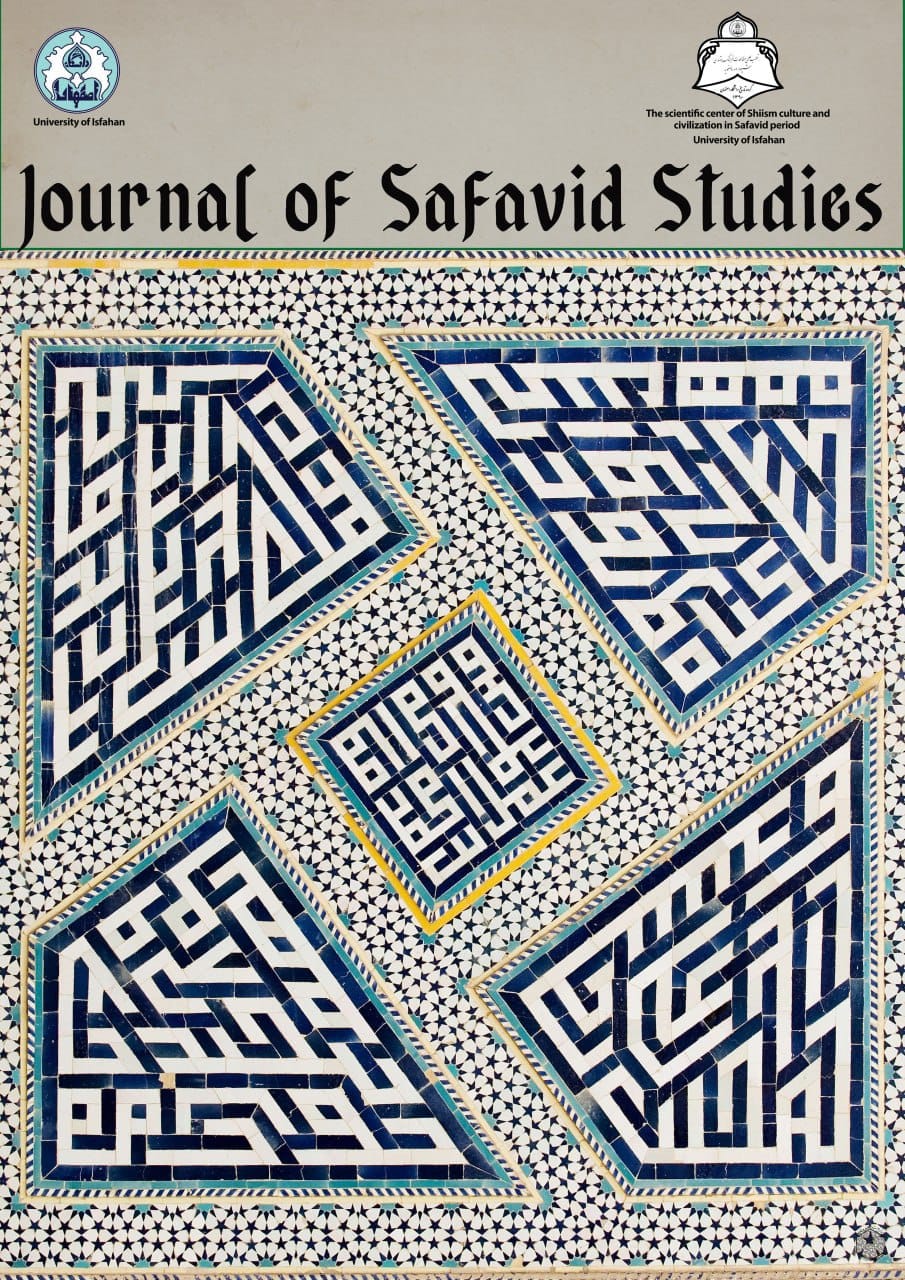
The Journal of Safavid Studies is an academic journal published by Safavid Studies center, University of Isfahan. The journal welcomes the articles that engage with any aspect of Safavid Studies that provide a scholarly platform for critical and informed articles with a historical approach.
The journal conscientiously aims to provide a scholarly platform for critical and informed articles with a historical approach in all fields of Safavid studies such as religious, political, cultural, social, economic, educational, artistic, international relations. The articles will cover the most debate-worthy issues in the aforementioned fields in the hope of ultimately contributing to the resolution of various theoretical, methodological and practical dilemmas encountered in Safavid Studies.This journal also aims to pave the way to increase cultural exchanges at the international level with an approach to introduce Safavid history and Shi’ism
https://ssj.ui.ac.ir/
Open Access Current Issue: Volume 1, Issue 1, Spring 2022
- February 03, 2022
- 0 Comment