Shii News – Academic Items
1. Pulpit, Mosque and Nation, Turkish Friday Sermons as Text and Ritual
Elisabeth Özdalga
2. Quranic Arabic, From its Hijazi Origins to its Classical Reading Traditions
Marijn van Putten
3. The British Institute of Persian Studies
WEBINAR | A hundred years of Persian performing arts, with Jane Lewisohn; 23 February 2022, 5PM (UK time)
This talk will show how the performing arts offer insights into the hopes, aspirations, aesthetics and even prejudices prevalent in Iran at this time and how they are valuable not just from an artistic point of view but also from the perspective of social and political history.
Register at:
https://us06web.zoom.us/webinar/register/1616413800466/WN_zBucdk9tQ6iHKrOZjmZS7Q
3. The Association for the Study of the Middle East and Africa (ASMEA) is offering two grant opportunities in conjunction with its Fifteenth Annual Conferencetaking place in Washington, D.C. on November 5 – 7, 2022.
The ASMEA Research Grant Program seeks to support research on topics in Middle Eastern and African studies that deserve greater attention. Applicants may submit paper proposals on any topic as long as it constitutes new and original research and is relevant to the five qualifying topic areas: Minorities and Women, Military History, Governance and Economy, Faith, and Iran. Grants of up to $2500 will be awarded. Successful research grant applicants are required to present their research at the Fifteenth Annual ASMEA Conference. The deadline to apply is April 15, 2022.
Separately, ASMEA is offering Travel Grants of up to $750 which can be used towards the costs associated with attending the Annual ASMEA Conference in Washington, D.C. The deadline to apply is April 15, 2022.
In addition, we have issued our general Call for Papers and Panels and Call for Undergraduate Poster Proposals.
Additional guidelines and information can be found on our website at www.asmeascholars.org.
Feel free to contact ASMEA at info@asmeascholars.org with any questions
4. Lecture on 13th-century plague in Baghdad and Syria
The recording of Monica Green’s 20 January lecture on the 13th-century outbreak of plague in Baghdad and Syria has been posted: https://stanford.zoom.us/rec/play/d9ZWSeqy1-t3ni-pInq_gsM6Ea04D1wyfWee4U7NWaoWTbREUxqwSRWecw0ETFwICLIENJ6iVqQUGJku.mxBI5-7gSMlfozjF?startTime=1642724813000&_x_zm_rtaid=yQ4Ee2myS1SUwyK7XnKlVw.1643248560182.0fe783a53e291014b799fd85472e87f9&_x_zm_rhtaid=560.
(If this long URL breaks up, you can also access the link from this list of the Stanford History of Science talks: https://web.stanford.edu/dept/HPST/colloquia.html. Scroll down to find the link.)
5. The Digital Modern Languages section of Modern Languages Open is inviting proposals for articles to contribute to an open special issue. Open Access article processing charges will be covered by the section using funds graciously provided by King’s College London. Proposals should be broadly connected to research and teaching in Modern Languages which engages with digital culture, media and technologies. Areas of potential but not exclusive interest include: digital cultural studies, digital archives and databases, digital/computational approaches to the study of language and text, digital ethnography, digital linguistics research (e.g. digital discourse analysis), and language teaching and digital technologies.
We particularly welcome contributions from Early Career Researchers.
Themes we are interested in exploring in this issue include:
-
- Digital multi/translingualism
- Forms of digital creativity and cultural expression
- Approaches to Digital Humanities beyond the anglophone world
- Critical digital literacies and Modern Languages pedagogies
- Co-production and collaborative digital research practices
- Critical Digital Modern Languages research (e.g. decolonial, anti-racist, intersectional feminist and queer approaches)
- Multilingual and parallel corpora
- Translation and digital technologies
- Minority/low-resource languages and digital media/technologies
While articles should have a primary focus on languages other than English, we seek to include a range of distinct linguistic and cultural perspectives. We particularly welcome contributions from Early Career Researchers. Proposals should include an abstract (max 250 words) and a short bio (max 70 words). Our selection process will be based both on the quality of the proposal, and on ensuring a range of approaches and linguistic/cultural contexts are represented across the Issue. Please submit your proposals here:
We invite abstracts by 11 February 2022.
Accepted proposals will be confirmed by the end of March 2022, and the deadline for submitting full articles after acceptance is 31 July 2022. Final articles should be between 8,000 to 10,000 words.
This special collection will be edited by Orhan Elmaz, Saskia Huc-Hepher, Paul Spence and Naomi Wells and published on Modern Languages Open https://www.modernlanguagesopen.org/
Please contact Paul Spence at paul.spence [at] kcl.ac.uk if you have any queries about your proposal.
6. The British Institute of Persian Studies is still accepting applications for its Research and Travel Grants.
Funding is available to cover costs associated with developing or executing research projects in any field related to the wider Persianate world. There is funding available for travel for students, either for research or to attend conferences. We invite applications for Research Awards and for Research Assistant Grants, in order to support scholars to develop or complete projects.
Awards of up to £1,200 will be considered for Student Travel Awards. Grants of up to £5,000 for Research Awards and Research Assistant Awards are invited, from PIs associated with a UK based HEI.
Please contact the relevant programme leader prior to submitting your application (Ancient: Professor Lloyd Llewellyn-Jones, Medieval: Professor Andrew Peacock, Modern: Dr Shabnam Holliday).
The deadline for submitting applications is Monday 7th February 2022.
For more information and to download the application form, visit our Grants page.
7. Global Displays of Islamic Art Today: Agency, Identity, and Politics
Virtual Panel & Discussion sponsored by the Islamic Art and Material Culture Collaborative (IAMCC), Toronto
Date: Saturday, February 12, 2022
Time: 10:00 AM to 12:00 PM (EST, Toronto)
Register for free here: https://www.eventbrite.ca/e/global-displays-of-islamic-art-today-agency-identity-and-politics-tickets-247387612007
Panel Summary:
Since the early 2000s, numerous museums around the world have reinstalled their collections of Islamic art as new galleries or created entire museums focusing on the arts and cultures of the Islamic world. During the same period, methodological interventions building on post-structuralist and post-colonial theory have begun to challenge long-standing formal and regional categories defining the field of Islamic art history and have impacted the display strategies of new displays of Islamic art. As a central interface between the academic study of the Middle East, its global representation, and the general public, the approaches these museums adopt to mediate between art, material culture, and Islamic or regional cultures play a central role in shaping discussions about the region. At the same time, Islamic art displays are also embedded in heterogeneous local politics and social discourses that serve local, regional or national agendas.
Through a series of case studies from both public and private museums in Turkey, Qatar, France, Spain, Canada and Iran, this panel of international doctoral candidates examines curatorial practice and agency vis-à-vis the politics of museum display and art discourses from 2000 until today. Rather than interpreting Islamic art displays as passive and neutral representations of the past, this panel theorizes them as a contemporary cultural practice that stages spatialized and immersive, ideological narrations of culture and identity. The papers examine new and complex ways in which museums and galleries of Islamic art use objects today to communicate broader ideas and narratives in various global contexts.
Schedule:
10:00 – Welcome and Introductions
10:05 – 10:20 – Objects Between Secularism and the Sacred at Istanbul’s Museum of Turkish and Islamic Art
Beyza Uzun, Doctoral Candidate, IMT School for Advanced Studies, Lucca, Italy
10:20 – 10:35 – The Cultural Diplomacy and Contested Modernity of Museological Development in Qatar
Abdelrahman Kamel, Doctoral Candidate, Queen’s University, Kingston, Canada
10:35 – 10:50 – Displaying the Transcultural History of Objects: Shaping a French Islamic Heritage?
Constance Jame, Doctoral Candidate, University of Heidelberg, Germany
10:50 – 11:05 – Short Break
11:05 – 11:20 – Configuring Multiculturalism: Heritage and Narrative at Toronto’s Aga Khan Museum and Granada’s Museo de la Alhambra
Philip Geisler, Doctoral Candidate, Kunsthistorisches Institut in Florenz (Max-Planck-Institut), Italy & Berlin Graduate School Muslim Cultures and Societies, Germany
11:20 – 11:35 – Political Dynamics of Curation and Waqf: The Malek National Library and Museum
Leila Moslemi Mehni, Doctoral Candidate, University of Toronto, Canada
11:35 – 12:00 – Audience Q&A and Discussion
The panel will be chaired by Dr. Fahmida Suleman, Curator of the Islamic World collections at the Royal Ontario Museum, Toronto, and co-chair of the IAMCC.
About the IAMCC: The Islamic Art and Material Culture Collaborative (IAMCC), is a research network based in Toronto that brings together the capacities and resources of the University of Toronto (UofT), the Royal Ontario Museum (ROM), and the Aga Khan Museum (AKM).
About the IIS: The Institute of Islamic Studies (IIS) at the University of Toronto offers a unique, multi-perspective view of Canadian society through the advanced study of Islam and Muslims.
8. New Podcasts on the New Books Network – with Anna McSweeney and D. Fairchild Ruggles
Two new podcasts published on the New Books Network with Anna McSweeney talking about the Alhambra and her recent book, From Granada to Berlin: The Alhambra Cupola (2020) https://newbooksnetwork.com/from-granada-to-berlin and D. Fairchild Ruggles talking about Cairo and her recent book, Tree of Pearls: The Extraordinary Architectural Patronage of the 13th-Century Egyptian Slave-Queen Shajar al-Durr (2020) https://newbooksnetwork.com/tree-of-pearls.
9. Online Symposium – Hidden Stories: Global History, Local Networks (Aga Khan Museum) – February 24 & 24
Join the Aga Khan Museum, Toronto, on February 24 and 25 for an online symposium celebrating the current exhibition Hidden Stories: Books Along the Silk Roads– which features books, scrolls, manuscript paintings, textiles, and objects spanning a 1,000-year history from the 10th to the 20th centuries. The exhibition is both global — examining a vast network of trade routes spanning Asia, Europe, and Africa — and local, bringing together historical artifacts from collections across Ontario, Canada.
About theHidden Stories Symposium
Marking the closing of the Hidden Stories exhibition, this 2-day virtual symposium showcases the ground-breaking collaborative research behind this historic exhibition. The event brings together an international group of researchers, museum, and library professionals in four roundtable sessions (Judaica, South and Southeast Asia, Ethiopia, and the Americas). Each session explores a Silk Roads cultural tradition and related Hidden Stories objects through presentations by panelists and an open discussion period with the virtual audience. Click here to view the full SYMPOSIUM PROGRAM
Hidden Stories: Global History, Local Networks, hosted by the Institute for Advanced Study (Princeton, NJ), will be held on Zoom and is free to attend but registration is required.
Can’t visit the Aga Khan Museum in person?
Walk through the HIDDEN STORIES MUSEUM EXHIBITION virtually here
Explore the HIDDEN STORIES DIGITAL EXHIBIT with videos and extended content – active through 2024
10. Near Eastern Studies Lecture
February 23,12:00 PM Eastern Time (US and Canada)
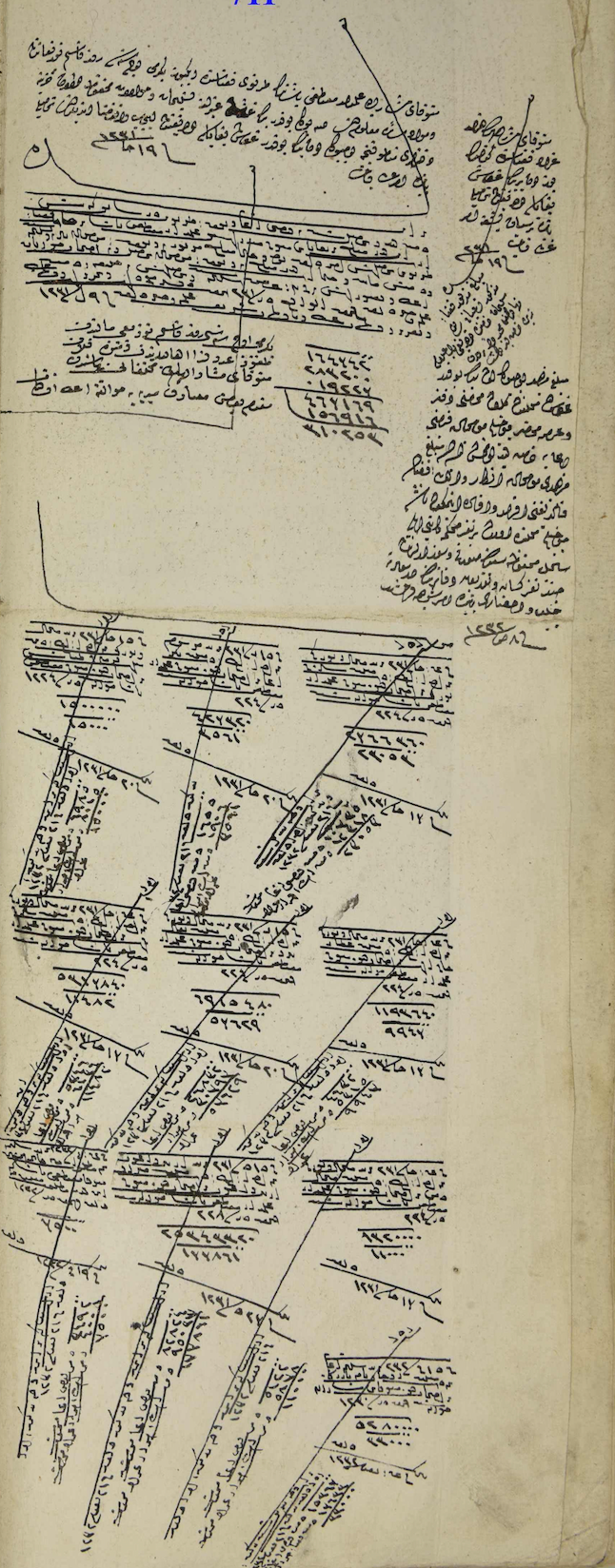
An Ottoman Fiscal Codex and Financial Tales of 134 Women and Men
Ali Yaycıoğlu (Stanford University)
Hosted by Sabine Schmidtke (School of Historical Studies, IAS).
At the center of this talk is a fiscal codex (defter), housed in the Ottoman Archives in Istanbul (call number MAD 9726), from 1808 to the 1840s. MAD 9726 was prepared by a group of Ottoman fiscal accountants to record the financial assets, public and private debts and credits of 134 prominent men (and a few women), who lost their lives (or who fled or were exiled) between 1807 and 1809. Among these individuals were high ranked statemen, bureaucrats, state contractors, financiers, merchants, and provincial notables. Most of them were Muslim, but some were Christian. The majority of them were part of a political movement known as the New Order (Nizam-ı Cedid). The New Order ruled the Ottoman Empire between 1789 and 1808 and fell in 1807-08 after three sequential popular revolts. In some ways, MAD 9726 is a massive confiscation inventory, prepared to seize, reveal, appraise, and redistribute the assets of a politico-financial network spread across the empire. In each entry in the codex, one encounters a dizzyingly complex financial tale centered on one of the 134 individuals, fashioned by tens of debt and credit transactions, financial partnerships, contracts, investments, speculations, capital transfers, bankruptcies, and confiscations. In each entry, one also meets several other individuals, waqfs and state institutions, communities, and sometimes foreign actors, who had financial deals with these individuals. The accounting in some of these entries was completed within a year or two after the death of the individual in question. Some cases, however, it continued for several years and even decades, because of intricacies of transactions, computations, and difficulties in debt collection, and complex political and diplomatic matters. These financial tales were narrated in an arcane accounting technique, known as fenn-i siyaqat, charged with encrypted short hands and paratextual symbols, which Ottoman fiscal scribes had employed for centuries to deal with complex financial matters in their computations. In fact, MAD 9726 is one of the most developed but also final examples of fenn-i siyaqat, which would die out in the mid-19th century, with the introduction of new accounting techniques. This talk will present the intertwined story of a codex, the financial tales of 134 prominent individuals, the final phase of the accounting methods of Ottoman fiscal bureaucracy, and the political-economic transformation of the Ottoman Empire in the late 18th and early 19th centuries.
Register in advance here.
After registering, you will receive an email containing information about joining the event.
Posted in: Academic items- January 29, 2022
- 0 Comment