
Categories : Field-specific (academic)
Shii News – Hybrid book presentation: ‘Shi`i Materiality Beyond Karbala’ – F G Marei (6.6.24, 5pm CEST)
HYBRID Book Presentation “Religion That Matters: Shiʿi Materiality Beyond Karbala”by Fouad Gehad Marei (Lund University), Leibniz-Zentrum Moderner Orient, Berlin, 6 June 2024, 5:00 pm CEST
The book engages with conceptual debates in the fields of Religious Studies, Material Religion, Anthropology of Religion, Media Studies, and Cultural and Heritage Studies. By examining how material things make the praesentia of the Sacred tangible, how they cultivate intimate relations between human and more-than-human beings, the book makes several propositions that push the frontiers of the social and anthropological
study of religion.
Register at:
https://us06web.zoom.us/meeting/register/tZYrcuqgrDsuHtJwD9CbctpsgRI6YACpf5Xf#/registration
- June 03, 2024
- 0 Comment
Shii News – ‘Shiʿi Materiality Beyond Karbala’ – eds., F G Marei, Y Shanneik and C Funke
- May 30, 2024
- 0 Comment
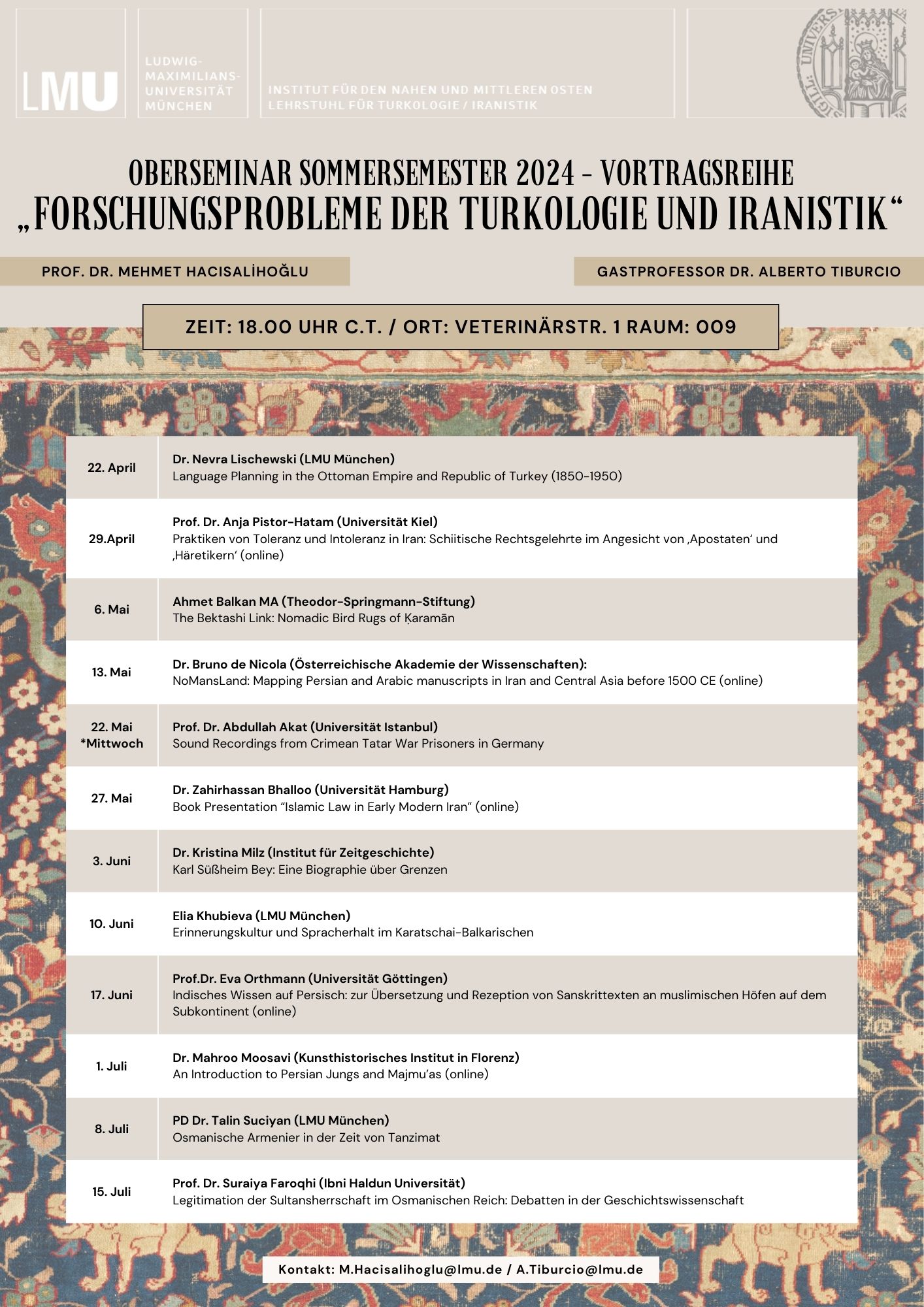
Shii News – book launch: Islamic Law in Early Modern Iran – Z Bhalloo (27.5.24, 6pm CET)
Zahir Bhalloo, book launch, Islamic Law in Early Modern Iran, Berlin: De Gruyter, 2023
Oberseminar summer 2024, Ludwig Maximilians-Universität München
May 27 2024, 6:00 pm, Central European Time (CET)
To attend online please contact m.hascisalihoglu@lmu.de / a.tiburcio@lmu.de
https://www.naher-osten.uni-muenchen.de/download/oberseminar-sose24-_1_.jpg
- May 27, 2024
- 0 Comment
Shii News – ‘Imam Jaʿfar al-Ṣādiq and His Legacy in Islamic Law’ – H Modarressi
- May 24, 2024
- 0 Comment
Shii News – Le CeRMI: ‘Self-education through the body in contemporary Shiism’ – A Neuve-Eglise (6.6.24, 5pm, Paris)
Le CeRMI a le plaisir de vous convier à la prochaine séance du séminaire “Sociétés, politiques et cultures du monde iranien”, qui se tiendra le jeudi 6 juin 2024, 17h-19h, en salle 3.15 à l’INaLCO (65 rue des Grands Moulins, Paris XIII, 3e étage).
Pour la dernière séance de l’année, nous sommes heureux d’accueillir Mme Amélie Neuve-Eglise, philosophe spécialiste du chiisme et de l’anthropologie religieuse de l’Iran contemporain, et Maîtresse de conférences à l’Inalco, pour une conférence intitulée : “L’éducation de soi par le corps dans le chiisme contemporain : l’exemple des marches pèlerines en Iran et en Irak”.
Résumé
Durant la seconde moitié du XXe siècle, l’accès aux sanctuaires d’Imāms situés en Iran et en Irak, principaux lieux de pèlerinage chiite, a été contraint par différents événements politiques, dont l’arrivée au pouvoir du régime baathiste irakien. La guerre Iran-Irak (1980-1988) a entraîné la fermeture des frontières entre ces deux pays, suivi d’une période de contrôle strict. La chute de Saddam Hussein en 2003, puis la mise en place de liaisons aériennes à bas coût reliant les principales villes saintes de ces pays les a rendues accessibles à un nombre croissant de pèlerins. Pourtant, depuis les années 2010, de nombreux fidèles choisissent de rejoindre ces sanctuaires en effectuant une partie du trajet à pied, dans le cadre de marches pèlerines organisées en des occasions liturgiques diverses. À titre d’exemple, en l’espace de quinze ans, la marche d’Arba‘īn, qui a lieu chaque année en Irak à l’occasion du quarantième jour de la mort de Ḥosayn ibn ‘Alī, est devenue un pèlerinage de masse. Bien que des estimations précises restent difficiles à obtenir, en 2019, près de trois millions d’Iraniens auraient parcouru le chemin reliant la ville de Najaf au sanctuaire de Ḥosayn à Karbala.
Si cette marche a été l’objet de plusieurs ouvrages en Iran, les études académiques en langues européennes consacrées à ce phénomène restent rares, et se concentrent principalement sur des observations ethnographiques ou l’analyse du contexte politique et social dans lequel il s’inscrit.
À travers l’analyse de discours de pèlerines et pèlerins iraniens, cette intervention s’attachera davantage à présenter les imaginaires et vécus des croyants lors de ces rituels, en se concentrant principalement sur la marche d’Arba‘īn. Nous tenterons ainsi d’appréhender ce que le corps en mouvement participe à produire en termes d’affects, de pensées et de représentations. Au-delà de la variété des propos, nous verrons la façon dont l’expérience de l’effort, de la fatigue, et de situations d’inconfort physique sont envisagés comme autant de mises à l’épreuve participant à une forme d’éducation de soi. Loin de rechercher un dolorisme exaltant un corps souffrant, nous montrerons comment la marche mobilise aussi un ensemble de techniques du corps et participe à cultiver un « souci de soi ».
Marcher est aussi un acte politique. En autorisant d’autres sociabilités et manières d’être au monde, elle permet de se rendre disponible à l’accueil de multiples présences, de questionner des hiérarchies sociales, et de façonner de nouvelles figures d’exemplarité. Nous étudierons ainsi la manière dont, face aux tentatives d’instrumentalisation étatique dont ils sont l’objet, ces rituels forment des espaces où s’expriment des désirs d’autonomie et participent à un mouvement plus large de remise en cause d’un biopouvoir exercé par des autorités politiques et religieuses.
Orientations bibliographiques
Géraldine CHATELARD, Sabrina MERVIN, « Arbaïn, un pèlerinage sous tension », Orient XXI, 2019, [en ligne].
Pedram KHOSRONEJAD (éd.), Saints and their Pilgrims in Iran and Neighbouring Countries, Wantage, Sean Kingston (« Anthropology of Persianate Societies » 1), 2012.
Mohsen Ḥesām MAZĀHERĪ (éd.), Piyādeh ravī-e arba‘īn, ta’amolāt-e jāme‘eh shenākhtī (La marche d’Arba‘īn, réflexions sociologiques), Ispahan, Ārmā, 2018.
Amélie NEUVE-EGLISE, « La marche d’Arba‘īn en Iran contemporain. Modalités de l’extension d’une temporalité sacrée entre logiques spirituelles et sociolopolitiques », Archives de Sciences Sociales des Religions 193, janvier-mars 2021, p. 199-229.
Anne-Sophie VIVIER, « Le corps dans le chiisme populaire iranien : entre savâb et impureté », Revue des mondes musulmans et de la Méditerranée 113-114, 2006, p. 125-149.
Pour rappel, vous retrouverez le programme 2023-2024 du séminaire mensuel de recherche “Sociétés, politiques et cultures du monde iranien” sur le site du CeRMI :
https://cermi.cnrs.fr/seminaires-de-recherche/societes-politiques-et-cultures-du-monde-iranien-2023-2024/
- May 22, 2024
- 0 Comment

Shii News – Edinburgh University Press: Call for proposals: Studies in Shi’i Materiality
Introducing: Studies in Shiʿi Materiality
Series editors: Karen Ruffle, University of Toronto & Babak Rahimi, University of California, San Diego
This new, interdisciplinary book series is the first dedicated to material practices, ritual, embodiment and the sensorium in Shiʿism, seeking to understand Islamic practices in everyday contexts from a broad historical and theoretical perspective.
> Focuses on lived Shiʿism as a lived tradition that is multiplex and creative rather than singular in expression
> Engages with all periods of history
> Features studies of Shiʿi communities including Ithna ʿAshari, Ismaʿili (Nizari and Tayyibi), Zaydi, Druze, Bektashi, Alevi, Nusayri, and ʿAlid traditions including Sufism
> Covers Shiʿi and ʿAlid traditions in South, Central and Southeast Asia, the Middle East, Turkey, the Caucasus, Africa, Europe, North America and Australia
> Encourages interdisciplinary approaches and methods
Find out more on the Studies in Shiʿi Materiality series page.
- May 17, 2024
- 0 Comment
Shii News – 2024 BRAIS (Leeds, 20-21 May) Panels of Potential Interest to Shii News Subscribers
The 2024 Annual Conference of the British Association for Islamic Studies final programme can be viewed online here: www.brais.ac.uk/conferences/brais-2024, including
The Science of Hadith Across Time and Tradition
Chair: Haroon Sidat (Cardiff University)
Ahmed Ragab Abu Zayd (University of Wales TSD), The Historicity of Biographical Sources on Ḥadīth Narrators: Why Al-Mizzī’s Tahdhīb Al-Kamāl Is Larger than Its Source?
Zachary Wright (Northwestern University), Sufism and Hadith Scholarship in the Eighteenth Century: the Writings of Muḥammad Ḥayāt al-Sindī
Haider Hobballah (Al-Mahdi Institute), The Emergence of the Hadith Critique Movement in the Twentieth Century Shīʿī Context: The Case of Abū al-Faḍl al-Burqaʾī
Amina Inloes (The Islamic College), Eclipses and Lament in Twelver Shīʿī Ḥadīth
Global Perspectives on Gender, Identity and Society
Chair: Alyaa Ebbiary (University of Lancaster)
Giammarco Mancinelli (École pratique des hautes études), Second generations and the mosque in Italy: Feminisation without feminism
Muhammad Tajri (Al-Mahdi Institute), Denying Dichotomy?: The Intersection of LGB Shīʿa Muslims
Ummul Fayiza Puthiya Peedikayil (University of Warwick), Muslim Women’s Rights and the Codification of Muslim Personal Law in India: Revisiting the Enactment of Muslim Women Act 1986
Ayesha Ulhaq (University of Cambridge) A qualitative study of Muslim women’s safety and resilience in the face of individual and cultural trauma in Britain
Of Coming and Becoming: Muslim Identities in Europe
Chair: Alyaa Ebbiary (University of Lancaster)
Jaffer A Mirza (King’s College London), The early Shi’a religious spaces in Britain (1960s-1970s)
Sayed Mahdi Mosawi (University of Edinburgh), Religious Dynamics in Transition: A Study of Hazara Migrants in Scotland
Akif Tahiiev (Goethe University Frankfurt), Becoming a Shia in Russia: understanding the reasons of Conversion to Shi’ism in Russia
Thijl Sunier (Vrije Universiteit Amsterdam), Branding Islam: Claims-Making, Knowledge Production and Academic legitimation
Sufi Knowledge Production in Pre-Modern Islam
Chair: Saeko Yazaki (University of Glasgow)
Faris Abdel-hadi (University of Exeter), The Aporia of Interpreting a Premodern Andalusian Mystic: Ibn ʿArabī’s Religious Pluralism
Eyad Abuali (Cardiff University), Space, Affect, and Imagination in the Transmission of Knowledge in medieval Sufism
Zoheir Esmail (Al-Mahdi Institute), Sayyid Ḥaydar Āmulī and the Oneness of Being in al-Muḥīṭ al-Aʿẓam
Bronislav Ostřanský (Czech Academy of Sciences), Sufi Dreams as a Tool of Spiritual Guidance: The Example of al-Risāla al-Qushayrīya
- May 13, 2024
- 0 Comment
Shii News – Hybrid Event: Edinburgh: ‘Shi’i Islam: Doctrinal Foundations and Historical Developments’ – M A Amir-Moezzi (27.5.2024)
W.M. Watt Lecture
Arabic has been taught at the University of Edinburgh for over 260 years, and today our department of Islamic and Middle Eastern Studies (IMES) is globally recognised as a leading centre in the field.
From his appointment as Lecturer in Arabic in 1947, until his retirement as Professor in 1979, William Montgomery Watt made an outstanding contribution both to Islamic scholarship and to the development of IMES.
The inaugural Watt Lecture was launched in November 2015 to mark the 50th anniversary of Watt’s Inaugural Lecture as the first Professor of Arabic and Islamic Studies in Scotland.
The 2024 lecture
We are delighted to welcome Professor Mohammad Ali Amir-Moezzi (École Pratique des Hautes Études – Sorbonne) to deliver the seventh annual W.M. Watt Lecture.
For more information and to register, click here.
- May 10, 2024
- 0 Comment
Shii News – Celebrating 25 years of ICAS Press with the book launch of Al-Asfa
At the upcoming Ninth Annual International Conference on Shi‘i Studies, 11 May, 2024, ICAS Press will celebrate its silver jubilee with the release of its largest publication to date: Al-Asfa, A 17th-Century Shi‘i Exegesis of the Qur’an by Mulla Muhsin Fayd Kashani.
All other ICAS Press books will be available at a 40% discount.
See the conference schedule and register here.
- May 09, 2024
- 0 Comment