
Categories : Academic items
Shii News – Academic Items
1. Iridescent Kuwait: Petro-Modernity and Urban Visual Culture since the Mid-Twentieth Century
Laura Hindelang
Open Access e-book
2. The Aga Khan Program for Islamic Architecture at Harvard University presents
Spring 2022 AKPIA Lecture Series
A Forum for Islamic Art & Architecture
Held via Zoom Webinar
February 24, 2022. 6:00pm EST
“Emperor Shāh Jahān: The Gardener (chaman-pera) of a Vast Garden (bāgh wa būstān) called Hindustan”
Gulfishan Khan, AKPIA Associate; Professor of Medieval Indian History, Chairperson of the Centre of Advance Study, Aligarh Muslim University, Aligarh, India
Registration: https://bit.ly/akpiagkhan
March 10, 2022. 6:00pm EST
“A Thousand Futures: Negotiating Urban Transformation in Early Republican Istanbul (1923-1949)”
Ümit Fırat Açıkgöz
AKPIA Fellow; Assistant Professor, Department of Architecture and Design, American University of Beirut
Registration: https://bit.ly/thousandfutures
March 24, 2022. 12:00 noon EST *
“On Polychromy, Polysemy and Whiteness in Islamic Art”
Alain Fouad George
I.M. Pei Professor of Islamic Art and Architecture, Director of Graduate Admissions, Faculty of Oriental Studies, Fellow of Wolfson College, University of Oxford
Co-sponsored with the Standing Committee on Medieval Studies at Harvard University
*special early start time
Registration: https://bit.ly/akpiageorge
April 21, 2022. 6:00pm EST
“Documentary Life: Sketch as Chronicle in Shah Abbas’ Iran”
Kishwar Rizvi
AKPIA Fellow; Professor of Islamic Art and Architecture, Department of the History of Art, Yale University
Registration: https://bit.ly/documentarylife
Lectures are held via Zoom webinar; time listed is Eastern Standard Time; registration is required.
We anticipate that all lectures will be recorded and made available at the AKPIA website, after the event date.
THE AGA KHAN PROGRAM FOR ISLAMIC ARCHITECTURE AT HARVARD UNIVERSITY
Website: https://agakhan.fas.harvard.edu/news-events
Email agakhan@fas.harvard.edu
3. ONLINE Lecture “Muslim Bioethics Reimagined: Towards an Islamic Feminist Practice” by Ruaim Muaygil (College of Medicine, King Saud University), University of Manchester, 2 February 2022, 1:00 pm GMT
This paper argues that Islamic bioethics must shift from its predominant practice of unreflective scriptural application to a more contemplative and re-interpretative understanding of Islamic texts in order to right these healthcare injustices. It proposes an alliance with Islamic feminism as an alternative method of examining the moral foundations of Islamic jurisprudence.
Registration: https://zoom.us/j/97710007495
4. ONLINE Book Presentation: “Islam and the Arab Revolutions — The Ulama Between Democracy and Autocracy” by Usaama al-Azami, Leibniz-Zentrum Moderner Orient, Berlin, 7 Febru-ary 2022, 5:00 pm CET
The author traces the public engagements and religious pronouncements of prominent ulama, including Yusuf al-Qaradawi, Ali Gomaa and Abdallah bin Bayyah, to explore their role in either championing the Arab revolutions or supporting their repression. While a minority of noted scholars have enthusiastically endorsed the counter-revolutions, their approach is attributable more to their distinctly modern commitment to the au-thoritarian state.
Information and registration: https://www.zmo.de/veranstaltungen/islam-and-the-arab-revolutions-the-ulama-between-democracy-and-autocracy
5. ONLINE Book Introduction: “Development, Architecture, and the Formation of Heritage in Late Twentieth-century Iran” by Dr Ali Mozaffari, Manchester University Press, 10 February 2022, 1:00 am – 12:00 pm GMT
In this lecture, using Iran as an example, the author will draw upon case studies to demonstrate how archi-tecture became a conduit for the production of heritage at large in a modernizing Muslim society, and how it has been entangled with development and intellectual debates before and after the Islamic Revolution.
Information and registration: https://manchesteruniversitypress.co.uk/events/development-architecture-and-the-formation-of-heritage-in-late-twentieth-century-iran/
6. ONLINE Lecture: “Early Cities in Iran” by Prof. Dr. Barbara Helwing, Museum für Islamische Kunst, Berlin, 17 February 2022, 6:30 pm CET
The lecture presents the current state of knowledge of archaeological research on the first cities in the Iranian highlands and takes a look at the imaginative imagery of the surviving finds.
Information and registration:
-Modern Art in Iran | Ina Sarikhani
Thursday, 24 February 2022, 6:30 pm (CET)
Webex link: https://spk-berlin.webex.com/spk-berlin/j.php?MTID=m353ad99b63c0b6df0144a8f0a710698b
Language: English
-Kashan – Crossroads of Commerce and Culture | Prof. Dr. Roy Mottahedeh
Thursday, 3 March 2022, 6:30 pm (CET)
Webex link: https://spk-berlin.webex.com/spk-berlin/j.php?MTID=mdd136325730ab0ebe56f35650d3ad67e
Language: English
-The Rituals of the Zoroastrians from Antiquity to the Present Day | Prof. Dr. Alberto Cantera
Thursday, 10 March 2022, 6:30 pm (CET)
Webex link: https://spk-berlin.webex.com/spk-berlin/j.php?MTID=mc5c488d74435198e43428e2f45f9dc8c
Language: English
–Gärten in Iran – Einst und jetzt | Prof. Dr. Peter Heine
Donnerstag, 17. März 2022, 18:30 Uhr (MEZ)
Webex-Link: https://spk-berlin.webex.com/spk-berlin/j.php?MTID=mc0d1c7f633c50302f9902fb9c1b8258c
Sprache: Deutsch
7. Junior Professorship for Middle Eastern and Islamic Studies, Focus on Pre-modern History of the MENA Region (W1 with Tenure-track to W2), Department of Oriental and Asian Studies, University of Bonn
Qualification: Mastery in Arabic and at least one other languages of the region; specialization in history, literature, history of science, philosophy, law, or adjacent fields with experience in historical, cultural, and/or sociological approaches. Excellent oral and written English is required and relevant teaching experience is expected. Knowledge of German is desirable, but not a requirement.
Deadline for application: 13 March 2022.
8. Research Fellowship in the Study of Muslims in Britain (2 Years, Commencement April 2022), Oxford Centre for Islamic Studies
Applications are invited for a Research Fellowship which will co-ordinate and develop the Centre’s research interest in the study of the experience, aspirations and challenges faced by British Muslims.
Deadline for applications: 28 February 2022.
Further information: www.oxcis.ac.uk/vacancies
9. Academic Director, Cambridge Muslim College
The successful candidate will be a senior academic with academic management experience who can assume responsibility for all aspects of academic programming and research.
Deadline for applications: 2 March 2022. Information: https://www.cambridgemuslimcollege.ac.uk/ad22/
10. Qatar Digital Library is free to use and reuse.
This growing archive covers modern history and culture of the Gulf and wider region, available online for the first time.
- February 01, 2022
- by Andrew Newman
- 0 Comment
Shii News – Academic Items
1. Pulpit, Mosque and Nation, Turkish Friday Sermons as Text and Ritual
Elisabeth Özdalga
2. Quranic Arabic, From its Hijazi Origins to its Classical Reading Traditions
Marijn van Putten
3. The British Institute of Persian Studies
WEBINAR | A hundred years of Persian performing arts, with Jane Lewisohn; 23 February 2022, 5PM (UK time)
This talk will show how the performing arts offer insights into the hopes, aspirations, aesthetics and even prejudices prevalent in Iran at this time and how they are valuable not just from an artistic point of view but also from the perspective of social and political history.
Register at:
https://us06web.zoom.us/webinar/register/1616413800466/WN_zBucdk9tQ6iHKrOZjmZS7Q
3. The Association for the Study of the Middle East and Africa (ASMEA) is offering two grant opportunities in conjunction with its Fifteenth Annual Conferencetaking place in Washington, D.C. on November 5 – 7, 2022.
The ASMEA Research Grant Program seeks to support research on topics in Middle Eastern and African studies that deserve greater attention. Applicants may submit paper proposals on any topic as long as it constitutes new and original research and is relevant to the five qualifying topic areas: Minorities and Women, Military History, Governance and Economy, Faith, and Iran. Grants of up to $2500 will be awarded. Successful research grant applicants are required to present their research at the Fifteenth Annual ASMEA Conference. The deadline to apply is April 15, 2022.
Separately, ASMEA is offering Travel Grants of up to $750 which can be used towards the costs associated with attending the Annual ASMEA Conference in Washington, D.C. The deadline to apply is April 15, 2022.
In addition, we have issued our general Call for Papers and Panels and Call for Undergraduate Poster Proposals.
Additional guidelines and information can be found on our website at www.asmeascholars.org.
Feel free to contact ASMEA at info@asmeascholars.org with any questions
4. Lecture on 13th-century plague in Baghdad and Syria
The recording of Monica Green’s 20 January lecture on the 13th-century outbreak of plague in Baghdad and Syria has been posted: https://stanford.zoom.us/rec/play/d9ZWSeqy1-t3ni-pInq_gsM6Ea04D1wyfWee4U7NWaoWTbREUxqwSRWecw0ETFwICLIENJ6iVqQUGJku.mxBI5-7gSMlfozjF?startTime=1642724813000&_x_zm_rtaid=yQ4Ee2myS1SUwyK7XnKlVw.1643248560182.0fe783a53e291014b799fd85472e87f9&_x_zm_rhtaid=560.
(If this long URL breaks up, you can also access the link from this list of the Stanford History of Science talks: https://web.stanford.edu/dept/HPST/colloquia.html. Scroll down to find the link.)
5. The Digital Modern Languages section of Modern Languages Open is inviting proposals for articles to contribute to an open special issue. Open Access article processing charges will be covered by the section using funds graciously provided by King’s College London. Proposals should be broadly connected to research and teaching in Modern Languages which engages with digital culture, media and technologies. Areas of potential but not exclusive interest include: digital cultural studies, digital archives and databases, digital/computational approaches to the study of language and text, digital ethnography, digital linguistics research (e.g. digital discourse analysis), and language teaching and digital technologies.
We particularly welcome contributions from Early Career Researchers.
Themes we are interested in exploring in this issue include:
-
- Digital multi/translingualism
- Forms of digital creativity and cultural expression
- Approaches to Digital Humanities beyond the anglophone world
- Critical digital literacies and Modern Languages pedagogies
- Co-production and collaborative digital research practices
- Critical Digital Modern Languages research (e.g. decolonial, anti-racist, intersectional feminist and queer approaches)
- Multilingual and parallel corpora
- Translation and digital technologies
- Minority/low-resource languages and digital media/technologies
While articles should have a primary focus on languages other than English, we seek to include a range of distinct linguistic and cultural perspectives. We particularly welcome contributions from Early Career Researchers. Proposals should include an abstract (max 250 words) and a short bio (max 70 words). Our selection process will be based both on the quality of the proposal, and on ensuring a range of approaches and linguistic/cultural contexts are represented across the Issue. Please submit your proposals here:
We invite abstracts by 11 February 2022.
Accepted proposals will be confirmed by the end of March 2022, and the deadline for submitting full articles after acceptance is 31 July 2022. Final articles should be between 8,000 to 10,000 words.
This special collection will be edited by Orhan Elmaz, Saskia Huc-Hepher, Paul Spence and Naomi Wells and published on Modern Languages Open https://www.modernlanguagesopen.org/
Please contact Paul Spence at paul.spence [at] kcl.ac.uk if you have any queries about your proposal.
6. The British Institute of Persian Studies is still accepting applications for its Research and Travel Grants.
Funding is available to cover costs associated with developing or executing research projects in any field related to the wider Persianate world. There is funding available for travel for students, either for research or to attend conferences. We invite applications for Research Awards and for Research Assistant Grants, in order to support scholars to develop or complete projects.
Awards of up to £1,200 will be considered for Student Travel Awards. Grants of up to £5,000 for Research Awards and Research Assistant Awards are invited, from PIs associated with a UK based HEI.
Please contact the relevant programme leader prior to submitting your application (Ancient: Professor Lloyd Llewellyn-Jones, Medieval: Professor Andrew Peacock, Modern: Dr Shabnam Holliday).
The deadline for submitting applications is Monday 7th February 2022.
For more information and to download the application form, visit our Grants page.
7. Global Displays of Islamic Art Today: Agency, Identity, and Politics
Virtual Panel & Discussion sponsored by the Islamic Art and Material Culture Collaborative (IAMCC), Toronto
Date: Saturday, February 12, 2022
Time: 10:00 AM to 12:00 PM (EST, Toronto)
Register for free here: https://www.eventbrite.ca/e/global-displays-of-islamic-art-today-agency-identity-and-politics-tickets-247387612007
Panel Summary:
Since the early 2000s, numerous museums around the world have reinstalled their collections of Islamic art as new galleries or created entire museums focusing on the arts and cultures of the Islamic world. During the same period, methodological interventions building on post-structuralist and post-colonial theory have begun to challenge long-standing formal and regional categories defining the field of Islamic art history and have impacted the display strategies of new displays of Islamic art. As a central interface between the academic study of the Middle East, its global representation, and the general public, the approaches these museums adopt to mediate between art, material culture, and Islamic or regional cultures play a central role in shaping discussions about the region. At the same time, Islamic art displays are also embedded in heterogeneous local politics and social discourses that serve local, regional or national agendas.
Through a series of case studies from both public and private museums in Turkey, Qatar, France, Spain, Canada and Iran, this panel of international doctoral candidates examines curatorial practice and agency vis-à-vis the politics of museum display and art discourses from 2000 until today. Rather than interpreting Islamic art displays as passive and neutral representations of the past, this panel theorizes them as a contemporary cultural practice that stages spatialized and immersive, ideological narrations of culture and identity. The papers examine new and complex ways in which museums and galleries of Islamic art use objects today to communicate broader ideas and narratives in various global contexts.
Schedule:
10:00 – Welcome and Introductions
10:05 – 10:20 – Objects Between Secularism and the Sacred at Istanbul’s Museum of Turkish and Islamic Art
Beyza Uzun, Doctoral Candidate, IMT School for Advanced Studies, Lucca, Italy
10:20 – 10:35 – The Cultural Diplomacy and Contested Modernity of Museological Development in Qatar
Abdelrahman Kamel, Doctoral Candidate, Queen’s University, Kingston, Canada
10:35 – 10:50 – Displaying the Transcultural History of Objects: Shaping a French Islamic Heritage?
Constance Jame, Doctoral Candidate, University of Heidelberg, Germany
10:50 – 11:05 – Short Break
11:05 – 11:20 – Configuring Multiculturalism: Heritage and Narrative at Toronto’s Aga Khan Museum and Granada’s Museo de la Alhambra
Philip Geisler, Doctoral Candidate, Kunsthistorisches Institut in Florenz (Max-Planck-Institut), Italy & Berlin Graduate School Muslim Cultures and Societies, Germany
11:20 – 11:35 – Political Dynamics of Curation and Waqf: The Malek National Library and Museum
Leila Moslemi Mehni, Doctoral Candidate, University of Toronto, Canada
11:35 – 12:00 – Audience Q&A and Discussion
The panel will be chaired by Dr. Fahmida Suleman, Curator of the Islamic World collections at the Royal Ontario Museum, Toronto, and co-chair of the IAMCC.
About the IAMCC: The Islamic Art and Material Culture Collaborative (IAMCC), is a research network based in Toronto that brings together the capacities and resources of the University of Toronto (UofT), the Royal Ontario Museum (ROM), and the Aga Khan Museum (AKM).
About the IIS: The Institute of Islamic Studies (IIS) at the University of Toronto offers a unique, multi-perspective view of Canadian society through the advanced study of Islam and Muslims.
8. New Podcasts on the New Books Network – with Anna McSweeney and D. Fairchild Ruggles
Two new podcasts published on the New Books Network with Anna McSweeney talking about the Alhambra and her recent book, From Granada to Berlin: The Alhambra Cupola (2020) https://newbooksnetwork.com/from-granada-to-berlin and D. Fairchild Ruggles talking about Cairo and her recent book, Tree of Pearls: The Extraordinary Architectural Patronage of the 13th-Century Egyptian Slave-Queen Shajar al-Durr (2020) https://newbooksnetwork.com/tree-of-pearls.
9. Online Symposium – Hidden Stories: Global History, Local Networks (Aga Khan Museum) – February 24 & 24
Join the Aga Khan Museum, Toronto, on February 24 and 25 for an online symposium celebrating the current exhibition Hidden Stories: Books Along the Silk Roads– which features books, scrolls, manuscript paintings, textiles, and objects spanning a 1,000-year history from the 10th to the 20th centuries. The exhibition is both global — examining a vast network of trade routes spanning Asia, Europe, and Africa — and local, bringing together historical artifacts from collections across Ontario, Canada.
About theHidden Stories Symposium
Marking the closing of the Hidden Stories exhibition, this 2-day virtual symposium showcases the ground-breaking collaborative research behind this historic exhibition. The event brings together an international group of researchers, museum, and library professionals in four roundtable sessions (Judaica, South and Southeast Asia, Ethiopia, and the Americas). Each session explores a Silk Roads cultural tradition and related Hidden Stories objects through presentations by panelists and an open discussion period with the virtual audience. Click here to view the full SYMPOSIUM PROGRAM
Hidden Stories: Global History, Local Networks, hosted by the Institute for Advanced Study (Princeton, NJ), will be held on Zoom and is free to attend but registration is required.
Can’t visit the Aga Khan Museum in person?
Walk through the HIDDEN STORIES MUSEUM EXHIBITION virtually here
Explore the HIDDEN STORIES DIGITAL EXHIBIT with videos and extended content – active through 2024
10. Near Eastern Studies Lecture
February 23,12:00 PM Eastern Time (US and Canada)
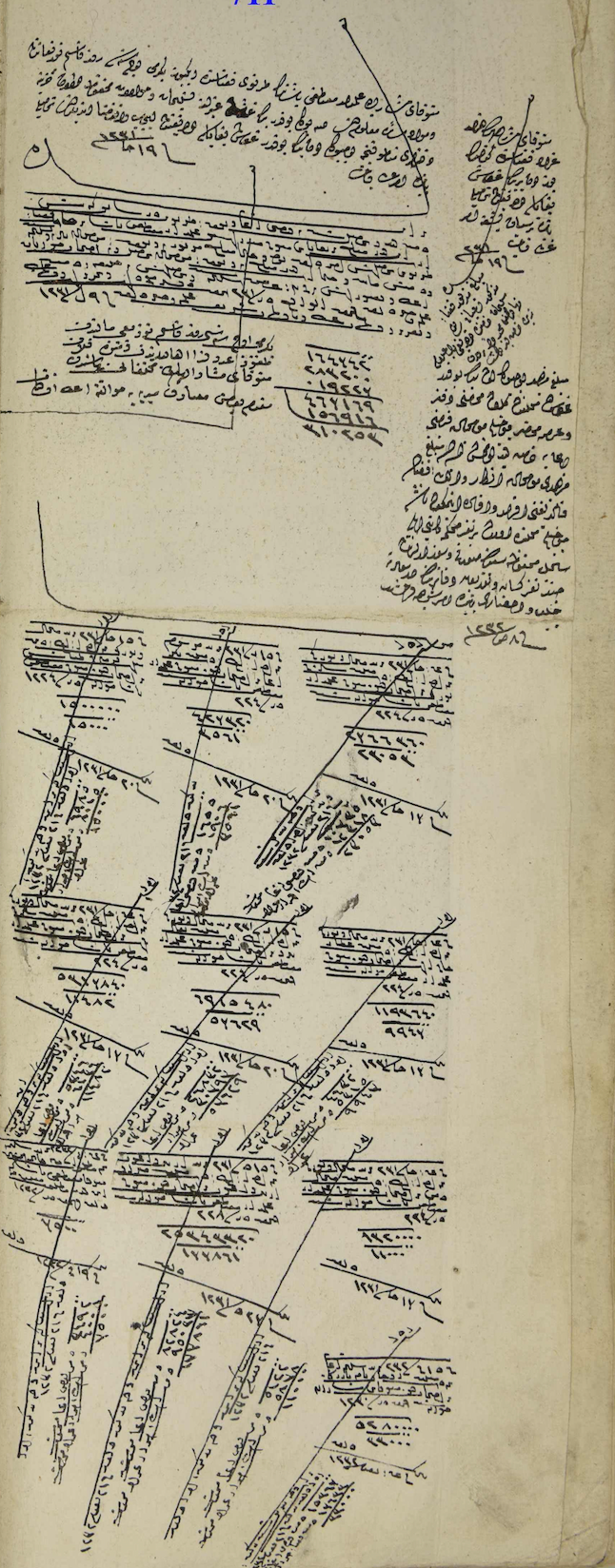
An Ottoman Fiscal Codex and Financial Tales of 134 Women and Men
Ali Yaycıoğlu (Stanford University)
Hosted by Sabine Schmidtke (School of Historical Studies, IAS).
At the center of this talk is a fiscal codex (defter), housed in the Ottoman Archives in Istanbul (call number MAD 9726), from 1808 to the 1840s. MAD 9726 was prepared by a group of Ottoman fiscal accountants to record the financial assets, public and private debts and credits of 134 prominent men (and a few women), who lost their lives (or who fled or were exiled) between 1807 and 1809. Among these individuals were high ranked statemen, bureaucrats, state contractors, financiers, merchants, and provincial notables. Most of them were Muslim, but some were Christian. The majority of them were part of a political movement known as the New Order (Nizam-ı Cedid). The New Order ruled the Ottoman Empire between 1789 and 1808 and fell in 1807-08 after three sequential popular revolts. In some ways, MAD 9726 is a massive confiscation inventory, prepared to seize, reveal, appraise, and redistribute the assets of a politico-financial network spread across the empire. In each entry in the codex, one encounters a dizzyingly complex financial tale centered on one of the 134 individuals, fashioned by tens of debt and credit transactions, financial partnerships, contracts, investments, speculations, capital transfers, bankruptcies, and confiscations. In each entry, one also meets several other individuals, waqfs and state institutions, communities, and sometimes foreign actors, who had financial deals with these individuals. The accounting in some of these entries was completed within a year or two after the death of the individual in question. Some cases, however, it continued for several years and even decades, because of intricacies of transactions, computations, and difficulties in debt collection, and complex political and diplomatic matters. These financial tales were narrated in an arcane accounting technique, known as fenn-i siyaqat, charged with encrypted short hands and paratextual symbols, which Ottoman fiscal scribes had employed for centuries to deal with complex financial matters in their computations. In fact, MAD 9726 is one of the most developed but also final examples of fenn-i siyaqat, which would die out in the mid-19th century, with the introduction of new accounting techniques. This talk will present the intertwined story of a codex, the financial tales of 134 prominent individuals, the final phase of the accounting methods of Ottoman fiscal bureaucracy, and the political-economic transformation of the Ottoman Empire in the late 18th and early 19th centuries.
Register in advance here.
After registering, you will receive an email containing information about joining the event.
- January 29, 2022
- by Andrew Newman
- 0 Comment
Shii News – Academic Items
1.HIAA Biennial Symposium CFP – Deadline April 8
Call for Papers
Historians of Islamic Art Association Biennial Symposium
“Expanding Contexts”
The Museum of Fine Arts and Rice University, Houston
March 2-4, 2023
As historians of Islamic art and architecture, we often deal with objects and edifices that are spatially and temporally removed from their contexts. Artworks are displayed in glass cases in museum galleries and heavily restored monuments offer little clue of the social life that once unfolded in and around them. The discussion of context has long been dominated by politics, dynasties, and patronage. Recent scholarship, however, has immensely expanded the definition of the context to include urban, sensory, perceptual, social, and global settings, to name a few trends. We no longer discuss works of art and architecture as reified creations but consider them in the context of labor, craft, and everyday practices. We construe artworks not as neutral reflections of their historical settings but as agents that actively inform their contexts. Rather than seeking a definite provenance, we write transregional narratives of objects and their dynamic (cross-) cultural lives.
For the next biennial HIAA symposium, we invite panels and papers that explore the question of context in Islamic art and architecture from new methodological and theoretical perspectives. We seek papers that engage new conceptual models, strategies, and technologies for reconstructing, narrating, and visualizing the historical contexts. What are the promises and pitfalls of the digital age for reconstructing the original contexts of artworks and architectural fragments? What approaches and conceptions can we take to invoke the context and intimate the embodied experiences of historical audiences for the public in museums, academic settings, and online platforms? Is it possible to redress the acts of transmission and dislocation that have led to the creation of major collections by means of reconstructing their contexts? How can we use the context to expand the global reach of the field and narrate the past in ways that speak to broader audiences?
There are two categories of submission: Pre-arranged panels (3-4 papers and a discussant) and individual papers. Please submit your abstract/s and a brief curriculum vitae to hiaa.symposium.2023@gmail.com, by April 8, 2022.
The 2023 Symposium Organizers:
Aimée Froom (Museum of Fine Arts, Houston) and Farshid Emami (Rice University)
Committee Members:
Stephennie Mulder, Nada Shabout, Abbey Stockstill, and Heather Ecker
2. Residence Program in Advanced Arabic & Social Studies
Fall Semester 2022
A limited number of merit-based tuition waiver and housing support
The Language Center at the Doha Institute for Graduate Studies (DI) is pleased to announce its Fall semester 2022 – 2023 Residence Program in Advanced Arabic Language and Social Studies. The DI aims to create an enduring legacy of intellectual innovation and education within the Arab world and beyond. It assumes and promotes the Arabic language as a tool of scientific inquiry, an official language in public discourse, and a primary language for teaching and research.
The Residence Program is an important part of the DI’s mission to establish, maintain, and nurture intellectual links and two-way dialogues between its students, faculty, and the international learning and research community. The Program is a unique forum for academic and cultural exchange between the DI’s predominantly native Arabic speaking graduate students and faculty (from across the Arab world) and their international non-native or heritage peers.
The Residence Program is offered for one semester on site in Doha (world health conditions permitting). It meets the language, culture, and academic needs of advanced non-native and heritage graduate students who wish to strengthen their language and cultural skills, as well as prepare for specific challenges related to their academic areas of expertise. The Program is delivered entirely in Arabic and consists of a twin advanced language-training and academic components.
The language-training component prepares students to function professionally in Arabic and offers dedicated courses in language, translation, and content-based instruction. The program adapts to the academic needs of students as a base for linguistic and cultural acquisition, emphasizes productive and presentation skills, and
develops higher levels of proficiency in speaking, listening, reading, writing, and translation.
The academic component gives fellows the opportunity to take advantage of the wide array of unique graduate-level courses the DI distinguished faculty teach in Arabic through its academic units: The School of Social Sciences and Humanities and the School of Public Administration and Development Economics. For more detailed
information about the DI, please go to:
https://www.dohainstitute.edu.qa/EN/Pages/default.aspx
To Apply to the Doha Residence Program, click on the link below:
https://dilc.wufoo.com/forms/znatdf40sd7rqv/
Semester Program Features:
- 6 credits of Intensive Arabic;
- A language partner;
- Option to audit graduate academic courses taught in Arabic if eligible;
- Option to have an academic partner;
- Access to the DI rich conferences, symposia, and guest lectures.
Admission Requirements:
- Advanced level in Arabic;
- Housing: 11,000 per semester (approximately $3000 or 2,650)
- Program Dates:
- Application Deadline: March 15, 2022
- Start of Classes: July 31, 2022
- End of Classes: November 3, 2022
3. ONLINE Lecture: “Hunger, Heresy and Rebellion in ʿAbbasid Arabia” by Peter Webb (Univer-siteit Leiden), University of Hamburg, 15 February 2022, 4:00 – 5:30 pm CET
This is a part of the lecture series: “Rethinking Social Contention: Rebellion, Banditry and Martyrdom in the Pre-Modern Islamicate World” hosted by the Emmy Noether Research Group “Social Contexts of Rebellion in the Early Islamic Period (SCORE)”.
Information and registration: https://www.aai.uni-hamburg.de/voror/forschung/score/news/2021-12-lecture-series.html
No lecture in March –
12 Apr 2022
Antonia Bosanquet (Universität Hamburg): Was it a Berber Rebellion? Ethnic and Religious Labels in Histories of the 740 Uprising
17 May 2022
Teresa Bernheimer (Ludwig-Maximilians-Universität München): ʿAlid and Kharijite Revolts in the First Two Centuries of Islam a Comparative Re-Assessment
14 Jun 2022
Maribel Fierro (CSIC Instituto de Lenguas y Culturas del Mediterráneo y Oriente Próximo): How Rebellions End: A View from the Medieval Islamic West
The online lecture series will take place during Spring Term on Tuesdays from 4.00 to 5.30 pm CET on Zoom. To register, please contact the SCORE team at score.aai@uni-hamburg.de.
4. ONLINE Conference: “The Concept of Protology/Cosmology and the Concept of Eschatology in Judaism, Christianity and Islam” in the Series “Key Concepts in Interreligious Discourses” (KCID), Bavarian Research Center for Interreligious Discourses (BaFID), Universität Erlangen-Nürnberg, 16-17 February, 2:00 pm CET
Speakers on Protology/Cosmology: Prof. em. Dr. Philip Alexander and Prof. Dr. Daniel Langton, University of Manchester/UK, on Judaism; Prof. Dr. Dirk Ansorge, Frankfurt/Main, on Christianity; Prof. Dr. Mira Sievers, HU Berlin, on Islam. Speaker on Eschatology: Prof. em. Dr. Todd Lawson, University of Toronto/CA, on Islam; etc.
Information and registration: https://www.bafid.fau.eu/research/conference-series-kcid/
June 22-24, 2022: The Concept of Emotion and the Concept of Morality in Judaism, Christianity and Islam
Lectures
- Emotion:
Prof. Dr. Jonathan Garb, Hebrew University Jerusalem/IL, on Judaism
Prof. Dr. John Corrigan, Florida State University/USA, on Christianity
Prof. Dr. Paul Heck, Georgetown University/USA, on Islam - Morality:
Prof. Dr. Alan Mittleman, Jewish Theological Seminary/USA, on Judaism
Prof. Dr. Marianne Heimbach-Steins, University of Munster, on Christianity
Prof. Dr. Mutaz Al-Khatib, Hamad Bin Khalifa University/QA, on Islam
September 21-23, 2022: The Concept of Mysticism and the Concept of Divine-Human Communication in Judaism, Christianity and Islam
Lectures
- Mysticism:
Prof. em. Moshe Idel, Hebrew University Jerusalem/IL, on Judaism
Prof. Dr. Ann Astell, University of Notre Dame/USA, on Christianity
Prof. Dr. Erdal Toprakyaran, University of Tübingen, on Islam - Divine-Human Communication:
Prof. Dr. Aaron Hughes, Indiana University Bloomington/USA, on Judaism
Prof. Dr. Jennifer Eyl, Tufts University/USA, on Christianity
Dr. Ghassan El Masri, BaFID/FAU Erlangen-Nuremberg, on Islam
February 15-17, 2023: The Concept of Religion and the Concept of Rationality in Judaism, Christianity and Islam
Lectures
- Religion:
Prof. Dr. Oliver Leaman, University of Kentucky/USA, on Judaism
Univ.-Prof. Mag. Dr. Gregor-Maria Hoff, University of Salzburg, on Christianity
Prof. Dr. Moncef Ben Abdeljelil, University of Sousse/TUN, on Islam - Rationality:
Prof. Dr. Yitzhak Melamed, Johns Hopkins University/USA, on Judaism
Dr. Dr. Martin Breul, University of Erfurt, on Christianity
Prof. Dr. Ulrich Rudolph, University of Zurich, on Islam
June 21-23, 2023: The Concept of Authority and the Concept of Modernity in Judaism, Christianity and Islam
Lectures
- Authority:
Prof. Dr. Lawrence Kaplan, McGill University/CA, on Judaism
Prof. Dr. Christoph Seibert, University of Hamburg, on Christianity
Prof. Dr. Vincent Cornell, Emory University/USA, on Islam - Modernity:
Prof. Dr. Allan Arkush, Binghamton University/USA, on Judaism
Prof. Dr. Vasilios N. Makrides, University of Erfurt, on Christianity
Prof. Dr. Armina Omerika, University of Frankfurt/Main, on Islam
October 11-13, 2023: The Concept of Suffering and the Concept of Happiness in Judaism, Christianity and Islam
Lectures
- Suffering:
Prof. Dr. Robert Gibbs, University of Toronto/CA, on Judaism
Prof. Dr. Christopher Southgate, University of Exeter/UK, on Christianity
Prof. Dr. Mohammed Ghaly, Hamad bin Khalifa University/QAT, on Islam - Happiness:
Prof. em. Dr. Kenneth Seeskin, Northwestern University/USA, on Judaism
Prof. em. Dr. Paul J. Wadell, St. Norbert College/USA, on Christianity
Dr. Raid al-Daghistani, University of Munster, on Islam
The last conferences were held from October 6th to 7th, 2021 on “The Concept of Education and the Concept of Family in Judaism, Christianity and Islam” (Program), from June 23th to 24th, 2021 on “The Concept of Sin and the Concept of Redemption in Judaism, Christianity and Islam“ (Program) and from February 17th to 18th, 2021 on “The Concept of Will and the Concept of Predestination in Judaism, Christianity and Islam” (Program).
5. ONLINE Lecture: “The Politics of Jihad in Early Crusading Period among the Turkmen and Kurds” by Prof. Dr. Taef El-Azhari (Helwan University), University of Marburg, Germany, 24 February 2022, 5:00 pm CET
This is part of the Lecture Series “Rethinking Memory and Historiography of the Crusades in the Middle East”. Moderator: Prof. Dr. Umar Ryad (University of Leuven). Organised by Dr. Ahmed M. Sheir.
Information and registration: https://drive.google.com/file/d/1w00onNuGTJiDFSoQ3gfE1cBsJF7zINd-/view?usp=sharing
6. Workshop: “The Arab-majority and Muslim-majority Worlds in/and Contemporary Decolonisation Debates”, University of Edinburgh, 5-6 April 2022
This workshop seeks to specifically think the decolonising movement and an engagement with it from the histories, experiences, perspectives, traditions, and problematics of the Arab-majority and Muslim-majority worlds (broadly defined) as a contribution toward growing decolonial scholarship and movement.
7. ONLINE Conference: “Islamic Perspectives on Exotheology”, Zayed University, 10-11 May 2022
Organised by Shoaib Ahmed Malik, Zayed University and Jörg Matthias Determann, Virginia Commonwealth University, etc.. Questions to be asked: Are extraterrestrials even metaphysically or hermeneutically possible in Islamic thought? If extraterrestrials exist, how would this impact Islamic jurisprudence and/or ethics? What philosophical implications could there be for Muslims if extraterrestrial life exists? Etc.
Information: https://www.academia.edu/51090491/Call_for_papers_Islamic_Perspectives_on_Exotheolgy
8. Panel on “Liberalism and Islam in Contemporary Global Literature”, Conference of the British Association of Islam Studies (BRAIS), University of Edinburgh, 6-7 June 2022
Topics include: “Every day Islam” in Literature; Liberalism and Orientalism; The relation between piety and its performance in Muslim everyday life in literature; Neo-Orientalism in global literature; Muslim identity pol-itics and liberalism in western spaces.
Deadline for abstracts: 28 January 2022. Information: https://networks.h-net.org/node/73374/announce-ments/9554601/liberalism-and-islam-contemporary-global-literature-brais
9. HYBRID Conference: “Mercenaries and Crusaders (1202-1480s)”, University of Debrecen, Hungary, 22-24 June 2022
Panels and papers are welcome on the topics: Mercenaries in the Holy Land; Mercenaries in Byzantine Armies; Mercenaries in the Crusades against the Ottomans; Crusades in the Holy Land, the Baltics, the Iberian Peninsula; against the Ottomans; Crusades against Christians; Perception of Mercenaries in Narra-tive Literature; etc.
Extended deadline for abstracts: 31 January 2022.
Information: https://mercenariesandcrusaders.com/?page_id=51
10. Conference: “Unfreedom in the Premodern World: Comparative Perspectives on Slavery, Servitude & Captivity”, Trinity College Dublin, 23-24 June 2022
Papers will explore any aspect of the history of unfreedom, slavery, servitude or captivity in the period before 1492. Papers are welcome from any academic discipline and with any geographical focus. Interdisciplinary papers and studies of regions outside of Western Europe are particularly encouraged.
Information: https://networks.h-net.org/node/8330/discussions/9058439/unfreedom-premodern-world-com-parative-perspectives-slavery
11. Eighth Conference of the School of Mamluk Studies, University of Marburg, 4-9 July 2022
The themed portion of the conference on 7July will be “Environment and Nature in the Mamluk Sultanate”. Papers will focus on land use, hydrology and irrigation, disease and famine, flora and fauna, crops and food, and anything related to these topics.
Information: https://mamluk.uchicago.edu/sms-conference.html
12. “Twelfth Nordic Conference on Middle Eastern Studies” by the “Nordic Society for Middle Eastern Studies (NSMES)” on “The Middle East in Myth and Reality”, University of Iceland, Reykjavik, 22-24 September 2022
Paper proposals are encouraged to explore and discuss social, political, geographical, historical and religious myths and realities from all fields and disciplines of the Middle Eastern studies, including the following fields: Middle Eastern history, anthropology, archaeology, religion, politics, sociology, language, and literature. Papers on other relevant themes pertinent to current Middle Eastern Studies are also welcome.
Deadline for abstracts: 15 March 2022. Information: https://vigdis.hi.is/en/events/nsmes-conference-2022/
13. Conference: “Balance of Justice in the Ottoman Empire. Non-Muslims as Agents in an Islamic Imperial Legal Context”, Sabancı University, Istanbul, 13-15 October 2022
Focusing on the period from the early modern to the modern era papers are invited on the followind questions: How can we reveal non-Muslims’ agency in the Ottoman legal context? What notions and practices of insti-tutionalization, authority, and coercion did non-Muslims have? And what new, dynamic models can we de-velop in their place to better understand the varying ways non-Muslims participated in Ottoman society?
Deadline for abstracts: 28 February 2022.
Information: https://www.ottolegal.net/thebalanceofjustice
14. Doctoral Research Fellowship (3 Years) in Middle Eastern Studies, University of Oslo, Norway
The doctoral project, designed by the applicant, is expected to explore the relationship between cultural pro-duction and social changes in the Middle East and beyond. Qualification: Master’s degree in Middle Eastern studies, comparative literature, or other related fields; Fluent oral and written communication skills in English, fluency in Arabic; Competency in other Middle Eastern Language.
Deadline for application: 28 February 2022. Information: https://www.jobbnorge.no/en/available-jobs/job/215412/doctoral-research-fellowship-in-middle-eastern-studies
15. Wissenschaftl. MitarbeiterIn (3 Jahre) in Arabistik/Islamwissenschaft, Dienstort Kairo, Orient-Institut Beirut
Voraussetzungen: MA-Abschluss oder BA-Abschluss und fortgeschrittenes MA-Studium in den Fächern Arabistik/Islamwissenschaft oder verwandten Fächern der Nahost-Studien; Sprachkenntnisse in Wort und Schrift in Deutsch, Arabisch und Englisch; Bereitschaft zu Dienstreisen.
Bewerbungsschluss: 15. Februar 2022. Informationen: https: https://www.orient-institut.org/people/vacancies/wmoibkairo/
16. Senior Assistant Professor/Associate Professor/Professor of Islamic Governance, Universiti Brunei Darussalam
Qualifications: Ph.D. in Islamic Studies (Governance, Politics and/or Public Policy), Political Islam, Islamic Law (Applied Shari’ah) or related field from a recognised university; Demonstrate outstanding record of re-search output, particularly on the conceptualisation and application of Shari’ah or policies within the context of Islamic or Muslim societies; Record of teaching excellence.
17. Visiting Assistant Professor (1 Year) of History with Specialisation in the Middle East, Nazareth College, Rochester, New York
Candidates must be either ABD or have a PhD in history or closely related field. The successful candidate will teach four courses per semester (two sections of introductory classes, survey classes and upper division classes in areas of specialization).
Deadline for application: Open until filled. Information: https://jobs.naz.edu/postings/2779
18. CEST Summer School “Cultural Exchange and Heritage (Related to Turkey)”, University of Vienna, 11-22 July 2022
The CEST Summer School is open to graduate students (enrolled in advanced MA and PhD programs) and early career scholars (within four years of receiving their PhD) in Turkey and Europe whose research interest is relevant to cultural exchange and heritage in the context of Turkey.
Deadline for applications: 25 February 2022. Information: https://cest-graduateschool.univie.ac.at
19. ONLINE Summer Course “Introduction to Arabic Manuscript Studies”, Hill Museum and Manuscript Library, Collegeville, MN, 13-24 June 2022
For graduate students, advanced undergraduates, faculty, and independent scholars with a research interest in Arabic manuscripts. The program welcomes international applicants.
Deadline for application: 1 March 2022. Information: https://hmml.org/programs/arabic-mss-studies/
20. The Qatar National Library, as the IFLA Preservation and Conservation Regional Center, for MENA region, is organizing this online training on “Combating Art Trafficking: A special focus on manuscripts“: Course will be offered in English, with translation into Arabic, Persian and Turkish under the framework of the Himaya project to counter the trafficking and illegal circulation of the documentary heritage.
Registration: https://events.qnl.qa/event/d175A/EN
This course is organized in the franwork on the HIMAYA
For more information contact Stephane Ipert sipert@qnl.qa
Starts:
21.02.2022 04:00 PM
Ends:
23.02.2022 06:00 PM
21. Siyah Zibast, Black is beautiful
Date: 25 January 2022Time: 5:00 PM
Finishes: 25 January 2022Time: 6:30 PM
Venue: Virtual Event
Type of Event: Webinar
Hidden Histories Seminar Series
A seminar series curated by the Library Decolonisation Operational Group, led by Farzana Qureshi, Dr Ludi Price, Amma Poku and Angelica Baschiera.
Hidden Histories seeks to highlight stories from African, Caribbean and Asian communities in the UK and beyond, bringing to light a shared vision of decolonising knowledge production, and documenting the unique voices and experiences of diasporas in Britain and across the world.
About this event
With Siyah Zibast, Black is beautiful, the Collective for Black Iranians invites you for a conversation about the importance of language in identity formation and in seeing ourselves. Black is beautiful, Siyah Zibast is the first call in the Iranian community to see and say that Blackness lives in Iranian identity and vice-versa, a call to say that “Black is beautiful”. Co-founders, Priscillia Kounkou-Hoveyda, Alex Eskandarkhah, Norman Soltan Salahshour and resident historian Beeta Baghoolizadeh, as well as residents from Iran, will join us for an evening of conversations on the myriad ways in which the Collective creatively says the Persian words, “Black is Beautiful”, through its work.
About the panellists
The Collective for Black Iranians is a creative and critically conscious initiative proposing an Iranian culture that stands fully at its Black and African intersections. Founded out of the necessity to be heard, seen and understood, the Collective has been trailblazing conversations around race, Blackness, belonging, anti-Blackness and the importance of listening to stories we may not have known existed.
The event will be chaired by Dr Ida Hadjivayanis (Lecturer in Swahili and Head of Africa section, School of Languages, cultures and linguistics, SOAS), and Dr Narguess Farzad (Senior lecturer in Persian studies and Chair of the Centre for Iranian studies, SOAS).
Registration
This event is free and open to public. If you would like to attend the event please register. Please register via Zoom.
Organiser: SOAS Decolonising Working Group (DWG)
Contact email: cas@soas.ac.uk
22. Call for Contributions to the 7th IDHN Conference
The 7th IDHN Conference will take place on Thursday, May 5, 2022.
We are now calling for contributions from both members and guests, who are developing or deploying digital methods and tools in the study of Islam and Muslim communities. Our conference is open to participants from both humanistic and scientific disciplines. We would also like to encourage Master’s and PhD students to share their Digital Humanities research with us.
If you wish to participate in the conference, please send an email to team@idhn.org with a preliminary title, abstract (150-300 words), and your academic affiliation by Friday, March 25, 2022.
We will select four to six presentations for our conference. Each presentation will be 20 minutes long, followed by Q&A for 10 minutes.
We will hold the meeting online on ZOOM; the access code and link will be sent to you in the network’s newsletter. We will schedule our conference to accommodate presenters from all time zones. This schedule will correspond with the morning hours in the Americas and evening hours in Europe and the Middle East.
- January 25, 2022
- by Andrew Newman
- 0 Comment
Shii News – Academic Items
1. IFRI Webinar SERIES : Regards sur les arts du monde iranien / Insights into the Art of the Persianate Societies
Nous avons le plaisir de vous annoncer que la première séance 2022 du Webinaire de l’IFRI (IFRI Webinar SERIES)
Regards sur les arts du monde iranien / Insights into the Art of the Persianate Societies
coorganisé par l’Institut Français de Recherche en Iran (IFRI) et le CeRMI,
aura lieu
le mardi 25 janvier 2022, de 15h à 17h (heure de Paris) / 17h30-19h30 (heure de Téhéran).
Cette première séance s’articulera autour du thème “Regards sur les arts du métal / Insights into Metalwork“, avec les interventions suivantes :
- Metalwares from the Medieval Iranian World: Archaeometallurgy, Actors and Systems of Production
Annabelle Collinet (Musée du Louvre, Paris), David Bourgarit (Centre de recherche et de Restauration des Musées de France, Paris/UMR 8068 TEMPS)
- Medieval Metalwork from Afghanistan: Preserving the Memory of Lost Collections
Valentina Laviola (University of Bologna)
Pour suivre cette séance online (sur Skyroom), inscrivez-vous avant le 22 janvier sur le lien suivant : https://webquest.fr/?m=111505_regards-sur-les-arts-du-monde-iranien-periodes-islamiques
>> Pour plus d’informations sur le Webinaire
N’hésitez surtout pas à faire circuler l’information !
Au plaisir de vous retrouver nombreux ;
Sandra Aube (CNRS, CeRMI)
pour le comité d’organisation
Centre de Recherche sur le Monde iranien (CeRMI), CNRS UMR 8041
27 rue Paul Bert – 94204 Ivry-sur-Seine
——————————————————–
CeRMI – CNRS UMR 8041
Centre de Recherche sur le Monde Iranien
27 rue Paul Bert – 94204 Ivry-sur-Seine – France
cermi@cnrs.fr – https://www.cermi.cnrs.fr
2. Smith College – Lecturer in Modern Middle East History
https://www.h-net.org/jobs/job_display.php?id=62862
Closing date: 4.14.22
3. Workshop series: Afghanistan through Afghan Voices: Society, Literature & the Arts
https://www.international.ucla.edu/apc/centralasia/article/251182
Afghanistan through Afghan Voices: Society, Literature & the Arts
Talks | Conversations | Readings | Visual Inspirations
Organizers: Aria Fani (University of Washington), Domenico Ingenito (UCLA), Mejgan Massoumi (Stanford University)
Afghanistan through Afghan Voices is a series of virtual workshops that highlights and critically engages with recent scholarship on one of the most culturally diverse regions in the world. It aims to open an inclusive and multidisciplinary space where Afghan scholars and artists come together in conversation with broad audiences to publicly reflect on their research endeavors and creative trajectories. Monthly programs include Afghan artists from around the globe in dialogue with scholars of literature, art, and history; panels featuring conversations on visual culture and media; and poetry readings in Persian/Dari, Pashto, and English.
The monthly series is hosted via Zoom by the UCLA Program on Central Asia and co-sponsored by the University of Washington’s Persian and Iranian Studies Program, Stanford University’s Center for South Asia and Abbasi Program in Islamic Studies, the UCLA Center for Near Eastern Studies, CMRS Center for Early Global Studies, as well as the Center for India and South Asia.
Schedule
Each meeting is held on the listed date from 9:30 to 11:00 AM Pacific time.
Session 1 | Mr. Blinken’s “Play List”: War, the State, and Empire in Afghanistan in the Age of Neo-liberal (Dis)Order
Thursday, January 27
Wali Ahmadi (UC Berkeley)
Discussant: Munazza Ebtikar (University of Oxford)
Session 2 | Invisible Persons, Invisible Texts: Translation and Translators in Medieval and Modern Afghanistan and the West
Thursday, February 17
Book Panel on Zrinka Stahuljak’s Les Fixeurs au Moyen âge – Histoire et littérature connectées
Zrinka Stahuljak (UCLA), Jawanshir Rasikh (University of Toronto), and Arezou Azad (University of Oxford)
Discussant: Domenico Ingenito (UCLA)
Session 3 | What is the Value of the Persianate to Afghanistan Studies?
Friday, March 11
Panel with Marjan Wardaki (Yale University), Neelam Khoja (University of Pennsylvania), and Nicolas Roth (Harvard University)
Discussant: Aria Fani (University of Washington)
Session 4 | Media, Feminism, and Resistance in and Beyond Afghanistan
Thursday, April 7
Panel with Wazhmah Osman (Temple University), Helena Zeweri (University of Virginia), and Hosai Qasmi (University of Ottawa)
Discussant: Mejgan Massoumi (Stanford University)
Session 5 | How to (Not) Read Afghan Literature?
Thursday, May 5
Panel with Ahmad Rashid Salim (UC Berkeley), Zuzanna Olszewska (University of Oxford), and Samuel Hodgkin (Yale University)
Discussant: Aria Fani (University of Washington)
Session 6 | Inside/Outside the Line: Reading and Translating Afghan Poetry
Thursday, June 2
Panel with Parwana Fayyaz (University of Cambridge), Rahman Arman (Indiana University), Elyas Alavi (Adelaide, Australia), Julie Ershadi (UCLA), and Domenico Ingenito (UCLA)
https://www.international.ucla.edu/apc/centralasia/article/251182
4. Online Talk – “Islamic Ceramics: Archaeology, The Art Market and the Creation of Taste,” with Scott Redford (SOAS) – February 1
Online Talk Announcement:
The 52 William Cohn Lecture, Ashmolean Museum, University of Oxford – Tuesday 1 February 2022, 5-6pm
Islamic Ceramics: Archaeology, The Art Market and the Creation of Taste
With Professor Scott Redford, Nasser D. Khalili Professor of Islamic Art and Archaeology, School of Oriental and African Studies, University of London
In the West, the collecting of Islamic ceramics has traditionally taken a back seat to east Asian ceramics. Why is this so? This lecture explores the roles played by dealers, collectors, and museums in creating a body of material known as “Islamic ceramics.” What constitutes this body, and how did it come to be? How might it have been different?
BOOKING:
Please book by emailing eastern.art@ashmus.ox.ac.uk
This free event will take place on Zoom and a link to join will be shared in advance by email.
5. Postdoctoral position at the UCLouvain (Louvain-la-Neuve, Belgium) as part of the FNRS Incentive Grant for Scientific Research “Prisca Alchimia. The Beginnings of Arabic Alchemy in the East (8th-10th centuries) and its Transmission to al-Andalus and to the Latin World” conducted by Prof. Sébastien Moureau.
Prisca Alchimia is a two-year F.R.S.-FNRS project to start in January 2022 at the UCLouvain (UCL) under the supervision of Prof. Sébastien Moureau. This research project focuses on the history of the Arabic alchemy of the first centuries (8th-10th centuries) approached as the starting context of the alchemical ideas that were transmitted to al-Andalus in the 10th century and then to the Latin West in the 12th and 13th centuries. The aim is to study the first of the three stages in the transfer of alchemy from the Arab-Muslim East to the Latin world through al-Andalus. In order to do so, research will be oriented towards the sources of alchemical literature of al-Andalus and Latin Europe.
As part of this project, a postdoc position of two years (to start before 1 July 2022) is offered for the second sub-project, i.e. a profound re-evaluation of the manuscript tradition of the corpus of alchemical texts attributed to Jābir b. Ḥayyān, the creation of an inventory of witnesses and the acquisition of copies of the most important manuscripts. This position will involve numerous stays in countries where little or poorly catalogued Arabic alchemical manuscript collections are found (Morocco, Algeria, Tunisia, Egypt, Turkey, Saudi Arabia, Iran, India, etc.).
The qualifications required are:
- a PhD in Islamic Studies, in Middle Eastern Studies, or related fields, granted within the last 6 years (i.e. after 1/7/2016);
- an excellent command of Classical Arabic;
- excellent skills in codicology, Arabic paleography, and manuscript tradition studies;
- a first-rate track record and research experience;
- publications of articles in peer-reviewed international journals or monographs with recognised academic publishers;
- academic writing and presentation skills in English;
- the ability to work both individually and as part of a team.
This postdoc position is full-time equivalent. It is offered initially for a period of 12 months, renewable for another 12 months (two years in total) upon good performance. The postdoc retained will be required to reside in Belgium for the whole period of the fellowship, with many trips and stays abroad, and will be asked to contribute to the intellectual life of the project and of the UCLouvain.
How to apply?
Applications should be made via PDF files and contain the following:
(1) a cover letter setting out the candidate’s qualifications and motivation for applying for the position (maximum 2 pages);
(2) a curriculum vitae (maximum 3 pages);
(3) a list of publications;
(4) two samples of published work (articles, chapters) in pdf (preferably in English or French);
(5) a transcript of grades and/or copy of the PhD certificate;
(6) the name (with title, affiliation and email) of three people having accepted to be contacted as potential referees.
Applications should be made electronically (PDF files only) and sent to the following address:
sebastien.moureau@uclouvain.be
The application deadline is 28 February 2022.
Candidates selected for the interviews will be contacted by March 4 and asked to write a short research design on a topic to be announced at that moment.
Online interviews will be arranged between 14 and 18 March 2022.
Employment must become effective before 1 July 2022.
6. Lecture Series – NYU, Silsila: Center for Material Histories – Spring 2022
Silsila: Center for Material Histories
Spring 2022 Series
We are delighted to announce the spring 2022 program of New York University’s Silsila: Center for Material Histories. The full details of our spring program are listed below and can also be found on our website:
https://as.nyu.edu/silsila/events.html
Only registered attendees will be able to access the events. Links to register for each event can be found on the webpage for each, accessed through the website.
Silsila Spring 2022 Series
Feb 2nd (Wed), 12:30-2:30pm
“ILLUMINATING THE HISTORY OF PRIVATE DEVOTION IN THE MUSLIM WEST” Hiba Abid, Silsila/NYU
Feb 9th (Wed), 12:30-2:30pm
“SILSILAS FROM THE ISLAMIC EAST: MIRACLES AND MATERIAL LIFE” Teren Sevea, Harvard University
Feb 23rd (Wed), 12:30-2:30pm
“THE FABRIC OF THE CITY: SPACES OF SILK WEAVING AND MASS PRODUCTION IN EARLY MODERN KASHAN” Nader Sayadi, Metropolitan Museum of Art
Mar 2nd (Wed), 12:30-2:30pm
“REVISITING THE GREAT MOSQUE OF DAMASCUS” Alain George, University of Oxford
Mar 9th (Wed), 12:30-2:30pm
“THE THEATRE-CARAVANSERAI OF TBILISI. A HETEROTOPIA FROM THE CAUCASUS” Luka Nakhutsrishvili, Ilia State University, Tbilisi
Mar 30th (Wed), 12:30-2:30pm
“MODERN MEN AND AMATEURS OF ANTIQUITIES: COLLECTING PRACTICE IN 19th OTTOMAN TUNISIA” Ridha Moumni, Harvard University
Apr 6th (Wed), 12:30-2:30pm
“ARCHIVE WARS: THE POLITICS OF HISTORY IN SAUDI ARABIA” Rosie Bsheer, Harvard University
Apr 13th (Wed), 12:30-2:30pm
“‘ABOU FARID’S WAR’ AND OTHER LOVE STORIES – ARTIST OMAR MISMAR IN CONVERSATION WITH JOAN RETALLACK” Omar Mismar, American University of Beirut & Joan Retallack, Bard College
Apr 20th (Wed), 12:30-2:30pm
“THE QUR’AN IN PRACTICE” Anouk Cohen, CNRS Paris
Apr 27th (Wed), 12:30-2:30pm
“BLOCK-PRINTED AMULETS FROM THE QUBBAT AL-KHAZNA IN DAMASCUS: DISCOVERY, TECHNIQUE AND TEXTS” Arianna D’Ottone Rambach, La Sapienza University, Rome
May 4th (Wed), 12:30-2:30pm
“SLAVES AND MATERIAL CULTURE IN THE MEDIEVAL AND EARLY MODERN MEDITERRANEAN” Lamia Balafrej, UCLA; M’hamed Oualdi, Sciences Po-Paris & Meredith Martin, NYU
7. New Publication – Epidemic Urbanism: Contagious Diseases in Global Cities
Epidemic Urbanism: Contagious Diseases in Global Cities, edited by Mohammad Gharipour and Caitlin DeClercq, is available as an ebook, paperback and hardback.
The recent pandemic has put into perspective the impact of epidemic illness on urban life and exposed the vulnerabilities of societies. Interdisciplinary case studies from across the globe explore what insights from the outbreak, experience, and response to previous epidemics might inform our understanding of the current world.
This book seeks to explore the profound and complex ways that architecture and landscape design were impacted by historical epidemics around the world, from North America to Africa and Australia, and to convey this information in a way that meaningfully engages a public readership. The chapters analyse the development of urban infrastructure, institutions and spaces in western and eastern societies in response to historical pandemics. They also demonstrate how epidemic illnesses, and their responses, exploit and amplify social inequality in the urban contexts and communities they impact. The contributors to this new study are historians, public health experts, art and architectural historians, sociologists, anthropologists, doctors and nurses. In researching their contributions, all have spoken to an audience that includes the public, practitioners and academic readers; the resultant case studies reveal a diverse range of urban interventions that are connected to the impact of epidemics on society and urban life, as well as the conceptualization of and response to disease.
8. The Alwaleed Centre for the Study of Islam in the Contemporary World
University of Edinburgh/IASH (Institute for Advanced Studies in the Humanities)
IASH-Alwaleed Research Fellowship
The application deadline for the 2022/23 IASH-Alwaleed Research Fellowship is 25th February 2022.
The Fellowship includes a stipend of up to £3500 to enable a scholar to visit Edinburgh for up to four months during the 22/23 academic year. Further details can be found here: https://www.iash.ed.ac.uk/iash-alwaleed-research-fellowship
Especially for those whose research fits with the Alwaleed Centre’s focus on the contemporary/globalised Muslim world. IASH are particularly keen to welcome scholars whose work links to their Institute Project on Decoloniality.
9. Teaching Fellow – Languages for All (Arabic)
University of Birmingham
Languages for All in the Department of Modern Languages is looking to appoint a Teaching Fellow in Arabic. As part of the University’s strategic vision for Languages for All, the Teaching Fellow will contribute to an innovative digital-first year-round programme which maximises the opportunities of digital language learning through a curriculum aligned with the University’s global community.
Deadline | 6 February 2022
10. Call for Papers – Post-Millennial MENAWA Conference
Online conference | 21-22 June 2022 | MENAWA
Papers are invited for this multidisciplinary conference which seeks to examine MENAWA (Middle East/North Africa/West Asia) creative expression through innovative lenses and new critical paradigms. The organisers aim to identify emergent trends across literature and visual media as well as networks of production, reception, and circulation (pedagogy, literary translation & criticism, publishing) in order to illuminate new approaches to understanding creative cultural expression from these regions.
Deadline | 28 February 2022
More information
11. British Yemeni Society Research Grant
As part of its educational mission, the British–Yemeni Society offers a £500 grant annually to assist with academic study related to Yemen. Applications are invited from anyone carrying out research in, or on Yemen, at a British or Yemeni University. Applicants’ nationality is irrelevant. Applications may be made to assist with study in any subject or field, so long as it is concerned with Yemen, and is for a specific qualification (e.g., BA, MA, PhD etc.). Post-doctoral researchers may apply but will only be considered should no more junior applicant approach the Committee.
Deadline | 31 May 2022
More information
12. NES Lecture: FROM COMPILATION TO INDEXING: TRACING THE PRACTICE OF EARLY MODERN ORIENTALIST SCHOLARSHIP, February 16, 12:00 PM
Near Eastern Studies Lecture
February 16,12:00 PM Eastern Time (US and Canada)
From Compilation to Indexing: Tracing the Practice of Early Modern Orientalist Scholarship
Paul Babinski (University of Copenhagen)
Hosted by Sabine Schmidtke (School of Historical Studies, IAS).
How did orientalists read, learn languages, and produce dictionaries, editions, and other works? Annotated manuscripts in particular offer a glimpse into the orientalist’s study, showing the sources they used, their methods of deciphering texts and comparing manuscripts, and their collaboration with amanuenses. Annotations also afford us a view of development over time, charting practices of early modern orientalist scholarship through shifting patterns of note-taking. This talk will trace that history in the early modern period, giving an overview of the conventions of orientalist annotation and focusing on a comparison between manuscripts from the two premier Western European Arabists of the seventeenth and eighteenth centuries, respectively: Jacob Golius and Johann Jacob Reiske. Both scholars’ libraries remain largely intact, and, viewed broadly, offer a perspective onto questions of scholarly specialization, the character of philological progress, and the changing social contexts of orientalist learning.
Register in advance here.
After registering, you will receive a confirmation email containing information about joining the webinar.
13. Storey Online– Persian Literature: A Bio-Bibliographical Survey
C.A. Storey’s Persian Literature: A Bio-Bibliographical Survey is the most authoritative reference work on the Persian written tradition, offering the names of authors and the titles of those of their works that have survived in the Persian language.
“Charles Ambrose Storey’s (1888-1968) Persian Literature: A Bio-bibliographical Survey is a standard reference work about the Persian literary tradition. Storey’s Survey originally consisted of 5 volumes (1.1; 1.2; 2; 3; and 4), but not all volumes were actually published. A new volume (no. 5) was published later by François de Blois. Based on Storey’s handwritten legacy preserved by the Royal Asiatic Society, Brill has published the missing volumes, completing the Survey in 2020 and 2021.
Explicitly intended as a counterpart to Carl Brockelmann’s Geschichte der arabischen Litteratur, Storey’s Survey offers entries on Persian authors as well as their works, listing their manuscripts and editions.
Storey Online makes available all 6 volumes of Persian Literature: A Bio-bibliographical Survey, as well as the new cumulative index volume, as an online resource. Its publication in Open Access was made possible by the Persian Heritage Foundation.”
14. The 8th Yemen Exchange Conference (Online), February 28 – March 11, 2022
The Eighth Yemen Exchange February 28-March 11 (Monday-Friday, 16:00-19:000 Sana’a Time) is an intensive online version of the Yemen Exchange organized by the Sana’a Center for Strategic Studies and The Exchange Foundation since 2017. The conference is designed to provide unique access to information, perspectives, updates and analyses on Yemen for both those seeking to develop a working background on the country as well as those already thoroughly versed in its dynamics. During the ten-day program conducted via Zoom, participants from around the world will listen to Yemeni analysts, academics, politicians, bureaucrats, business leaders and international experts to gain insight and rare first-hand knowledge about the country from a wide range of perspectives. Participants will have the chance to both virtually engage with speakers during the sessions and connect with speakers individually after the Exchange.
The sessions themselves – totaling more than 30 hours – will dive into several specific areas, including but not limited to: Yemen’s multifaceted conflicts, socio-political dynamics, internal divisions and alliances among parties to the conflict, developments in the southern governorates and the Red Sea, military and political developments on the ground, the status of various armed groups, gender issues, the Yemeni diaspora, the regional battle for Yemen, the humanitarian response, the state of the economy, the UN-led peace process and a variety of other topics.
All information at: https://sanaacenter.org/event/the-eighth-yemen-exchange
15. Lecture on “The Metaphysical Dimension of the Prophet in Avicenna’s Thought” at The Institute of Ismaili Studies, London
This upcoming lecture is the eighth in the ‘Islamic History and Thought Lecture Series’ convened by The Institute of Ismaili Studies, and the first to be hybrid. Scholars are warmly invited to register to attend online via Zoom, or in person at the Aga Khan Centre in Kings Cross, London.
Date: 3 February, 2022
Time: 5:00pm – 6:30pm GMT
Speaker: Dr Meryem Sebti (CNRS)
The prophet has a major metaphysical function. This is a fundamental thesis of Avicenna’s prophetology, and one of the main theses that will be explored in this lecture. The Metaphysics of the Kitāb al-Šifā’ closes with a treatise on prophetology, and one must give a reason for that. The prophet is not only the one who transmits the revealed Law to mankind, nor merely the one who ensures the best possible government of the city: he is also a model of perfection for men. This exemplarity of the prophet has its foundation in the very structure of Avicenna’s metaphysics. The intellect, soul and body of the prophet – in their mutual relationship – present a perfect correspondence with the intellect, soul and body of the ten celestial entities that structure the cosmos according to Avicenna.
Find out more and register (in person or online): https://bit.ly/3nBHM9w
About the lecture series: https://bit.ly/31VxnLb
Subscribe to The Institute of Ismaili Studies academic newsletter: http://eepurl.com/gqvLlz
- January 22, 2022
- by Andrew Newman
- 0 Comment
Shii News – Academic Items
1. ONLINE Lecture: “From Victims to Survivors: Violence, Memory and Social Reconstruction in Rizgari, Kurdistan Region of Iraq” by Karin Mlodoch (Sigmund Freud University Berlin & HAU-KARI e.V.), Hochschule für Jüdische Studien Heidelberg, 18 January 2022, 6:00 pm MET
In 1988 the Iraqi Baath-regime destroyed thousands of Kurdish villages in Northern Iraq. Since 2009, a group of women survivors in the town of Rizgari have engaged for the construction of a self-designed memory site, which shall represent their specific gendered experience of violence and serve as a platform for bringing the survivors’ claims for justice into the public debate.
Information and registration: https://www.asia-europe.uni-heidelberg.de/fileadmin/Pictures/Events/2021/Jewish__Kurdish_and_Amazigh_Life_-_Poster_-_FINAL.pdf
2. ONLINE Rencontre avec Adam Baczko ( CNRS – CERI Sciences Po): « Le gouvernement des Taliban en Afghanistan, de l’insurrection à l’administration du pays », Halqa Association des jeunes chercheurs et chercheuses en sciences sociales sur les mondes musulmans mo-dernes et contemporains, 18 janvier 2022, 18:00 h
Information: https://halqa.hypotheses.org/5033 .
Inscription : halqadesdoctorants@gmail.com
3. ONLINE Lecture on “Sharīʿa Genres and their Writers in Imamic Yemen” by Dr. Brinkley Messick, Columbia University, 1 February 2022, 12:00 pm – 2:00 pm EST
The historical instance in question comprises the twentieth-century decades of an imam-led polity in the uncolonized, late agrarian-age society of highland Yemen. With the support of ethnographic photography, Messick surveys the relations between the main roles in sharīʿa governance, and between the main types of sharīʿa writings in the textual formation of the period.
Deadline for registration: 25 January 2022 at abw2163@columbia.edu
4. ONLINE Seminar: “Sketching/Scripting Women – Women and Comics in the Arab World”, In-stitute of Modern Language Research, University of London, 4 March 2022, 2:00 pm – 5:30 pm GMT
The seminar will explore the work of Francophone female graphic novelists from the Arab World, with contri-butions from academic speakers focusing on different historical and socio-political contexts spanning from the Maghreb to the Middle-East, and a talk by prize-winning Beirut-born bande dessinée author Michèle Standjofski.
Information and registration: https://modernlanguages.sas.ac.uk/events/event/25230
5. Conference: “Red Sea Project X: Red Sea Horizons, Edges and Transitions”, Rethymno, Crete, Greece, 6-9 July 2022
Conference themes will include: Lines of sight, shores, and islands in the maritime experience; Archaeology and material culture of forelands, hinterlands, and contact zones; Movement, dependencies, and enslaved lives across geographic and temporal borders; Traditional maritime technologies; the transition from the age of sail to the age of steam; Religion and the sea; etc.
Information: Information: https://networks.h-net.org/node/11419/discussions/9015868/cfp-reminder-red-sea-project-x-conference-rethymno-crete-july-6-9
6. Conference: “Assessing the Ethnic Groups of the Late Ottoman Empire through a Decolonial Lens (1900 – 1922)”, University of Florida, Gainesville, 9-11 September 2022
The goal of the symposium is to marshal decolonial theory in order to understand how the dynamics between the Ottoman Empire’s ethnic groups can provide insights for contemporary knowledge production for Arme-nia, Greece, Cyprus, Iraq, Israel, Jordan, Lebanon, Palestine, Syria, Turkey and the United States.
Deadline for abstracts: 31 January 2022. Information: https://ogus.oral.history.ufl.edu/events/fall-2022-symposium/
7. Postdoctoral Fellows/Research Associates (2 Years) for Project “Interactive Histories, Co-Produced Communities: Judaism, Christianity and Islam”, Princeton and University of Bern
Applicants must have graduated with their PhD in a relevant field (History, Religion, Art History, Interreligious Studies, Theology, etc.); An appropriate number of publications depending on the candidate’s experience; A general interest in the historical relations between Jews, Christians, and Muslims as manifest in the candi-date’s track record.
Deadline for applications: 31 March 2022. Information: https://www.h-net.org/jobs/job_display.php?id=62833
8. Postdoctoral Fellow in the Modern and/or Contemporary History of the Arab World, Institute for Oriental and Classical Studies, Moscow, Russia
Candidates should have a strong background in the Modern and Contemporary History of the Arab World, ability to teach for the Arab World Programme and to conduct research in the relevant field; Fluent English and Arabic; Knowledge of other Oriental and/or Russian languages will be an asset.
Deadline for applications: 31 January 2022. Information: https://iri.hse.ru/ru/pd2223_HistoryoftheArabWorld
9. International Parliamentary Scholarship (IPS) Programme for Graduates from Arab Countries of the German Bundestag, Berlin, 1-20 September 2022
The programme is intended for talented Arab graduates who are interested in politics and who are keen to play an active role in promoting core democratic values in their home countries. The programme includes a one-week work placement with a Member of German Bundestag and aims at bringing German politics closer to its participants.
Extended deadline for application: 20 January 2022. Information: https://www.bundestag.de/en/europe/inter-national/exchange/ips/arabian-250618
10. Grants for Research in the Emirate Ras Al Khaima, UAE
The research grants are awarded in the following categories: 1) Doctoral Research Grants; 2) Faculty Re-search Grants; 3) Seed Research Grants. This is an excellent opportunity for PhD students and faculty mem-bers from all nationalities at recognized tertiary institutions from across the world, seeking to conduct field-work in the Emirate of Ras Al Khaimah.
Deadline for application: 1 March 2022. Information: https://www.alqasimifoundation.com/grants-research
11. Fully-funded PhD position in Islamic Studies at Lund University in Sweden.
Closing date for applications: 15.2.22
https://lu.varbi.com/en/what:job/jobID:463766/type:job/where:4/apply:1
12. Events on Islam and the Middle East around Cambridge
Tue 18 Jan
5:00pm – 6:00pm
The Contribution of Hanafi Jurists to the Urban Domain of the Islamic City.
(Meriem Ben Ammar (University of Cagliari))
Wed 19 Jan
6:00pm – 7:00pm
Palestine: Memories of Western Palestine –1948 Memory, Geography and Distanciation
(Various speakers – Director and Convener: Dr Makram Khoury-Machoo)
Thu 20 Jan
5:30pm – 6:30pm
Marginal Words: The Local and the Cosmopolitan in an Eighteenth-century Indian Dictionary in Persian
(Dr Arthur Dudney, University of Cambridge)
Fri 21 Jan
5:00pm – 6:00pm
Book launch: Islam and the Arab Revolutions
(Usaama Al-Azami (St. Antony’s College, Oxford))
Sat 22 Jan
2:00pm – 5:00pm
Ottoman Music Workshops with Baha Yetkin
(Baha Yetkin )
And don’t forget that next Monday (Mon 24 Jan) the Persian Poetry Reading Group start their fortnightly meetings and the first CIS Public Talk is Thurs 27 Jan (Conquered Populations in Early Islam (Elizabeth Urban)).
13. Islamic History Geodata Initiative
The Islamic History Geodata Initiative (ihGeo) seeks to stimulate scholarship on the role of places and spaces in the history of the Middle East during the Islamic period. Established by a research unit at the University of Tübingen, it provides a forum for international exchange and envisages collaborative projects in the Spatial Humanities. Another aim is to develop novel research tools for use in the public domain.
Learn about the endeavour of ihGeo to link history, geoinformatics, and cartography for a new understanding of how the region’s societies have been geared to the making and re-making of human landscapes.
14. Hikmat International Institute
Only three days remain to register for the fifth learning and sightseeing tour of Iran that will take place on May 8 – 25, 2022. This special tour is perfect for any travel passionate, especially those who want to explore the beautiful Iran and learn more about its people, culture, ancient and modern history, politics, public life, etc.
In this tour, the participants will see Iran’s most important tourist attractions in six major cities. They can also attend three informative workshops about religion and politics in Iran. There will be friendly meetings and discussions with academics, religious leaders, scholars etc. The tour will be held with high standards and is an amazing opportunity. The group will include 15 to 20 participants. Most seats are already taken, so register soon before it is too late! Deadline for registration is January 20, 2022.
Hikmat Institute organizes this tour only once a year. We hope you can join us in this exciting program.
Please check the webpage of the tour for more information and let us know if you have any questions.
Contact us any time at info@hikmat-ins.com
- January 18, 2022
- by Andrew Newman
- 0 Comment
Shii News – Academic Items
1.New Podcast – ART Informant: A Podcast on Islamic Art History
Dear Colleagues,
I am glad to introduce a new podcast dedicated to the actuality of Islamic Art History.
Every other Mondays, I welcome historians, curators, conservators, experts and other actors of Islamic Art History, who made this field so vibrant and dynamic.
You can already listen to four episodes on Spotify, Amazon music, Apple music, and via the link below.
In the latest episode, I welcome Dr Negar Habibi, lecturer in Iranian art history at the University of Geneva and who recently started the huge task of cataloguing Jean Pozzi’s collection of Islamic art, supported by a fellowship of the Soudavar Foundation.
If you are interested in this new format, please consider subscribing on your favourite podcast platform, and share to help grow the ART Informant community!
Listen to the ART Informant here.
Isabelle Imbert
2. IHU Summer Language School 2022 program (Modern Turkish, Ottoman Turkish, Arabic, Persian, Chinese, Japanese, Korean, French, German, and Spanish)
27 June – 19 August 2022, IHU Campus
27 June – 19 August 2022, Online via Zoom
The Ibn Haldun University (IHU) Summer Language School Program offers intensive instruction in Modern Turkish, Ottoman Turkish, Arabic, Persian, Chinese, Japanese, Korean, French, German, and Spanish for students and professionals. This is a full Summer Term that over seven weeks offers the transferable credits. A wholly immersive experience is designed to comprise co-curricular and extra-curricular activities such as conversation tables and study hours, seminars by top scholars on history, politics, literature, and arts, cultural events including movie screenings and field trips to historical sites and archives.
- Basic, Intermediate, and Advanced levels are available
- 20 hours per week for 7 weeks (140 class hours) – Fully credit-transferable, equivalent to two normal semesters
- 10 hours per week for 7 weeks (70 class hours) – Fully credit-transferable, equivalent to a normal semester
For information on fees, financial aid and housing you canvisit our website: summer.ihu.edu.tr
To apply, please fill out the online application form, submit the following documents, and pay the application fee via credit cards at https://iber.ihu.edu.tr/PrivatePay.
- CV
- Copy of an official transcript (signed or with barcode), if you are still a student
- Copy of passport ID page
- A passport size photo
- A recommendation letter (if you are planning to apply for a tuition fee discount)
The IHU Summer School Language Program is coordinated and developed in collaboration with the IHU School of Languages and the Department of History.
If you have questions about the program, please feel free to e-mail the IHU Summer School Deputy Directorate at summerschool@ihu.edu.tr
3. Launch of ‘The Dinner Table Prejudice: Islamophobia in Contemporary Britain’, 25 January, 6pm GMT
In ‘The Dinner Table Prejudice: Islamophobia in Contemporary Britain’ Stephen H. Jones (University of Birmingham) and Amy Unsworth (University College London) present the findings of one of the most detailed surveys conducted on Islamophobia and other forms of racism and prejudice in modern Britain. Uniquely, the research investigates both prejudice against Muslims as a group of people and Islam as a belief system, and shows how these two varieties of Islamophobia appear differently in British society. The report speaks directly to questions about racism, religion, free speech and discrimination, and will be a vital resource for anyone interested in prejudice and how to counter it.
At this event, the lead author will discuss the survey findings and their implications for British public policy and politics. The event will be chaired by Professor Peter Morey and will feature a response by Zara Mohammed, the General Secretary of the Muslim Council of Britain (MCB).
4. AKU-ISMC
1-22 March 2022 The Qur’an in Muslim Practice – Online short course
How do Muslims use the Qur’an?
The course attempts to answer this question by exploring the use of the Qur’an in various Muslim contexts, both religious and social. The course will be delivered over four weeekly online sessions using zoom.
The introductory session will discuss the Qur’an as a religious text, situating it within the contexts of Muslim beliefs and perceptions. Its recitation and writing will be explored in the second session, focusing on the culture of writing the Qur’an (including the skill and art of calligraphic writing). The third session will consider activities that draw on the Qur’an as a source of comfort, healing, protection, divination and ritual. The final session will examine Sufi beliefs and practices as derived from the Qur’an. The course convenors are Dr Walid Ghali and Professor Farouk Topan.
The course will be delivered online via zoom. Log in details and reading lists will be shared on registration.
The course will not be recorded.
Date and Time
1, 18, 15 and 22 March 2022, 1:00-3:00pm (London Time).
Tickets and Booking
Tickets: £75 professionals | £45 students, AKU alumni and staff.
For more information and to book, see:
https://www.eventbrite.co.uk/e/the-quran-in-muslim-practice-short-course-tickets-232079464927
5. Call for Papers :
Journal of Islamic Studies and Culture
Journal of Islamic Studies and Culture is a peer reviewed international scholarly journal. The journal is dedicated to the scholarly study of all aspects of Islam and of the Islamic world. Particular attention is paid to works dealing with history, geography, political science, economics, anthropology, sociology, law, literature, religion, philosophy, international relations, environmental and developmental issues, as well as ethical questions related to scientific research. The journal is committed to the publication of original research on Islam as culture and civilization. It particularly welcomes work of an interdisciplinary nature that brings together history, religion, politics, culture and law. The Journal has a special focus on Islam in Africa, and on contemporary Islamic Thought. Contributions that display theoretical rigor especially work that link the particularities of Islamic discourse to the enterprise of knowledge and critique in the humanities and social sciences, will find Journal of Islamic Studies and Culture to be receptive to such submissions.
The journal is published by the American Research Institute for Policy Development that serves as a focal point for academicians, professionals, graduate and undergraduate students, fellows, and associates pursuing research throughout the world.
The interested contributors are highly encouraged to submit their manuscripts/papers to the executive editor via e-mail at editor@aripd.net, editor.aripd@gmail.com
Please indicate the name of the journal (Journal of Islamic Studies and Culture) in the cover letter or simply put ‘Journal of Islamic Studies and Culture’ in the subject box during submission via e-mail.
The journal is Abstracted/Indexed in CrossRef, CrossCheck, Cabell’s, Ulrich’s, Griffith Research Online, Google Scholar, Education.edu, Informatics, Universe Digital Library, Standard Periodical Directory, Gale, Open J-Gate, EBSCO, Journal Seek, DRJI, ProQuest, BASE, InfoBase Index, OCLC, IBSS, Academic Journal Databases, Scientific Index.
E-Publication FirstTM
E-Publication FirstTM is a feature offered through our journal platform. It allows PDF version of manuscripts that have been peer reviewed and accepted, to be hosted online prior to their inclusion in a final printed journal. Readers can freely access or cite the article. The accepted papers are published online within one week after the completion of all necessary publishing steps.
DOI® number
Each paper published in Journal of Islamic Studies and Culture is assigned a DOI® number, which appears beneath the author’s affiliation in the published paper.
JISC is inviting papers for Vol. 10, No. 1. The online publication date is February 28, 2022. Submission Deadline: January 31, 2022.
For any additional information, please contact with the executive editor at editor@aripd.net, editor.aripd@gmail.com
Regards,
Dr. Mohammad Reza Iravani, Azad University of Khomeinishahr & Islamic Azad University, Khomeinishahr branch, Khomeinishahr, Esfahan, Iran.
Editor-in-Chief
Journal of Islamic Studies and Culture
Website: www.jiscnet.com
Email: editor@aripd.net, editor.aripd@gmail.com
6. “On Pedagogy: Islamic Art and Architecture in the Classroom,” International Journal of Islamic Architecture Dialogues Series – January 21
Join the International Journal of Islamic Architecture (IJIA) for its Dialogues Series, an annual webinar that brings together scholars and practitioners from across varied disciplines for a discussion of critical contemporary issues that interrogate the boundaries between architecture, art, anthropology, archaeology, and history. Just in time for the beginning of the spring semester, the 2nd annual session, “On Pedagogy: Islamic Art and Architecture in the Classroom,” features series host, Emily Neumeier, joined by Christiane Gruber, Stephennie Mulder, and Fernando Luis Martínez Nespral for a virtual discussion (via Zoom) on a number of pressing issues surrounding the teaching of Islamic art in a wide range of classroom settings, including:
- The impact of the pandemic and frequent pivoting between online and in-person instruction,
- The demands for anti-racism and DEI initiatives within the field and intersections with decolonial studies
- And what’s on the horizon for new and ongoing pedagogical initiatives such as Khamseen, the #StudentsofIslamicArt Wikipedia edit-a-thon, and GAHTC (Global Architectural History Teaching Collaborative).
Date and Time: Friday, January 21, 2021, 12:00-1:00 pm US EST
Register in advance for this session: https://temple.zoom.us/meeting/register/tJErde2orTkrGtyn2BG5bvkVVij_WrjJvxxa
After registering, you will receive a confirmation email containing information about joining the session. The discussion will appear in print as part of the journal’s new “Dialogues” section.
ABOUT THE DISCUSSANTS
Christiane Gruber is Professor and Chair of the History of Art Department at the University of Michigan.
Stephennie Mulder is Associate Professor in the Department of Art and Art History at the University of Texas at Austin.
Fernando Luis Martínez Nespral is Professor of Architectural History and a Researcher at the American Art and Aesthetic Studies Institute, based in the School of Architecture, Design and Urbanism, at the Universidad de Buenos Aires.
Emily Neumeier is Assistant Professor in the Art History Department at Temple University.
7. Launch of the Khamseen Graduate Student Presentation Award
Khamseen: Islamic Art History Online offers short-form presentations and glossary term definitions to support teaching, learning, and research in Islamic art and related fields. Since the website’s launch in Fall 2020, we have regularly added new presentations. While the PhD has been a requirement for submission until now, Khamseen is pleased to announce the launch of a new initiative: the Khamseen Graduate Student Presentation Award.
We invite PhD candidates (ABD) to submit short (10-12 minute) video presentations for consideration. The winning applicant(s) will work with our team to revise and publish their short video presentation(s), which then will be featured on the Khamseen website. In addition, each awardee will receive a $500 honorarium upon the presentation’s official launch. Applications are due March 1, 2022 and decisions will be announced on April 1, 2022.
Submission Guidelines:
Applications due: March 1, 2022
Notification of decisions: April 1, 2022
Eligibility: PhD candidates (ABD) enrolled in a degree-granting program in Islamic art and allied fields. We do not accept applications from undergraduate or Masters students.
Application procedures: Candidates submit a short-form presentation, whose format must follow the production guidelines provided here. Additionally, applications should include: a 3-5 sentence summary, a 2-page CV, and a note of support from a PhD advisor or dissertation committee member.
Please submit the short-form presentation as an MP4 and the application materials as a single PDF to TeamKhamseen@umich.edu; notes of support by advisors and queries by candidates also should be sent to TeamKhamseen@umich.edu.
Sincerely,
Team Khamseen
8. UCLA Bilingual Lecture Series – The Collective for Black Iranians
On the Importance of Centering Erased Black and Afro Iranian Histories from Iran and the Diaspora
Sunday, February 27, 2022 at 11:30am Pacific Time via Zoom
Panel in Persian
9. 2-Year Visiting Assistant Professor of Islamic Art http://apply.interfolio.com/101082
Washington and Lee University: Art and Art History Department
Open Date
Jan 11, 2022
Description
The Art and Art History Department of Washington and Lee University invites applications for a two-year Visiting Assistant Professor position in Islamic Art (July 1st, 2022-June 30th 2024). Area of specialization is open. This position carries a 6-course teaching load distributed over Fall and Winter terms (12 weeks each), and the University’s signature 4-week Spring Term. The course load will be 2-3-1 or 3-2-1, depending on the needs of the department in a given academic year. The successful candidate would teach an introductory course that emphasizes the trans-regional interactions of the Islamic world, several intermediate courses (focused on theme, period, and/or region), and upper-level course/s related to the candidate’s specialization. The candidate’s course offerings and research would benefit from and contribute to Washington and Lee University’s rich disciplinary focus on Islamic cultures as demonstrated through the Middle East and South Asia program, Medieval and Renaissance Studies Program, Religious Studies, and Politics Department. Of particular interest are candidates whose teaching can support other dynamic interdisciplinary programs such Africana Studies and Women’s, Gender and Sexuality Studies. Candidates will also demonstrate an ability to support the University’s commitment to diversity, equity, and inclusion.
W&L is ranked among the top liberal arts institutions in the U.S. and the Art and Art History Department is one of the largest in the College. The University promotes a dynamic and inclusive environment that allows students and employees of multiple backgrounds, cultures, and perspectives to learn, work, and thrive together. Successful candidates will contribute to that environment and exhibit potential for excellence in teaching and scholarship. In keeping with the University Strategic Plan, we welcome applications from underrepresented minority candidates and members of other communities that are traditionally underrepresented in academia. The University’s commitment to supporting faculty research will provide the successful candidate the opportunity to apply for summer research and conference funds.
Qualifications
A PhD in Art History or Visual Studies at the time of appointment is preferable.
Application Instructions
Review of applications will begin February 1, 2022, and continue until the position is filled. To be considered, applicants should submit the following materials to the Interfolio portal: http://apply.interfolio.com/101082
- Cover letter describing their teaching interests and experiences, as well as addressing their recent research projects and agenda
- Sample Syllabus
- Curriculum vitae
- Three confidential letters of recommendation
Contact Information
For more information, please contact the head of the search committee, Prof. Melissa Kerin at kerinm@wlu.edu
Anthony Edwards, Ph.D.
Assistant Professor of Arabic
Middle East and South Asia Studies Program
**Check out @WLUMESA on Instagram**
Washington and Lee University
Center for Global Learning 238
204 West Washington Street
Lexington, Virginia 24450-2116
Email: EdwardsA@wlu.edu
Office Phone: 540.458.8396
10. 2 PhD Positions in Digital Islamic History, University of Hamburg
Dear colleagues, I am advertising for two PhD positions in my project “The Evolution of Islamic Societies (c.600-1600 CE): Algorithmic Analysis into Social History” (EIS1600). Each position is 2+2 years. The deadline for applications is March 31, 2022. Successful applicants will work on one of the case studies of the project and will write and defend a PhD thesis on the topic of their choice, within a selected case study. Descriptions of both positions and detailed information on the application process can be found at the following links: https://tinyurl.com/PhD01; https://tinyurl.com/PhD02. Feel free to email me, if you have any questions (maxim.romanov@uni-hamburg.de). The project is funded by the German Research Foundation (DFG) within the framework of the Emmy Noether Program (https://tinyurl.com/EIS1600). It is hosted at the Institute of Asian and African Studies (Islamic Studies Division) of the University of Hamburg.
Best regards,
Maxim Romanov
Description of the EIS1600 project: Arabic chronicles and biographical collections preserve a plethora of information on long-term environmental and societal processes that shaped and molded Islamic society. Numerous and extensive, these written sources are the richest “mine” of information and are particularly valuable for the period before the 15th century, for which exceptionally few documents and archives are available. The EIS1600 project undertakes a study of “The Evolution of Islamic Societies (c. 600-1600 CE)” through the computational analysis of these historical texts, which will be treated holistically as a unified corpus of historical information (c.300 titles; 100 million tokens; c.500,000 biographical records). The project’s team will work on identifying and analyzing long-term historical trends through three closely connected case studies: 1) of major ethnic, religious, and professional groups—and how they shaped the development of local communities and fused them into what we call the Islamic world; 2) of dynastic cycles through the patterns of the rise and fall of regional powers, their conflicts with rivals, and interactions with local communities; 3) of environmental factors—plagues, famines, droughts, pest infestations, earthquakes, and climate change—and their effect on the life of local communities. These case studies will be the foundation for a robust synthesis of the evolution of the Islamic world over the period under study. In order to overcome the complexity and sheer volume of medieval Arabic historical sources, as well as to analyze them in an effective and reproducible manner, the EIS1600 project employs a series of advanced computational methods of text analysis and data modeling that are the key to discovering, evaluating, and modeling all relevant textual evidence at an unprecedented scale. Among other deliverables, the EIS1600 project will produce an open and expandable online research ecosystem, MasterChronicle, which will allow scholars in the field to engage in various modes of close and distant reading of the Arabic historical corpus.
11. New issue of Quaderni di Studi Arabi
Volume 16 (2021): Issue 1-2 (Dec 2021): Issue 1: History Writing as an Inter-confessional Enterprise, edited by Martino Diez
https://brill.com/view/journals/qsa/16/1-2/qsa.16.issue-1-2.xml
12. Lecture series: ‘Rethinking Social Contention’
We’re delighted to invite you to our new online lecture series, ‘Rethinking Social Contention: Rebellion, Banditry and Martyrdom in the Pre-Modern Islamicate World’. The series is organised by our Hamburg-based research group, ‘Social Contexts of Rebellion in the Early Islamic Period’ (SCORE), and starts next Tuesday (18 Jan), 4 pm CET. Our first speaker is Andrew Marsham (Cambridge), who will talk about “Rebels, Rhetoric and Reality in the Umayyad Era: Violent Conflict and Contention in the Early Islamic Empire”.
The programme for the first term can be found here: https://www.aai.uni-hamburg.de/voror/forschung/score/news/2021-12-lecture-series.html. To register and receive the Zoom link, simply contact us at score.aai@uni-hamburg.de. Please share widely with colleagues and students as well. We’re looking forward to ‘seeing’ you there, and to a lively, stimulating discussion!
- January 15, 2022
- by Andrew Newman
- 0 Comment
Shii News – Academic Items
1. ONLINE Webinar “Bridging the Gulf Cultural Segment III: Stories of Al Zubarah, Qatar’s
Largest Heritage Site”, Middle East Institute, National University of Singapore, 21 January 2022, 2:00 pm – 3:30 pm SGT
Added to the UNESCO World Heritage List in 2013, the Al Zubarah Archaeological Site is Qatar’s first entry in this international register. Once a thriving pearl fishing and trading port in the 1760s, the Al Zubarah site showcases impressive, excavated findings. Stretching from Fort Zubarah lining the coast to the early inland settlement of Qal’at Murair, the site provides a reimagination of a Gulf merchant town in the 18th and 19th centuries.
Information and registration: https://mei.nus.edu.sg/event/bridging-the-gulf/
2. ONLINE 67th AWR International Migration Conference: “Global Migration: Trans-cultural,
Trans-disciplinary and Intersectional Perspectives”, Friedensau Adventist University, 9-10 February 2022
Contributions should cover one of the following topics: Methodology and new approaches in trans-cultural, trans-disciplinary and intersectional migration research; Rights, norms, ethics and migration; Gender/sexual-ity and migration; Religion and migration; Culture/origin/race/ethnicity/colour and migration; etc.
Information: http://www.awr-int.de . Contact: simone.emmert@th-nuernberg.de
3. ONLINE “2nd International Conference on Medical Humanities in the Middle East”, Weill Cornell Medicine-Qatar, 9-10 April 2022
Oral presentations and posters are invited on the topics of narrative medicine, medical sociology, philosophy of medicine, medical ethics and narrative ethics, literature and medicine, history of medicine and other hu-manistic initiatives in medicine occurring in the Middle East and North Africa region.
Deadline for abstracts: 15 February 2022. Information: https://qatar-weill.cornell.edu/event/medical-humanities-in-the-middle-east
4. Mediterranean Seminar Spring 2022 Workshop on “Crisis, Migration, and Displacement in the Mediterranean”, Rutgers University-Newark, 6-7 May 2022
The aim of this workshop is to explore parallel and/or connected historical processes that move us away from narratives that privilege certain historical moments, specific cases. Papers from history, art history, literary and cultural studies, or any relevant Humanities or Social Sciences disciplines are welcome. Our Mediterra-nean is including southern Europe, the Near East, North Africa, and the Red Sea.
Deadline for abstracts: 15 February 2022. Information: https://docs.google.com/forms/d/e/1FAIpQLSe1wsuBMDc-Q5T4ID5n8noHItYzSCUhAl4l1mUtlZKzlaupkQ/viewform
5. International Workshop: “Policy Implementation in the Global South”, Budapest 28-30 June 2022
This workshop represents an opportunity to contribute to empirical, methodological and theoretical knowledge about the policy implementation process in the Global South, and to assess the usefulness of approaches and debates to explain political changes in the region. We expect proposals from political sci-ence, anthropology, sociology, public management, public administration, sociology, but we are open to other disciplinary approaches.
Deadline for abstracts: 31 January 2022. Information: https://www.ippapublicpolicy.org/conference/iwpp3-budapest/panel-list/15/panel/policy-implementation-in-the-global-south/1257
6. Assistant Professor for Contemporary Politics and Modern History of the Middle East, Radboud University, the Netherlands
Applicants should be experts in the modern history and politics of the Middle East, its global networks, and the role of Muslim actors within the contemporary political sphere.
Deadline for application: 24 January 2022. Information: https://academicpositions.co.uk/ad/radboud-university/2021/assistant-professor-contemporary-politics-and-modern-history-of-the-middle-east/172947
7. 150 Fully-funded Scholarships for PhD Candidates in “Economics”, “History and Civilisation”, “Law” and “Political and Social Sciences”, European University Institute, Badia Fiesolana, Italy
Deadlineforapplications: 31 January 2022.
8. 10 One-Year Post-Doctoral Positions, l´EHESS, Paris
All candidates must have defended their theses between 1 September 2019 and 31 January 2022. Gross monthly salary: 2365 €. Themes include: Imperial Construction in Muslim Asia: Institutions, Norms, Practices; Societies of Medieval Islam; Infra-political Perspectives on Migration; etc.
Deadline for applications: 2 February 2022.
Information: https://iismm.hypotheses.org/57458
9. Cinq contrats post-doctoraux (1 an) à de jeunes chercheurs, Laboratoire d’Excellence en his-toire et anthropologie des savoirs, des techniques et des croyances (HASTEC)
Candidatures avant 17 mars 2022. Information : https://labexhastec.ephe.psl.eu/2022/01/04/appel-candidature-pour-les-contrats-post-doctoraux-2022-2023/
10. Two Tenure-Track Assistant Professor Positions in Late Medieval and/ or early Modern Middle East/ Islamic History, American University of Beirut
The positions are open to scholars of all sub regions and thematic interests, but the department especially welcomes applications of candidates working on subjects that address issues relevant to intellectual/ cultural and/or social history within a comparative perspective.
Deadline for applications: 1 February 2022. Information: https://www.aub.edu.lb/fas/pages/academic-employment.aspx
11. Managing Editor of New Counter-Islamist Media Outlet, Middle East Forum
Qualifications: At least five years’ experience as an editor and/or journalist; Agreement with MEF’s outlook that ‘radical Islam is the problem, moderate Islam is the solution’; Proficiency with a website content man-agement system and social media advertising; Knowledge of research tools and techniques.
Deadline for applications: 14 January 2022. Information: https://www.meforum.org/62930/job-announcement-managing-editor
12. The Journal of Law and Islam (Zeitschrift für Recht und Islam, ZRI)
The peer-reviewed Journal is covering theoretical legal debate as well as the practical application of both secular and Islamic laws. It takes regard of the historical development as well as the interaction of “secular” and Islamic laws in different contexts, but also address the actual developments. Contributions can be submitted in German, English and French to zri@gair.de .
Information: http://zri.gair.de/index.php/en/
13. CFP – The Textile Museum Journal
We invite manuscript submissions on any topic related to textile arts for the 2023 The Textile Museum Journal, which will be the journal’s 50th volume. Manuscripts should be based on original documentary, analytical, or interpretive research on the textile arts. We encourage submissions examining the cultural, technical, historical, and aesthetic significance of textiles through time and across cultures.
Deadline for abstract submissions: April 31, 2022.
Deadline for full manuscript submissions: August 31, 2022.
For Manuscript Submission and Author Style Guide documents, please visit https://museum.gwu.edu/submit-research
Manuscripts should be submitted by email to the Editorial Assistant of The Textile Museum Journal at tmjournal@gwu.edu.
_______________________
The Textile Museum Journal publishes high-quality academic research on the textile arts and serves as an interface between different branches of academia and textile scholars worldwide. International in scope, the journal is devoted to the presentation of scholarly articles concerning the cultural, technical, historical, and aesthetic significance of textiles.
A complete submission includes 5 elements:
- Abstract: A single Microsoft Word document (no longer than 250 words) in English with the title of your manuscript accompanied with another Microsoft Word document with sample images (photographs, drawings, diagrams, maps, etc.) and their caption(s).
- Bio: A single Microsoft Word document detailing author(s) name, institutional affiliation(s), mailing address(es), telephone number(s), email address(es), and short biography (100 words) of author(s).
- Full Manuscript: Microsoft Word document of the main text in English should be double-spaced throughout in 12-point Times Roman typeface. Use endnotes (do not embed) and cite references separately. Manuscripts should be between 5,000 to 10,000 words (including endnotes, captions, and references) and Research Notes should be between 2,000 to 3,000 words.
- Image Document: A single Microsoft Word document that combines all photographs, drawings, diagrams, maps, etc. referenced in your manuscript with their accompanying captions. A good rule to follow that helps with a good distribution of images in the manuscript is to use one image for every 400-500 words.
- Images Files: All full manuscript submissions must be accompanied by images (one image for every 400-500 words.). Authors will provide high-resolution TIFFs or JPEGs (4 X 6 inches at 300 DPI or preferably higher) and secure all necessary permissions if the manuscript is accepted for publication. Each image should be clearly labeled (e.g., Smith_Fig. 1) and have a corresponding caption that provides identifying information and appropriate image credits in the Image Document.
Please see Manuscript Submission and Author Style Guide documents at https://museum.gwu.edu/submit-research for more details on preparation of these 5 elements.
Any submission that does not conform to The Textile Museum Journal style guidelines will be returned to the author.
Articles must present original research that has not been published in any language previously. Authors must properly credit previous scholarship on the subject and cite the source of each quotation, with brief bibliographic details given in the endnotes and the full bibliographic information in the References section.
All articles are subject to review by the editorial team and anonymous peer-reviewers, whose comments will be sent to the author only if the manuscript is accepted for publication. Authors expected to make revisions based on the feedback of the peer-reviewers and editors.
The Textile Museum Journal follows the most recent edition of the Chicago Manual of Style. For further specifications on preparing text and images for publication, see the The Textile Museum Journal Manuscript Submission and Author Style Guide documents (available to download from our website: https://museum.gwu.edu/submit-research).
Contact Info:
Editorial Assistant, The Textile Museum Journal
The George Washington University Museum and The Textile Museum
701 21st Street, NW
Washington, D.C. 20052
E-mail: tmjournal@gwu.edu
With best wishes,
The Textile Museum Journal Editorial Team
14. Online Lecture – Medinas of the Maghreb and the concept of Islamic city: Between texts and models – January 25
A lecture by Amine Kasmi, Associate Professor, Department of Architecture, University of Tlemcen, Algeria
Tuesday, January 25, 2022, 5:00pm – 6:30pm; Registration Required: https://libcal.mit.edu/calendar/events/MaghrebiMedinas
Abstract:
On the question of an archetypal model of the Islamic city, several regional scholars and Orientalists have tried to give some answers, each focusing on a specific aspect to the originality of these cities. Some even expressed great skepticism toward the concept of “Islamic city” as an urban ideal of the Muslim world.
The medinas of the Maghreb (Algeria, Morocco and Tunisia), like most medieval Islamic cities, are characterized by the centralization of the main religious and economic institutions. They are also divided into specialized districts so that the compact districts of the residential areas are clearly distinguished from an economic district that is morphologically much less dense.
Defensive structures also hold a prominent place in the medieval Islamic conception of the city, expressed through ramparts, crooked streets, and vaulted passages. It should be added that medieval Islamic cities generally incorporated most characteristics of medieval European cities, including the concept of enclosure. However, in the case of the medinas in the Maghreb, this sense of enclosure is pushed to the extreme for climatic and military reasons, as well as the constant concern for the protection of privacy.
On the other hand, Islamic cities as human settlements suggest additive growth. This does not mean that cities developed haphazardly, but rather development proceeded according to a voluntaristic design, structured by non-geometric paths connecting various destinations, the most significant of which were the mosque, the souk, and residential quarters. We can note many similarities of the medinas throughout the Maghreb. This is especially true given that the early Islamic conquests favored the generalization of the same ideas. In less than a century after the emergence of Islam, several new cities sprang up following the model of Medina, the first city of Islam.
The purpose of this lecture is to confront various theoretical conceptions of this issue in order to trace morphological and landscape characteristics of Maghrebi medinas.
The lecture is intended for all audiences interested in the historical development of cities in the Maghreb or Islamic societies more broadly. No prior knowledge is required.
About the Speaker:
Amine Kasmi is a conservation architect and associate professor at the Department of Architecture, University of Tlemcen, Algeria. He teaches courses and conducts research in the history of urban design with a particular focus on the tensions between modern town planning and traditional urban fabric. His areas of interest also include the interaction between Islamic architecture and other architectures in the medieval Mediterranean world. He worked on numerous urban conservation sites in Algeria as well.
15. Conference “The Qur’an in Rome. Catholicism and the Study of Islam in Early Modern Era”
1-2 March 2022 – Rome – Italy
The objective of this conference will be to give an overview of the perspectives through which the Catholic world studied the Qur’an and Islam at the beginning of the modern era (16th-17th centuries). We will try to show how although Catholic authors inherited a series of well-established polemical tools (Collectio Toletana, Riccoldo da Montecroce, etc.) from the Middle Ages they were nonetheless able to renew their approach to the study of Islam, adapting it to the new historical context and inaugurating a scientific and philological study of texts.
The event will be held both in presence in Rome and online.
16. Edinburgh Byzantine Studies Seminar Series, Semester 2
The seminars take place at 17:15 and will be held via Zoom. You can register by following this link (https://ed-ac-uk.zoom.us/meeting/register/tZErc-ivqTwpHNf57PwnG5xjYqqdbG9z_iZd).
Monday, 17 January 2022, 17:15
Beate Böhlendorf-Arslan (Philipps-Universität Marburg)
‘Archaeological interpretation between hypothesis and evidence: some thoughts on new discoveries in the Late Antique and Byzantine city of Assos / Turkey’
Monday, 31 January 2022, 17:15
Constantin Zuckermann (École pratique des hautes études, Paris)
‘The fiscal context of the Byzantine Farmer’s Law’
Monday, 14 February 2022, 17:15
Vasileios Marinis (Yale University)
‘The many lives of the martyr Euphemia’
Wednesday, 16 February 2022, 13:00
Matteo Martelli (Università di Bologna)
‘Alchemical Equipment in Byzantine and Syriac Manuscripts’
Co-hosted with the History of Science, Medicine and Technology Seminar
Monday, 28 February 2022, 17:15
Emilio Bonfiglio (Universität Tübingen)
‘Education in Late Antique and Early Mediaeval Armenia: agency and movements of scholars and books between Armenia and Byzantium’
Monday, 14 March 2022, 17:15
Giulia Maria Paoletti (Austrian Academy of Sciences)
‘”For happy is he who speaks to listening ears”: Paraenetic poetry in Late Byzantium’
Monday, 28 March 2022, 17:15
Ioanna Rapti (École pratique des hautes études, Paris)
‘Viewing the history of Siwnik’ with Step’anos Orbelian, prince, bishop and historian (ca 1300)’
17. The Islamic College
A Short Online Course on Moral Philosophy and Islamic Ethics
10 Weekly Sessions (two-hours each)
First Session: Monday the 24th of January 2022
Lecturer: Prof. Mohsen Javadi
Course fee: £50
For more information and to register, see:
https://www.islamic-college.ac.uk/study/short-courses/moral-philosophy-and-ethics/
18. Call for papers: The International Research Network for the Study of Science And Belief In Society, 3rd Annual Conference
University of Birmingham and Online (hybrid conference)
13-15 July 2022
Bursaries and honoraria to support participation, whether in-person or online are available, see below for more.
The International Research Network for the Study of Science and Belief in Society has been at the centre of the recent significant growth in social scientific and humanities research focusing on science, religion, and belief in society. Following our successful online conference in 2021, this 3rd annual conference of the network will have a hybrid in-person and online format and will focus on the theme of crossing boundaries.
As this field of research has grown it has engaged in myth busting popular perceptions and stereotypes about the relationship between science and religion, which treat both science and religious/spiritual populations as monolithic. To date, much of this foundational research has focused on North American contexts or debates. This conference seeks to build on this essential work and address future avenues for research within the social scientific and historical study of science, religion, and belief in society to examine the practical implications and applications of research in this field.
This conference will bring together international researchers with backgrounds in sociology, science and technology studies, psychology, political science, history, social anthropology, and related humanities or social science disciplines, to discuss perspectives on the overarching topic of science and belief in society.
We are pleased to invite submissions of papers that relate to any aspect of STEMM in society (science, technology, engineering, medicine, and mathematics), that discuss any religious, spiritual, or non-religious tradition, position, or worldview.
Abstracts are invited for the conference relating to the following themes:
- Public engagement with STEMM in pluralistic or religiously diverse societies.
- The social scientific and historical study of the relationship between science and religious and/or non-religious belief and identity.
- Public perceptions of the relationship between science, religion and non-religion and their respective roles in society.
- National and international comparative perspectives on the study of science, religion and belief in society.
- Past and present media or popular representations of science, religion and belief in society.
- The past or present roles of science, rationalism, religion and belief in national, social or cultural identity and related geopolitical narratives.
- Multidisciplinary and interdisciplinary approaches to the study of science, religion and non-religion in society.
- Methodological approaches to, and issues in, the study of science, religion and belief in society.
- Studies on the impact of publics’ views on science and religion on policy making, and provision for religious, spiritual or non-religious communities across a range of geographies and issues (e.g., healthcare provision, educational policy, science policy, environmental policy or development).
- Religion and inequalities in access to science and technology, including the intersections between religious and racial, ethnic, class and/or gender inequalities.
Individual or panel session submissions may cross over several of the themes listed above, and those intending to submit papers are encouraged to consider the relevance of their work to other academic disciplines.
Conference format
Due to the ongoing and inequitable constraints imposed by COVID-19, the conference will use a hybrid format that combines in-person presentations at the University of Birmingham, with online contributions by those unable to travel due to ongoing restrictions and health concerns.
We ask that in arranging their travel, all in-person participants ensure that they comply with all COVID-19 regulations, both in the UK and their home country. The conference will be run in line with any UK regulations as they stand in July 2022 and will adopt best-practice regarding health and safety of attendees on-site.
Please notethat as in prior years, we will be running a fully funded early career workshop in the days prior to this conference, but this will be announced and advertised via a separate call.
We have bursaries available to support both in-person and online attendance (see below).
If you have any questions or concerns about access or the conference format, please email INSBS@contacts.bham.ac.uk.
Paper and Panel Submissions
Please follow the below links to submit a stand-alone paper or a panel proposal. Information on what is required on the form can be found below.
Submit an individual paper: https://birminghamcoaal.eu.qualtrics.com/jfe/form/SV_4ZKljAc0Gha6aSa
Submit a panel proposal: https://birminghamcoaal.eu.qualtrics.com/jfe/form/SV_3C08z9ubs0oda9E
Individual paper submissions
To submit a paper proposal, please write a title and abstract of no more than 300 words, alongside a biographical note of no more than 200 words (please use this online form).
Panel session proposals
We will also be accepting a limited number of panel proposals with a maximum of four speakers. To submit a panel proposal, using the online form please send a session summary of no more than 250 words, alongside abstracts of no more than 300 words for each individual paper and a short biography of no more than 200 words for each contributor. The format and individual presentation length for panel sessions is flexible, but please note that panel sessions must not take longer than 90 minutes overall.
Contributor Biographies
For all submissions, please send a biography of no more than 200 words for each contributor, including name, institutional affiliation, email address, primary discipline or subject area, a statement regarding career stage (e.g., early career, mid-career), and if possible, a link to a personal profile on an institutional website or similar. Biographies of successful applicants will be added to the International Network’s Research Directory. Please indicate on your application if you would like to opt out of being added to the Research Directory.
All abstracts and panel proposals must be submitted online by 14 February 2022.
Conference Costs, Bursaries and Honoraria
This conference is funded by the International Research Network for the Study of Science and Belief in Society, as part of a grant from the Templeton Religion Trust. Please note that for all successful applicants, accommodation and registration costs will be covered by this grant. In addition, a number of honoraria and bursaries are also available to help with costs that may be incurred as a result of conference participation:
- Conference attendance honoraria. For those attending the conference in-person, who do not have institutional support for conference attendance or preparation, these honoraria are designed to allay the costs of attending.
- Childcare/dependent bursaries. For both those participating in-person and online, these bursaries are to help cover the costs of any extra childcare or other dependents’ costs incurred from participating.
- Digital inclusion bursaries. For those participating online these bursaries can be used to cover any extra costs incurred related to digital access (e.g., Wi-Fi costs or data packages). Please note these bursaries cannot be used for hardware (e.g., laptops).
We will prioritise those who have the most need such as postgraduate, early career, retired, low income/unwaged, or any researcher who may not ordinarily be able to access institutional funds.
To request a bursary or any additional support, when submitting your abstract, please complete the additional box on the online submission form.
Please note that while completing the form you will be asked whether you are planning to attend in-person or virtually, however given the uncertainties of the coming months with regards to international travel, you will only have to confirm in-person attendance after your abstract is accepted.
Key Dates
Deadline for online submissions (abstracts, panels & bursaries): 14 February 2022
Decision notification: 28 February 2022
Registration deadline for presenters: 30 April 2022
The conference is supported by the Templeton Religion Trust and is being held as part of the activities of the International Research Network for the Study of Science and Belief in Society, based at the University of Birmingham (UK).
You can download a PDF version of this call for papers here. For more information about the conference or wider network please email INSBS@contacts.bham.ac.uk.
19. Muqarnas: An Annual on the Visual Cultures of the Islamic World invites submissions for the forthcoming volumes 40 and 41, to be published in 2022 and 2023.
Muqarnas is a scholarly journal that publishes articles on art, architectural history, and archaeology, as well as all aspects of Islamic visual and material cultures, historical and contemporary. Full-length articles are accompanied by shorter submissions grouped under a separate section titled “Notes and Sources,” for which we particularly welcome studies that introduce textual and visual primary sources.
Deadline for submissions: March 1, 2022.
Manuscripts should be submitted by email to the Managing Editor of Muqarnas at muqarnas@fas.harvard.edu.
A complete submission includes five elements:
- Microsoft Word document of the main text file. Submissions should be double-spaced throughout in 12-point typeface. Use endnotes rather than footnotes; no bibliography is required. Articles should be no longer than 50 pages (not including endnotes). Images should be sent as a separate file.
- Images. All submissions must be accompanied by images, with an upper limit of approximately 30. For review purposes, please compile images into a single Word or pdf file. Low-resolution images are acceptable for initial consideration, with the expectation that authors will provide high-resolution TIFFs or JPEGs (at least 300 dpi at 4 x 6 inches) and secure all necessary permissions if the article is accepted for publication.
- Captions file. Each image should be clearly labeled and have a corresponding caption that provides identifying information and appropriate image credits.
- Abstract and keywords. Submit a 150- to 200-word abstract and 12 keywords for publication in the online version of the journal.
- CV, stating the author’s institutional affiliation (if any), mailing address, phone number, as well as academic status and a list of publications.
Any submission that does not include these five elements will be returned to the author, as will articles that do not conform to the Muqarnas style sheet.
Articles must present original research that has not been published in any language previously. Authors must properly credit previous scholarship on the subject and cite the source of each quotation, with full bibliographic details given in the endnotes (no additional bibliography is required).
All articles are subject to review by the Editorial Committee and anonymous external readers, whose comments will be sent to the author only if the article is accepted for publication. Authors may be expected to make revisions based on the feedback of the readers and editors.
Muqarnas follows the most recent edition of the Chicago Manual of Style. For further specifications on preparing text and images for publication, see the Muqarnas style sheet (available to download from our website: https://agakhan.fas.harvard.edu/submission-guidelines).
Contact info:
Managing Editor, Muqarnas
History of Art and Architecture Department, Harvard University
485 Broadway, Office 411
Cambridge, MA 02138 USA
Phone: 617-495-3774
E-mail: muqarnas@fas.harvard.edu
https://agakhan.fas.harvard.edu/muqarnas
- January 11, 2022
- by Andrew Newman
- 0 Comment
Shii News – Academic Items
1.Intellect is pleased to announce that Journal of Arab & Muslim Media Research 14.2 is out now!
For more information about the journal and issue click here>>
https://www.intellectbooks.com/journal-of-arab-muslim-media-research
Aims and Scope
The Journal of Arab & Muslim Media Research (JAMMR) is a refereed academic publication dedicated to the study of communication, culture and society in the Arab and Muslim world. It aims to lead the debate about the rapid changes in media and society in that part of the world. This journal is also interested in diasporic media like satellite TV, radio and new media, especially in Europe and North America. The journal serves a large international community in the West as well as the Arab and Muslim countries.
We welcome contributions on, but not restricted to, the following themes:
- Communication and development in the Arab region
- Media and the construction of public opinion
- Media and social change in the Arab and Muslim world
- Media coverage of wars and conflicts in the region
- New media, culture and society in the Arab and Muslim World
- Arab/Muslim youth, identity and the media
- Media and women empowerment
- Arab media, political activism and democracy
- Diasporic media and diasporic audiences
- Global media and its impact on local cultures
- Internet social networks and the changing face of journalism practice
- Reality TV and the tabloidization of Arab media
- Pan-Arab Satellite TV and audience research
- Media, subcultures and resistance in the Arab and Muslim countries
2. Full-time tenure track open rank position at Department of Arabic Language and Culture, National Chengchi University (ROC/Taiwan)
Job Description
The Department of Arabic Language and Culture at National Chengchi University invites applications for one full-time tenure track open rank position in Arabic/Arab/Middle East/Islamic studies, starting on 1 August 2022. The deadline for the application is 2022 March 8.
We are seeking a junior or senior scholar with an excellent track of research in one (or more) of the following fields:
Arabic linguistics
Arabic literature
Arabic language teaching
Islamic studies
Middle Eastern studies
Candidates with experience in teaching Arabic to non-native speakers at beginner level or specialised subjects such as Arabic syntax, Arabic morphology, Arabic literature, or history of Arabic literature will be strongly preferred.
The ideal candidate will have active research agendas and a remarkable record of publications in her or his field after the appointment. The candidate will contribute to Arabic teaching in accordance with the teaching guideline of the Department, or teach the courses on the Department’s curriculum. He or she will have to teach 6 hours per week in one semester, which usually comprises 18 weeks, and two semesters per year. In addition, the candidate is expected to share the administrative responsibilities, engage in the intellectual activities of the Department, and take part in students’ activities. The candidate must be able to communicate in English and/or Chinese with the faculty members and the administrative staff.
Employer: National Chengchi University
Location: Taipei, Taiwan (ROC)
Salary: approx. 34,500 USD (minimum) per annum (before taxation), with stipends and funding available for research- and teaching-related expenses
Starting Date: 1 August, 2022
Deadline for Applications: March 8, 2022 (GMT +8). Review of applications will begin immediately after the deadline.
Qualification: Applicants must have a PhD in Arabic Studies, Islamic Studies, Middle Eastern studies, or a related discipline, preferably with a record of an active research agenda and teaching experience.
Application Instructions and Procedures
All applicants must send the required documents (listed below) to arabic@nccu.edu.tw and isu@nccu.edu.tw. Enquiries concerning the application and related matters may be directed to the Department’s secretary, Ms. Wei (arabic@nccu.edu.tw), or the Head of the Department, Dr. I-Wen Su (isu@nccu.edu.tw).
After the first round of review, which will take about one month, the shortlisted candidate will be invited to online or in-person interview and to deliver an open lecture to the faculty members and students. Further details and schedules will be announced in the due course.
Required Documents
All applicants must submit the following documents via email to: arabic@nccu.edu.tw and isu@nccu.edu.tw
- An updated C.V.
- A cover letter/statements of teaching and research (no more than three pages)
- D. dissertation and the publications of the past five years
- A scanned copy of Ph.D. degree or any document certifying that the candidate will be awarded Ph.D. degree before the date of the appointment (the copy must be authenticated by the Ministry of Foreign Affairs, Republic of China, or its representative division)
- Scanned copies of the transcriptions of M.A. and Ph.D. degrees (the copies must be authenticated by the Ministry of Foreign Affairs, Republic of China, or its representative division)
- Two sample syllabi for two courses: one on the subject of the applicant’s choice and the other on one of the following: Arabic syntax, Arabic morphology, Intermediary Arabic or Advanced Arabic
- Two or more letters of recommendation
- Any other supporting documents or material, e.g. demo teaching video
Please name your files (in Word or PDF) with the numbers given above, the type of document, and your last name, for example, ‘1-cv-Chang’ or ‘7-reference-Chang-1’. Application that does not provide the first seven documents or does not adhere to the given format will not be considered.
Contact Information
Department of Arabic Language and Culture, National Chengchi University
Address: No.64,Sec.2,ZhiNan Rd.,Wenshan District,Taipei City 11605,Taiwan (R.O.C)
Tel:886-2-29393091(63400 or 63401)
Fax:886-2-2938 7074
E-mail: arabic@nccu.edu.tw; isu@nccu.edu.tw
Website: https://arabic.nccu.edu.tw
3. Dear Fellow Researchers,
We hope all is going well with you and wish you a very happy and healthy new year.
University of Religions and Denominations (URD) is looking forward to your collaboration and scholarly contribution.
To see the scholarly journals published by the University of Religions and Denominations, please follow this link: https://journals.urd.ac.ir/
About the University of Religions and Denomination
The University of Religions and Denominations (URD) seeks to help promote mutual understanding, dialogue, and peaceful coexistence among world religions and the peoples of the world. The University is concerned to study world religions and religious traditions in an unbiased way. It is also concerned to show that our shared humanity is emphasized by all religions and we need to appreciate our common humanity, love one another and proceed to come together and make a better world of peace and friendship, while acknowledging our differences in every aspect.
URD Website: https://urd.ac.ir/en/
URD LinkedIn: https://www.linkedin.com/company/university-of-religions-and-denominations
URD Twitter: https://twitter.com/home
With best regards
Office of the Vice President for Research
University of Religions and Denominations, Qom, Iran
- January 08, 2022
- by Andrew Newman
- 0 Comment
Shii News – Academic Items
1. From Istanbul to Byzantium: Paths to Rediscovery, 1800–1955
“What Byzantinism Is This in Istanbul!”: Byzantium in Popular Culture
23 November 2021 – 6 March 2022
Suna and İnan Kıraç Foundation Pera Museum will present two new exhibitions focusing on Byzantium, in November 2021. While From Istanbul to Byzantium: Paths to Rediscovery, 1800–1955 sheds light on the central role of the Ottoman capital in shaping the emerging discipline of Byzantine studies with a rich selection of archives and impressive animations, “What Byzantinism Is This in Istanbul!”: Byzantium in Popular Culture brings together representations of Byzantine history in different art forms such as literature, cinema, graphic novels and fashion, and questions the interaction of popular culture with Byzantine heritage in detail.
Byzantine Istanbul with the guidance of archaeological findings and digital animations.
In the nineteenth and early twentieth centuries, a confluence of geopolitical, diplomatic, academic, artistic, and local interests in Istanbul paved the way for increased awareness of the Byzantine past as a rich and shared heritage. Pera Museum and Istanbul Research Institute’s exhibition From Istanbul to Byzantium: Paths to Rediscovery, 1800–1955, curated by Brigitte Pitarakis, explores the central role of the Ottoman capital in shaping the emerging discipline of Byzantine studies with an impressive array of archival holdings. The exhibition, which conveys the modern discovery of Byzantium and the path toward its heritage becoming an area of academic study, conservation, and widespread interest, brings together Byzantine artifacts along with related books, prints, maps, photographs, documents and paintings from the collections of Istanbul Archaeological Museums, Istanbul University Rare Books Library, Suna and İnan Kıraç Foundation, German Archaeological Institute in Istanbul, Paris-EPHE, Meşher, Galeri Nev, Ömer Koç, Serap Kayhan, Dr. Safder Tarim, Büke Uras, Birmingham East Mediterranean Archive, EPHE, Fonds Gabriel Millet, Collège de France, Fonds Thomas Whittemore, and Bibliothèque nationale de France in Paris, as well as a 3D animation by A. Tayfun Öner.
Byzantium(s) in the popular culture and the art world
Opening simultaneously with the exhibition From Istanbul to Byzantium, “What Byzantinism Is This in Istanbul!”: Byzantium in Popular Culture exhibition, which is prepared by Istanbul Research Institute for Pera Museum, navigates through the eclectic presence of Byzantium in popular culture. Curated by Emir Alışık and borrowing its title from Yakup Kadri Karaosmanoğlu’s novel Panorama (1953-1954), the exhibition brings together representations of Byzantium from a variety of art forms: contemporary novels, metal music, comics and graphic novels, visual arts, video games, movies, and fashion. Exploring multiple and conflicting meanings of Byzantinisms and questioning popular culture’s interaction with the Byzantine legacy by scrutinizing a selection of topoi, the exhibition reveals how Byzantinism is a far-stretching phenomenon to be encountered even in places one does not usually look.
Pera Museum’s upcoming exhibitions From Istanbul to Byzantium: Paths to Rediscovery, 1800–1955, and “What Byzantinism Is This in Istanbul!”: Byzantium in Popular Culture can be visited through November 23, 2021 – March 6, 2022.
For more information: https://www.peramuseum.org/
2. ONLINE International Symposium: “Enchantments and Disenchantments: Early Modern Otto-man Visions of the World”, Halcyon Days in Crete XI, 14-17 January 2022
Information, program and registration: https://networks.h-net.org/node/11419/discussions/9366793/international-symposium-halcyon-days-crete-xi-enchantments-and
3. HYBRID 55th Seminar for Arabian Studies for Students and PhD candidates, Humboldt Uni-versity of Berlin, 5-7 August 2022
This Seminar meets annually for the presentation of the latest academic research in the humanities on the Arabian Peninsula from the earliest times to the present day or, in the case of political and social history, to the end of the Ottoman Empire (1922).
To offer a paper, please send an abstract to seminar.arab@theiasa.com by 28 February 2022.
4. Extended Deadline for Papers and Panels: 34th Deutscher Orientalistentag / 28th Congress of DAVO, Freie Universität Berlin, 12-17 September 2022
– Submission of panels with at least three confirmed participants has been extended until 10 January 2022. Send to dot2022@fu-berlin.de .
– Registration of individual participants with abstracts has been extended until 31 January 2022 via https://www.conftool.pro/dot2022/
Registration fee of €120/€60 (reduced) is valid until 31 January 2022.
– Further information: https://dot2022.de/en/
5. 3-year Post-doc Position: “Interreligious Communication in and between the Latin-Christian and the Arabic-Islamic Sphere”, University of Konstanz
Requirements: PhD-degree and appropriate number of publications; general interest in the historical rela-tions between Jews, Christians, and Muslims; Very good reading skills in Arabic and/or Latin and Romance languages; German skills are not required but will make communication in Konstanz easier; within the project, the language of communication is English.
Deadline for applications: 1 February 2022. Information: https://mailchi.mp/mediterraneanseminar/apply-3-year-post-doc-interreligious-communication-in-and-between-the-latin-christian-and-the-arabic-islamic-sphere-konstanz-2022-25?e=82aeb6c61d
6. Prix de thèse Moyen-Orient et mondes musulmans 2022
Le GIS Moyen-Orient et mondes musulmans et l’Institut d’étude de l’Islam et des sociétés du monde musul-man (IISMM, UAR 2500) organisent en 2022 la neuvième édition du Prix de thèse Moyen-Orient et mondes musulmans. Sont éligibles des travaux soutenus en français ou en France entre le 1er janvier 2020 et le 31 décembre 2021, dans toutes les disciplines des lettres et sciences humaines et sociales.
Date limite de dépôt des candidatures : 14 janvier 2022. Information : https://irmc.hypotheses.org/3352
7. Uppsala University is seeking a lecturer in Semitic languages with specialization in Arabic, particularly in Arabic literature and/or media.
Deadline 21st January.
Please find the details in the job announcement, at:
https://www.uu.se/en/about-uu/join-us/details/?positionId=440047
8. Exeter Monday Majlis schedule for the Spring Term – all are welcome to register for sessions and join us.
10th January: Professor Miriam Künkler (Münster Institute for Advanced Study) will talk about her research on the history of female religious authority in Islam: Wither Female Religious Authority?
To register click here:
https://universityofexeter.zoom.us/meeting/register/tJwtdOGprzgoHNE69OHi9fc0IrNbt0_N4Cbd
Upcoming Majalis:
17th January – NOTE: 4.30pm start: Professor Michael Cooperson (UCLA) will talk about his latest project: writing a new history of Classical Arabic Literature.
https://universityofexeter.zoom.us/meeting/register/tJEtcu-uqT4sGtOhimMJqVw6FNBMHvt0nDkS
24th January: Professor David Vishanoff (University of Oklahoma) will talk about his latest research: “Psalms of the Muslim Prophet David: Reconstructing a Document of Early Islamic Asceticism”
https://universityofexeter.zoom.us/meeting/register/tJAlf-ivpz8sG9ahJbnqia-mXG9g3XDdakBS
31st January: Professor Christian Lange (Utrecht) will talk about his research on “Sensory History” as an emerging paradigm in Islamic Studies.
https://universityofexeter.zoom.us/meeting/register/tJAtc-mgrz8rHdedjqnYg1JA20VG6rRTwDiS
7th February: Professor Richard McGregor (Vanderbilt University) discussing his research on the Devotional Object in Islam: “Tomb Dressing as an Islamic Ritual for the Dead in Premodern Egypt and Syria”
https://universityofexeter.zoom.us/meeting/register/tJIqd-6spjgpHdxLvqF1oNFeEwg3ztxmrx3v
The Monday Majlis is an informal online gathering weekly, coordinated by the Centre for the Study of Islam at the Institute of Arab and Islamic Studies, University of Exeter. Each week, we meet with a scholar to discuss their new programme of research or one of their recent publications. Advance registration is required via the link below. Please register by 0900 on the Monday morning of the Majlis.
9. Dr. Maxim Romanov is offering two Ph.D. positions in the project “The Evolution of Islamic Societies (c.600-1600 CE): Algorithmic Analysis into Social History” (EIS1600). Each position is 2+2 years. The deadline for applications is March 31, 2022.
Successful applicants will work on one of the case studies of the project and will write and defend a Ph.D. thesis on the topic of their choice, within a selected case study. Descriptions of both positions and detailed information on the application process can be found at the following links: https://tinyurl.com/PhD01; https://tinyurl.com/PhD02. The project is funded by the German Research Foundation (DFG) within the framework of the Emmy Noether Program (https://tinyurl.com/EIS1600). It is hosted at the Institute of Asian and African Studies (Islamic Studies Division) of the University of Hamburg.
- January 04, 2022
- by Andrew Newman
- 0 Comment
Shii News – Academic Items
1.Webinar Series – Research Seminar in Islamic Art (ReSIA), SOAS
RESEARCH SEMINAR IN ISLAMIC ART (ReSIA)
SOAS, University of London – School of Arts
Thursday 20th January 2022 at 7 pm (UK time)
On Zoom
Convened by Professor Anna Contadini
Please register with Matty Bradley: mb@royalasiaticsociety.org by 19 January
Samer Akkach
Naẓar: The Question of Vision in Islamic Art and Architect
Abstract: Naẓar, literally ‘vision’, is a unique Arabic-Islamic term/concept that offers an analytical framework for exploring the ways in which Islamic visual culture and aesthetic sensibility have been shaped by common conceptual tools and moral parameters. It intertwines the act of ‘seeing’ with the act of ‘reflecting’, thereby bringing the visual and cognitive functions into a complex relationship. Within the folds of this multifaceted relationship lies an entangled web of religious ideas, moral values, aesthetic preferences, scientific precepts, and socio-cultural understandings that underlie the intricacy of one’s personal belief. Peering through the lens of naẓar, this seminar will shed light on aspects of these entanglements to provide insights into how vision, belief, and perception shape the rich Islamic visual culture and underlie the production of Islamic art and architecture.
RESEARCH SEMINAR IN ISLAMIC ART (ReSIA)
SOAS, University of London – School of Arts
Thursday 3rd February 2022 at 6 pm (UK time)
On Zoom
Convened by Professor Anna Contadini
Please register with Matty Bradley: mb@royalasiaticsociety.org by 2 February
María Gómez López
Cartobiography: an experiential mapping of the world
Abstract: In this presentation, we will explore the growing presence of territorial depictions through a critical gaze and personal experience of place in contemporary art from the Arab world. In some works, the canonical map is manipulated and subverted with the purpose of evidencing its shortcomings. Other pieces reconfigure, and even transcend, the cartographic lexicon to explore alternative forms of spatial representation, seeking to articulate a more diverse and experiential narration of the world. Behind both types of projects lies a reconsideration of the definition, the relationship with and the narration of the places we traverse. This, in turn, evidences the inherent need of human beings – geographical beings – to learn and convey the territory through their experience of it.
RESEARCH SEMINAR IN ISLAMIC ART (ReSIA)
SOAS, University of London – School of Arts
Thursday 3rd March 2022 at 6 pm (UK time)
On Zoom
Convened by Professor Anna Contadini
Please register with Matty Bradley: mb@royalasiaticsociety.org by 2 March
Isabelle Dolezalek and Mattia Guidetti
Interpretations of Objects from the Islamic Lands during the Age of Enlightenment
Abstract: The study and interpretation of medieval and early modern objects from Islamic lands in Europe was revived during the eighteenth century. Efforts were made to reconnect them with the historical contexts in which they were produced, and these Islamicate objects were classified and given a new place in history. With reference to well-known objects, in this seminar we will explore the approaches and new interpretations proposed.
RESEARCH SEMINAR IN ISLAMIC ART (ReSIA)
SOAS, University of London – School of Arts
Thursday 17th March 2022 6 pm (UK time)
On Zoom
Convened by Professor Anna Contadini
Please register with Matty Bradley: mb@royalasiaticsociety.org by 16 March
Darka Bilić
Mobility on the borders of the Empire: Shared Spaces of the Caravanserais in Ottoman Balkans
Abstract: The process of islamization and integration of western Balkans within the Ottoman-Islamic cultural norms during the fifteenth and sixteenth centuries was, among others, conducted through urbanization. The central government in Istanbul stimulated the construction and maintenance of roads, bridges, and caravanserais, as well as the broader infrastructure that enabled both the development of trade and fulfilled key military functions in this border province. The proposed talk will focus on the different types of buildings built along the trade routes in the geographic area of western Balkans from the fifteenth to the eighteenth century. Various examples of caravanserais as the ones in Sarajevo, Skopje, Počitelj and Vrana will be examined from the aspect of architectural design, their formal and functional characteristics. The recounts of many travellers – members of different religions, cultures and social classes – who used caravanserais for lodging are a valuable source of information about their aspect and conditions of lodging, but also in general of the conditions of travel through the Ottoman Balkans.
2. Reed College – Visiting Assistant Professor History and Humanities (Africa, Middle East, or South Asia)
https://www.h-net.org/jobs/job_display.php?id=62776
Closing date: 21.3.22
3. The British Library – Situations of Delicacy and Embarrassment: Ill-considered Favours in 1830s Persia
- December 31, 2021
- by Andrew Newman
- 0 Comment