Archive for 2024
Shii News – Academic Items
1.HIAA Call for Online Workshop Proposals
HIAA is again pleased to announce a call for Online Workshop proposals on diverse topics pertaining to our field, encompassing scholarship, teaching, and professional development. These workshops will provide excellent opportunities for members to engage in conversations on pressing issues that have bearing on the study of Islamic art and contribute to the advancement of the discipline and our community. HIAA will assist the workshop organizers in designing, staging, and promoting the event. Any current HIAA member in good standing may submit a proposal. The workshops will be held online. Proposals may encompass conventional panel-style workshops, but we also encourage our members to propose workshops in alternative formats allowing for an interactive and engaging conversation.
Deadline:
July 15, 2024
Required Documents:
- Title & Description: A 200-word description outlining the workshop’s content, objective and format.
- Potential Discussants (when relevant to the format): A list of 4-5 potential discussants
- Curriculum Vitae: A 2-page cv of the organizer
Please submit your proposal to HIAA Secretary Emily Neumeier at sec.hiaa@gmail.com
~~~~~~~~~~~~~~~~~~~~
Additionally, some follow-up resources that have been produced after our two HIAA Online Workshops this academic year (“Researching and Publishing the Provenance Histories of Islamic Art” and “Career Diversity Resources”) have now been published on the HIAA website: https://www.historiansofislamicart.org/resources-and-pubs/Onile-Workshops-Resources
Please note that you need to log in to the website in order to access this section. The materials include video recordings, bibliographies, and lists of resources both for those seeking a diversity of careers after the Islamic Art Ph.D. as well as their graduate advisors.
2. Nokhostineh chāp-hā-ye Iran, Persian Incunabula (Tehran: Pouyā-namā, 2024).
The book, Nokhostineh chāp-hā-ye Iran, Persian Incunabula, offers an exhaustive study of Persian incunabula, with a focus on books printed with movable type in Iran from 1233 AH/1818 AD to 1275 AH/1858 AD. The book is organized into four primary chapters and is supplemented by seven appendices. The opening chapter presents a historical survey of printing with movable type in Iran, drawing from a rich array of previous sources, research, and new discoveries. Following chapters delve into the specifics of the printing houses that produced these books, categorized by their city of operation. This section examines various facets of the printing process, including size, page layout, typeface, catchword and page counter, array (signs and headings), image, and watermark. The “Subjects” chapter scrutinizes the topics and authors of the books, while the “Appearance Characteristics” chapter discusses the images, decorations, and typefaces used in these prints. The appendices encompass a “Bibliography,” “First and last pages of the book,” “Images,” “Chapter Headings,” “Quran clichés 1265 AH,” “Typefaces,” and “Watermarks.” The book was published to mark the 200th anniversary of book publication in Tehran.
This book will be available in the Tehran Book Fair or those interested from abroad can contact the author (Ali Boozari ) or publisher.
3. CFP – ‘Interaction vs. Isolation: Development of Settlements in the Mediterranean Basin’, SAH 2025
CFP for “Interaction vs. Isolation. Development of Settlements in the Mediterranean Basin,” a proposed panel for the 2025 Annual Conference of the Society of Architectural Historians to be held April 30th–May 4th in Atlanta, Georgia.
Proposals are due on 5 June.
Abstract:
The Mediterranean region has been a historical hub of trade and cultural exchange for millennia, and settlements have often been impacted by the circulation of people and goods. This panel considers the degree of connectivity between human habitats has molded both urban and rural spaces.
Experts in archaeology, history, and geography have studied how interaction or isolation influenced the cultural, economic, social, and political development of these communities. Those located along trade routes or coastal areas are most likely to be transformed by incorporating external influences, fostering cosmopolitan societies. In contrast, remote regions less frequently came into contact with different cultures, and sometimes faced challenges such as the scarcity of resources. Though not entirely insulated, remote settlements have proven more likely to maintain distinct local cultures.
Analysis of the interplay of internal and external forces—climate change, resource availability, trade networks—reveals complex factors shaping settlement growth and decline. This panel on the built environment of the Mediterranean offers insights into the development of settlements at different scales through isolation and circulation since the rise of Islam in the 7th century.
Focusing on architecture and material evidence from interdisciplinary approaches, contributions to this panel will enhance the understanding of Mediterranean settlements. Although the period we propose to consider begins with Islam’s arrival in the region, essays need not be limited to consideration of Islamic aspects.
Questions to be considered include, but are not limited to:
- Diversity within religious traditions and the interaction of those traditions with other cultures;
- How local and external markers of identity shaped the built environment;
- How building materials and techniques were shaped by the local environment, commerce, and interaction across long distances;
- Theological and cultural considerations shaping structures and communities;
- How a given area’s cultural and physical characteristics shaped settlements;
- How the interaction between broader social factors such as economics, demographics and local conditions has changed over time.
Session Chairs: Michael Toler, Aga Khan Documentation Center, MIT Libraries; and Beniamino Polimeni, University of Hertfordshire
Submission guidelines: The deadline for abstract submission is June 1. Proposals must be submitted through the conference website.
Contact Information
Michael A. Toler, Archnet Digital Librarian
Aga Khan Documentation Center, MIT Libraries
Contact Email
URL
https://www.sah.org/2025/call-for-papers
4. ONLINE Webinar: ‘Historiographical Controversies Involving the Rise of the Achaemenid Empire’
with Reza Zarghamee
British Institute of Persian Studies, 19 June 2024, 5PM (UK time).
On Zoom.
The political background to the rise of the Achaemenid Empire remains elusive and the subject of important shifts in scholarly consensus over the past four decades. Specifically, scholarly perceptions regarding the importance of the Medes as imperial predecessors of the Persians, the dynastic unity of Cyrus II and the Darius I, and the Iranian character of the pre-Darian kings have been called into question. This presentation provides an overview of the changing paradigms, and counter theories, along with a call for a more synthetic and less radical approach to the sources.
5. Beinecke Rare Book & Manuscript Library – Beinecke Rare Book & Manuscript Research Fellowships
https://www.h-net.org/jobs/job_display.php?id=67227
6. Columbia University – Visiting Professor/Asst Professor/Lecturer (Armenian Studies)
https://www.h-net.org/jobs/job_display.php?id=67220
7. Les Unités mixtes de recherche CeRMI et IREMAM, ont le plaisir de vous inviter au :
3rd Research and Training Workshop / 3e Atelier de recherche et de formation
Reading Sources in Area Studies / Lire les sources en études aréales
Privacy Uncovered: Daily Life in the Turco-Iranian World through Archival Documents, 8th-18th Centuries
Dévoiler le privé : le quotidien à travers les documents d’archives du monde turco-iranien, VIIIe-XVIIIe siècle
Wednesday 12 June 2024 / Mercredi 12 juin 2024
Maison de la Recherche de la Sorbonne nouvelle
4 rue des Irlandais, 75005 Paris
Salle Athéna, 9h30 – 18h
PhD candidate students and advanced MA students are invited to participate
Doctorants et étudiants de master sont encouragés à participer
Convenors/Responsables : Simon Berger (CNRS, CeRMI), Camille Rhoné-Quer (AMU, IREMAM) et Maria Szuppe (CNRS, CeRMI)
Détails et informations sur le site du CeRMI
Contacts: simon.berger@cnrs.fr
8. The Spiritual Vernacular of the Early Ottoman Frontier
The Yazıcıoğlu Family
Carlos Grenier
9. HYBRID Book Presentation and Panel Discussion “Seidener Handel (Silk Trade). Basel and the Ottoman Empire in the 19th Century” by Dr. Yiğit Topkaya (University of Zurich), Orient-Institut Istanbul, 6 June 2024, 19:00 h, Turkish Time
Basel, at the beginning of the 19th century the largest and most prosperous city in German-speaking Switzerland, owed its wealth primarily to the worldwide export of silk ribbons. The book tells the story of merchants, manufacturers, trading houses, agents and bankers and traces the transformation of urban living and trading spaces in the course of industrialization and urbanization.
Information and registration: https://www.maxweberstiftung.de/aktuelles/veranstaltungen/einzelansicht-veranstaltungen/detail/News/seidener-handel-silk-trade-basel-und-das-osmanische-reich-im-19-jahrhundert.html
10. ONLINE International Workshop “Digging Up the Past: Aspects of a Multi-Layered Archaeology in the Ottoman Empire from the Late 19th to the Early 20th Century”, Museum für Islamische Kunst, Berlin, 6-7 June 2024
The aim of this workshop is to initiate an international dialogue on contentious provenances of antiquities in international museum collections, with a focus on historical excavation campaigns and the trade and export practices in place at the time. Furthermore, the workshop will offer an opportunity to discuss some of the ethodologies, challenges, and outcomes of provenance research on archaeological objects from the Ottoman Empire.
Information, programme and registration:
11. HYBRID International Conference “Modern Challenges to Islamic Law: Exploring New Pathways”, Max Planck Institute for Comparative and International Private Law, Hamburg, 6-7 June 2024
This international conference in honour of Prof. Shaheen Sardar Ali (University of Warwick, UK) takes up the urgent issues of modernity that Islamic law is faced with in various ways, including Islamic constitutionalism, family law reform in the Muslim world, and the epistemology of Islamic law by looking at how Islamic law is
being taught.
Information and registration: https://www.mpipriv.de/1790969/6-7-june-2024-modern-challenges-to-islamic-law-exploring-new-pathways.html
12. Workshop “Race and Racialization in Ottoman and Post-Ottoman Spaces”, Queen Mary University of London, 6-7 June 2024
This workshop aims to bring together scholars from different disciplines and from diverse geographical and thematic perspectives who are interested in questions of race and racialization in the Balkans, North and Northeast Africa, and Southwest Asia from Ottoman to contemporary times.
Programme and abstracts of the presented papers:
https://networks.h-net.org/system/files/attachments/race-racialisation-workshop-program.pdf
- June 01, 2024
- 0 Comment
Shii News – ‘Shiʿi Materiality Beyond Karbala’ – eds., F G Marei, Y Shanneik and C Funke
- May 30, 2024
- 0 Comment
Shii News – Academic Items
1. Of Joy & Sorrow is a compilation of the unpublished travelogues of Doustali-Khan Moayer al-Mamalek (1876 – 1966) and Mirza Hassan Khan Mostowfi al-Mamalek (1871 – 1932) while accompanying Mozaffar al-Din Shah Qajar (1853 – 1907), the King of Persia (1896 – 1907), during his first journey to Europe to attend the 1900 Paris Expo.
Moezzi, Fatemeh and Khosronejad, Pedram. 2024. Of Joy & Sorrow.
2. 34th Exeter Gulf Conference “Life Worlds of Energy and Environment in the Gulf”, 27-28 June 2024
Information, programme and abstracts of papers:
https://www.exeter.ac.uk/research/centres/gulf/events/gulfconference/
3. Conference of the Commission on Anthropology of the Middle East: “Fortitude in Face of Turmoil”, International Union of Anthropological and Ethnological Sciences, Institut Francais d’Etudes Anatolienne, Istanbul, 4-6 September 2024
Panels: Gift-Giving and Exchange: Perspectives from Cultural and Economic Anthropology. – Ethnographic Encounters with Nonhuman Actors in the Middle East. – Sports in the Middle East. – Food on the Move: Home, Belonging and Resilience. – Shifting Social Landscapes: Legacy of Migration in the Middle East. – Ethno-History of the Middle East and Central Asia. – Tourism and Tourists in the Middle East. – Gender, Religion, Sexuality and Identity. Etc.
Deadline for abstracts: 30 June 2024. Information: https://iuaes.ir/
4. Conference of the Central Eurasian Studies Society (CESS, Focus on Iran, Afghanistan etc.), Syracuse University , New York, 12-15 September 2024
Extended deadline for abstracts: 1 June 2024. Information: https://sendy.nomadit.co.uk/w/Muv8925H4nJPTnDqC0l92JOA/2eq3XPGlrllxNvUNWHpT9g/9w3VZV5cykiJkGDsceNBDw
5. Symposium on “The Natural Sciences in the Ottoman Empire: Scholars, Works, Problems”, Istanbul Center for Research and Education, 13-14 December 2024
This symposium aims to explore the rich history and development of the natural sciences within the Ottoman context. Travel expenses and accommodation for speakers with accepted papers will be fully covered
Deadline for abstracts: 15 June 2024.
Information: https://www.isar.org.tr/en/sempozyum-calistaylar/osmanlida-ulum-i-tabiiyye-2/home-24
6. Workshop “Policing the Prayer in Sectarian Islam: Spaces, Temporalities, Coercion (7th–15th Centuries)”, Università di Napoli L’Orientale, 27-28 February 2025
Particular attention should be paid to collective strategies elaborated by sectarian groups in the medieval period. In what context did scholars, religious authorities, the state, and people frame these strategies? How did these strategies evolve through time and space? To what extent did these strategies involve/have an impact on acts of worship such as prayer?
Deadline for abstracts: 15 July 2024.
Information: https://iismm.hypotheses.org/files/2024/05/CfP_Policing_Prayer.pdf
7. Alexander Key
The Novel in Adab: A Modern Genre in Conversation with al-Tanukhi and al-Tawhidi
Monday Majlis Online and in Person (IAIS LT1) on the 3rd of June, 17:00-18:30 (UK time)
Registration is required. Register please on this link:
https://universityofexeter.zoom.us/meeting/register/tJEpdeyqrjwqE9bs2VxW1A5HfvsnOFHSuV6F
- May 28, 2024
- 0 Comment
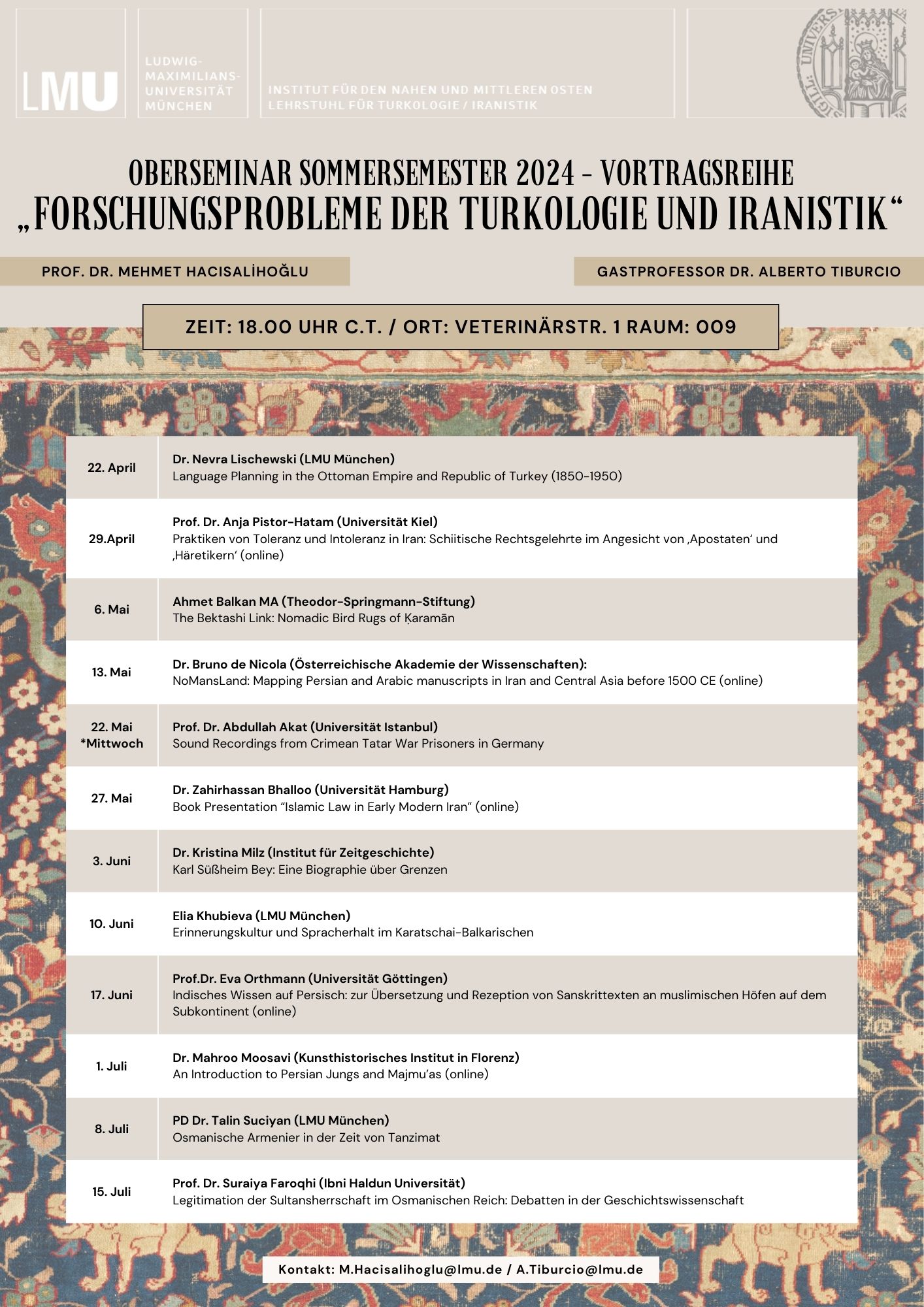
Shii News – book launch: Islamic Law in Early Modern Iran – Z Bhalloo (27.5.24, 6pm CET)
Zahir Bhalloo, book launch, Islamic Law in Early Modern Iran, Berlin: De Gruyter, 2023
Oberseminar summer 2024, Ludwig Maximilians-Universität München
May 27 2024, 6:00 pm, Central European Time (CET)
To attend online please contact m.hascisalihoglu@lmu.de / a.tiburcio@lmu.de
https://www.naher-osten.uni-muenchen.de/download/oberseminar-sose24-_1_.jpg
- May 27, 2024
- 0 Comment
Shii News – Academic Items
1.Symposium – “Aesthetic and Symbolic Dimensions of Arabic Writing – New Perspectives on Manuscripts, Epigraphy, and Numismatics”, Wolfson College, University of Oxford – July 4–5
As the disciplines of Islamic history and Arabic palaeography make steady progress, many questions concerning the aesthetic and symbolic dimensions of Arabic writing remain unanswered. This symposium will bring together fourteen scholars working on Arabic calligraphy, epigraphy, palaeography, numismatics, and diplomatics in different regions of Afro-Eurasia, from the seventh to the sixteenth centuries. The aim is to showcase brand new research on a wide range of artifacts (Qurʾanic manuscripts, chancery documents, monumental epigraphy, inscribed objects, coins…), grounded in material evidence but also engaged with textual sources (historiography, biographical dictionaries, philosophical treatises, fatwas and legal compendia, chancery manuals, adab…). Each contribution will shed light on previously unnoticed paradigms and practices, proposing new frameworks and approaches to Arabic writing that could be applied on a macro level, and unveiling the processes by which meaning was conveyed not just textually, but also visually. The symposium will lay the foundations for a methodological shift in the way we understand calligraphic and epigraphic styles, as it will mainly focus on the ‘why’ and ‘how’ such styles originated, developed, transformed, and became extinct, exposing or disproving their links with doctrinal notions, dynastic claims, aesthetic discourses, cultural identities, or the self-representation of distinct professional groups.
These are some of the questions that will be tackled: Why were specific scripts and layouts employed in some Arabic manuscripts, documents, and inscriptions on various media, instead of others? How did such scripts and layouts originate and develop, and how can the available literary sources help us understand these processes? Through what channels did calligraphic and epigraphic styles travel and spread? What role did different social groups (Quranic calligraphers, book copyists, chancery scribes, stone carvers, die engravers…) play in these processes, and to what extent did they affect each other’s work? What influence did certain patrons, intellectual elites, and religious scholars have on the adoption and canonisation of specific calligraphic and epigraphic styles? What meanings were conveyed by calligraphic diagrams, calligrams, or by epigraphy that followed distinctive configurations or colour schemes? How did contemporary viewers and users perceive calligraphy and epigraphy beyond their textual content? How did they engage with their visual properties and material qualities?
For further information and schedule: https://krc.web.ox.ac.uk/event/asdaw-symposium
2. LACISA’s 2024 Colloquium
Muslim Contributions to Civil Society and Philanthropy in the Caribbean
May 29-30, 2024 [ONLINE]
**REGISTER TODAY**
Research on both Muslim communities and their contributions to civil society in the Caribbean is expanding. What might we learn by putting the two into conversation?
In collaboration with the Muslim Philanthropy Initiative (MPI) at Indiana University-Purdue University Indianapolis (IUPUI), LACISA is hosting an online colloquium on Muslim contributions to civil society, philanthropy and activism in the Caribbean, May 29-30. 2024.
This colloquium brings together scholars and practitioners to conceptualize overarching patterns, offer case studies, and suggest possible avenues forward in the study of Muslim communities in the Caribbean.
Held over two days, each panel will consist of two presentations, one practitioner interview and time for Q&A and discussion. To register, click on the link below.
Day One (May 29) 11:00 am – 12:30 pm U.S. EST
- Ken Chitwood, Introduction and Moderation
- Anisur Rahman, “The Role of South Asian Muslim community in shaping the Caribbean society”
- An Interview with Sakina Bakharia from the Barbados Association of Muslim Ladies (BAML)
- Suleiman Bulbulia (with Sabir Nakhuda), “From Bengal to Barbados: Muslim contributions to Bajan society”
Day Two (May 30): 11:00 am – 12:30 pm U.S. EST
- Harini Kumar, Introduction and Moderation
- Azhar Goraya, “Humanity First in Puerto Rico and the Caribbean”
- Mina Sanz and Rolando Macias, “Humanity First: Serving Mankind and its work in the Caribbean”
- Muhammad Husayn, “The early roots of Shiiism in the Caribbean”
**Inquiries, and other communication related to the colloquium should be sent to lacisanews@gmail.com .**
3. Islamochristiana is the annual scientific journal of PISAI (Pontificio Istituto di Studi Arabi e d’Islamistica)dedicated to Muslim-Christian dialogue.
The journal publishes articles, documents and book reviews concerned with the theoretical and practical aspects of Christian-Muslim dialogue, both past and present. Members of BRISMES are able to access articles published in Islamochristiana Volume 49 (2023) through an exchange agreement with PISAI.
Download vol 49: https://mcusercontent.com/6f554375a2851024e355e1bbd/files/2842a6dd-357e-c2e2-042f-2ee01aa51d6b/islamo_49_2023.pdf
4. Centre for Palestine Studies (CPS) Master’s Scholarship
SOAS University of London
SOAS is pleased to announce the new Centre for Palestine Studies (CPS) Master’s Scholarship which is generously funded entirely through donations. There is one scholarship available for 2024/25 which has been established to support a student ordinarily resident in Palestine to study any taught master’s programme at SOAS.
Deadline | 7 June May 2024
More information
5. Lecturer / Senior Lecturer in Politics and/or International Relations X2
SOAS University of London
Applications are invited for two Lecturer / Senior (T&R) Lecturer positions in Politics and/or International Relations starting in the Autumn of 2024. The role holder will be expected to contribute to—and shape—the Department’s research profile as well as the delivery of our undergraduate and postgraduate degrees.
Deadline | 15 June 2024
More information
6. Call for Papers | Imagined Geographies: From Past to Future
Symposium, University of East Anglia, 2-3 October 2024
The New Area Studies Research Centre, the East Centre and the School of Global Development at the University of East Anglia are calling for papers between 5000-8000 words to be presented at a symposium on the topic of Imagined Geographies: from Past to Future. The organisers particularly welcome original, cross-disciplinary topics and approaches, showcasing innovation, evolving, or new methodologies.
Deadline | 1 June 2024
7. Call for Papers | Transregionalism in the Middle East and Northern Africa
Special Issue, Middle East Critique
Submissions are invited for a Special Issue of Middle East Critique edited by Estella Carpi and Luigi Achilli. This Special Issue aims to scrutinize the concept of transregionalism radiating from and revolving around the MENA as a result of migrations generated by conflict and disasters. Against this backdrop, it aims to explore how identities, solidarities, assistance, as well as fear and violence all transcend national borders, thereby reshaping both sending and receiving societies in profound ways.
Deadline | 30 July 2024
8. Prize for Arabic to English Translators
The Bait AlGhasham DarArab Translation Prize proudly invites translators and authors to participate in an enriching cultural exchange that celebrates Arabic literary heritage. This annual prize is designed to recognize and promote Arabic literature by facilitating its translation into English, thereby making these works accessible to a global audience.
Deadline | 31 July 2024
9. The Lure of the East: A Curator’s Fascinating Journey,
Marilyn Jenkins-Madina
Rodin, 2024
10. ONLINE Round Table “Women and Academy in the MENA Region: Comparing Experiences and Sharing Practices”, Mediterranean Universities Union (UNIMED), 27 May 2024, 5:00 pm – 6:15 pm CEST
The Round Table is organised in the framework of the project “WOMEDa – Promoting the overcoming of the Academic Gender Gap in the MENA region”. It will see the intervention of Academics from Italy and Tunisia discussing the current status of the Academic Gender Gap in the Mediterranean region and presenting practices and initiatives to promote the overcoming of this aspect.
Information and registration: https://www.uni-med.net/events/women-and-academy-in-the-mena-region-comparing-experiences-and-sharing-practices-online-round-table-27-may-2024/
11. ONLINE Webinar “The Threats of AI and Disinformation in Times of Global Crises”, Arab Center Washington DC, 29 May 2024, 11:00 am – 12:30 am EDT
Israel’s recent war on Gaza after October 7 has exposed the myriad methods of digital dehumanization and deception that can result in tech-driven atrocities and justifications for war crimes. Whether it is political influence operations, propaganda, deep fakes, biometric surveillance, predictive policing, or autonomous weapons, the threats of Artificial Intelligence (AI) and disinformation are far-reaching.
Information and registration:
https://arabcenterdc.org/event/the-threats-of-ai-and-disinformation-in-times-of-global-crises/
- May 25, 2024
- 0 Comment
Shii News – ‘Imam Jaʿfar al-Ṣādiq and His Legacy in Islamic Law’ – H Modarressi
- May 24, 2024
- 0 Comment
Shii News – Le CeRMI: ‘Self-education through the body in contemporary Shiism’ – A Neuve-Eglise (6.6.24, 5pm, Paris)
Le CeRMI a le plaisir de vous convier à la prochaine séance du séminaire “Sociétés, politiques et cultures du monde iranien”, qui se tiendra le jeudi 6 juin 2024, 17h-19h, en salle 3.15 à l’INaLCO (65 rue des Grands Moulins, Paris XIII, 3e étage).
Pour la dernière séance de l’année, nous sommes heureux d’accueillir Mme Amélie Neuve-Eglise, philosophe spécialiste du chiisme et de l’anthropologie religieuse de l’Iran contemporain, et Maîtresse de conférences à l’Inalco, pour une conférence intitulée : “L’éducation de soi par le corps dans le chiisme contemporain : l’exemple des marches pèlerines en Iran et en Irak”.
Résumé
Durant la seconde moitié du XXe siècle, l’accès aux sanctuaires d’Imāms situés en Iran et en Irak, principaux lieux de pèlerinage chiite, a été contraint par différents événements politiques, dont l’arrivée au pouvoir du régime baathiste irakien. La guerre Iran-Irak (1980-1988) a entraîné la fermeture des frontières entre ces deux pays, suivi d’une période de contrôle strict. La chute de Saddam Hussein en 2003, puis la mise en place de liaisons aériennes à bas coût reliant les principales villes saintes de ces pays les a rendues accessibles à un nombre croissant de pèlerins. Pourtant, depuis les années 2010, de nombreux fidèles choisissent de rejoindre ces sanctuaires en effectuant une partie du trajet à pied, dans le cadre de marches pèlerines organisées en des occasions liturgiques diverses. À titre d’exemple, en l’espace de quinze ans, la marche d’Arba‘īn, qui a lieu chaque année en Irak à l’occasion du quarantième jour de la mort de Ḥosayn ibn ‘Alī, est devenue un pèlerinage de masse. Bien que des estimations précises restent difficiles à obtenir, en 2019, près de trois millions d’Iraniens auraient parcouru le chemin reliant la ville de Najaf au sanctuaire de Ḥosayn à Karbala.
Si cette marche a été l’objet de plusieurs ouvrages en Iran, les études académiques en langues européennes consacrées à ce phénomène restent rares, et se concentrent principalement sur des observations ethnographiques ou l’analyse du contexte politique et social dans lequel il s’inscrit.
À travers l’analyse de discours de pèlerines et pèlerins iraniens, cette intervention s’attachera davantage à présenter les imaginaires et vécus des croyants lors de ces rituels, en se concentrant principalement sur la marche d’Arba‘īn. Nous tenterons ainsi d’appréhender ce que le corps en mouvement participe à produire en termes d’affects, de pensées et de représentations. Au-delà de la variété des propos, nous verrons la façon dont l’expérience de l’effort, de la fatigue, et de situations d’inconfort physique sont envisagés comme autant de mises à l’épreuve participant à une forme d’éducation de soi. Loin de rechercher un dolorisme exaltant un corps souffrant, nous montrerons comment la marche mobilise aussi un ensemble de techniques du corps et participe à cultiver un « souci de soi ».
Marcher est aussi un acte politique. En autorisant d’autres sociabilités et manières d’être au monde, elle permet de se rendre disponible à l’accueil de multiples présences, de questionner des hiérarchies sociales, et de façonner de nouvelles figures d’exemplarité. Nous étudierons ainsi la manière dont, face aux tentatives d’instrumentalisation étatique dont ils sont l’objet, ces rituels forment des espaces où s’expriment des désirs d’autonomie et participent à un mouvement plus large de remise en cause d’un biopouvoir exercé par des autorités politiques et religieuses.
Orientations bibliographiques
Géraldine CHATELARD, Sabrina MERVIN, « Arbaïn, un pèlerinage sous tension », Orient XXI, 2019, [en ligne].
Pedram KHOSRONEJAD (éd.), Saints and their Pilgrims in Iran and Neighbouring Countries, Wantage, Sean Kingston (« Anthropology of Persianate Societies » 1), 2012.
Mohsen Ḥesām MAZĀHERĪ (éd.), Piyādeh ravī-e arba‘īn, ta’amolāt-e jāme‘eh shenākhtī (La marche d’Arba‘īn, réflexions sociologiques), Ispahan, Ārmā, 2018.
Amélie NEUVE-EGLISE, « La marche d’Arba‘īn en Iran contemporain. Modalités de l’extension d’une temporalité sacrée entre logiques spirituelles et sociolopolitiques », Archives de Sciences Sociales des Religions 193, janvier-mars 2021, p. 199-229.
Anne-Sophie VIVIER, « Le corps dans le chiisme populaire iranien : entre savâb et impureté », Revue des mondes musulmans et de la Méditerranée 113-114, 2006, p. 125-149.
Pour rappel, vous retrouverez le programme 2023-2024 du séminaire mensuel de recherche “Sociétés, politiques et cultures du monde iranien” sur le site du CeRMI :
https://cermi.cnrs.fr/seminaires-de-recherche/societes-politiques-et-cultures-du-monde-iranien-2023-2024/
- May 22, 2024
- 0 Comment
Shii News – Academic Items
1.HYBRID Panel Discussion on Book Launch “Jerusalem Through the Ages: From Its Beginnings to the Crusades” by Prof. Jodi Magness (UNC-Chapel Hill), W. F. Albright Institute, 10 June 2024, 16:00 CEST
For followers of the three Abrahamic faiths, Jerusalem is the place where the presence of the God of Israel dwells. The book explores how this belief came to be associated with the city by introducing readers to its complex and layered history, including the most recent archaeological discoveries. Each chapter focuses on a key moment of transition from Jerusalem’s beginnings to the Middle Ages, providing a vivid narrative of the city’s many transformations as it changed hands and populations.
Information and registration:
https://mailchi.mp/aiar/announcement-jodi-magness-book-launch?e=4b7f78b915
2. Conference of the “Ottoman and Turkish Studies Association (OTSA)”, Northwestern University, Evanston Campus, 25-27 October 2024
Proposals of papers and panels from any discipline in the humanities and the social sciences on themes dedicated to the study of the Ottoman Empire and modern/contemporary Turkey are welcome. We especially encourage proposals that address the state of the field of Ottoman and Turkish Studies, broadly construed.
Proposals from scholars at all levels of seniority are welcome.
Deadline for abstracts: 23 June 2024. Information: https://networks.h-net.org/group/announcements/20034106/ottoman-and-turkish-studies-association-2024-conference-call
3. Workshop “Knowledge in the Islamic Court: Evidence, Proof, Procedure Symposium”, Netherlands Institute Morocco (NIMAR), Rabat, 14-15 May 2025
Themes: How do qadis evaluate various evidentiary forms, and to what extent does this relate to discursive Islamic legal traditions? How are evidentiary forms produced and made probative before the qadi? What is the role of sensory perception? Etc. – Co-organizers: Dr. Nurul Huda Mohd. Razif (University of Bergen) and Dr. Ari Schriber (Utrecht University)
Deadline for abstracts: 30 June 2024. Information: https://forms.gle/jk6unUFnTtEeVCNn8
4. Articles on “Transhumanism and Islam” for a Special Issue of the “Journal of Ethics and Emerging Technologies”
Themes: Philosophical reflections on the nature of humanity and enhancement within Islamic thought. – Theological perspectives on the ethical implications of transhumanism and biotechnologies in Kalam. – Islamic
legal perspectives on bioethical dilemmas and emerging biotechnologies. – Explorations of spirituality and
the human condition in relation to transhumanist aspirations. Etc.
Deadline for submissions: 1 December 2024.
Information: https://jeet.ieet.org/index.php/home/announcement/view/3
5. Legal Transformation in Muslim Societies, Volume 1 Issue 1 2024
https://revivalpress.co.uk/journal-issues
6. Hikmat International Institute (Qom)
The Tasnim Course is now open for registration. This intensive two-month, in-person program is designed for youths eager to explore various topics related to Islam, including principles of faith, faith in action, everyday ethics, and Islamic rulings (Ahkam).
Plus, participants will benefit from a special Tajweed program to enhance their Quran recitation skills.
For just $1500, enjoy over 100 sessions, accommodations, airport transfers, cultural activities, meetings with scholars, and visa assistance.
Course Dates: June 1 – July 31, 2024
Registration Deadline: May 31, 2024
https://hikmat-ins.com/tasnim-summer-course/
7. University of Idaho – Postdoctoral Fellow – International Relations
https://www.h-net.org/jobs/job_display.php?id=67217
8. Zahra Mohaghegian, ‘The Qurʾān and Its Masculine God: A Historical Feminist Analysis’. Monday Majlis Online on the 27th of May, 17:00-18:30 (UK time)
Centre for the Study of Islam, Institute of Arab and Islamic Studies, Exeter.
Register please on this link: https://universityofexeter.zoom.us/meeting/register/tJcqduihpzkiE90GvS8Nmel8pGeLyHUyXQI6
- May 21, 2024
- 0 Comment