
Shii News – Online – ‘Denotations and Connotations of Text in the Arts of the Safavids’ (3.3.22) – M Moosavi
The Psycho-Architectonics of the Imżā Inscriptions: Denotations and Connotations of Text in the Arts of the Safavids
The Courtauld, University of London
March 3, 2022, 18:00-19:30 (London)
By Dr. Mahroo Moosavi
By working between the two media of art and literature, this paper challenges some manners by which the textually infused arts of the early modern Iran have been conventionally perceived. While through the inherited discourse of Western art history, the inscription or epigraph is an appurtenance of the object’s visual and thematic language or is, on some occasions, reduced to a purely scientific and palaeographic element, this paper suggests an alternate discourse that extends the significance of such texts, especially the imżā [signature] inscriptions, beyond the normative, emphasising their particular agency as possible strategic ‘interventions’ envisioned and adopted by the artist, architect, or the patron.
Tracing its earlier roots in the increasing use and thematic specificities of text in the artistic productions of the Persianate societies from the thirteenth and fourteenth centuries onwards, this paper aims to open the current methodologies and understandings of the arts of the Safavids (1501-1722 AD) to a rereading. It does so by engaging with the ‘signature inscriptions’ as systematic architectonic design strategies that constantly de and re construct the object/space and the inter-woven micro politico-cultural context around it through activating the emotive-cognitive recipients of the user. By focusing on a number of cases such as the early seventeenth century mosque of Luṭfullāh in Isfahan and the mid-sixteenth century Sultan Ibrāhīm Mīrzā’s manuscript of Haft Awrang of Jāmī, this study shows how the application of text in the arts of early modern Iran operates as a mechanism through which the boundaries between different branches of art and knowledge may blur, making space for the reception and perception of art as an abstruse apparatus that functions through the layers of connotations of Persian psyche, language and literature.
Dr Mahroo Moosavi is Bahari Fellow in the Persian Arts of the Book at University of Oxford, Oliver Smithies Lecturer at Balliol College, University of Oxford, and Lecturer in architectural history, theory, and design at the University of Sydney. Her research is concerned with the intertext of art/architecture and poetry/prose, with a particular focus on the early modern Iran, through an interdisciplinary study of art/architectural history, literature, and post-structuralist philosophy. Her current project analyses the interpretations of form and structure of rhetorical devices in the chancellery writings of the sixteenth and seventeenth centuries Iran to discern possible resonances within the artistic and urban system of the new city of Isfahan.
Please register at: https://courtauld.ac.uk/whats-on/imza/
- February 16, 2022
- 0 Comment
Shii News – Two Zoom events on Muharram during the Qajar period (15.2, 17.2.2022)
1. “Tekye-ye Dowlat” a documentary
Babak Rahimi is inviting you to a scheduled Zoom meeting.
Topic: Tekye-ye Dowlat
Time: Feb 15, 2022 12:30 PM Pacific Time (US and Canada)
Join Zoom Meeting
https://ucsd.zoom.us/j/91833762354
Meeting ID: 918 3376 2354
One tap mobile
+12133388477,,91833762354# US (Los Angeles)
+16692192599,,91833762354# US (San Jose)
Dial by your location
+1 213 338 8477 US (Los Angeles)
+1 669 219 2599 US (San Jose)
+1 669 900 6833 US (San Jose)
Meeting ID: 918 3376 2354
Find your local number: https://ucsd.zoom.us/u/abZ4emITJu
2. “Photography of Moharram Rituals inside the Golestan Palace(1860s-1900s)”
Pedram Khosronejad (Powerhouse Museum, Sydney)
Time: Feb 17, 2022 02:00 PM Pacific Time (US and Canada)
Join Zoom Meeting
https://ucsd.zoom.us/j/99404838317
Meeting ID: 994 0483 8317
One tap mobile
+16692192599,,99404838317# US (San Jose)
+16699006833,,99404838317# US (San Jose)
Dial by your location
+1 669 219 2599 US (San Jose)
+1 669 900 6833 US (San Jose)
+1 213 338 8477 US (Los Angeles)
Meeting ID: 994 0483 8317
Find your local number: https://ucsd.zoom.us/u/aRLInGyfT
- February 14, 2022
- 0 Comment


- February 07, 2022
- 0 Comment
Shii News – Journal of Safavid Studies
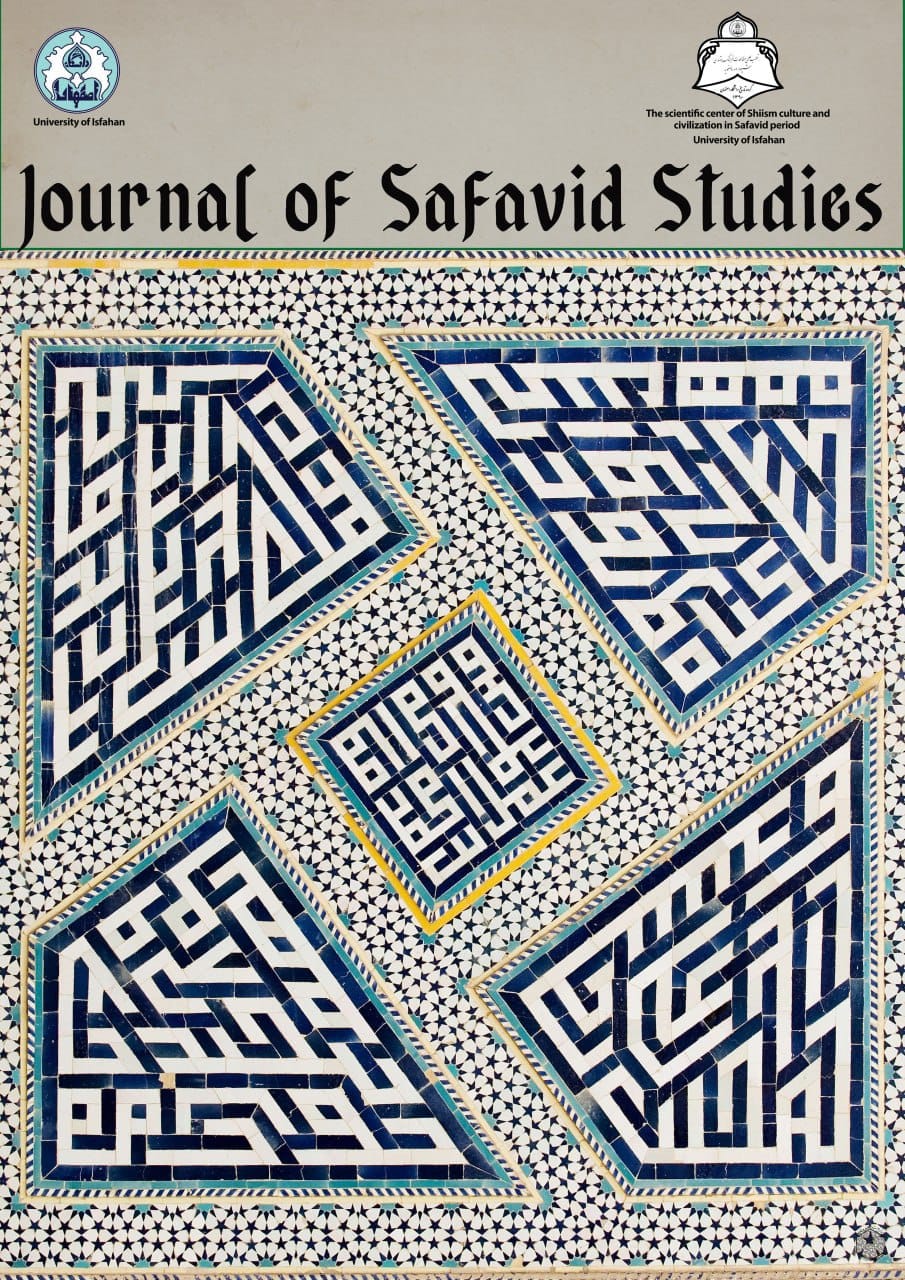
The Journal of Safavid Studies is an academic journal published by Safavid Studies center, University of Isfahan. The journal welcomes the articles that engage with any aspect of Safavid Studies that provide a scholarly platform for critical and informed articles with a historical approach.
The journal conscientiously aims to provide a scholarly platform for critical and informed articles with a historical approach in all fields of Safavid studies such as religious, political, cultural, social, economic, educational, artistic, international relations. The articles will cover the most debate-worthy issues in the aforementioned fields in the hope of ultimately contributing to the resolution of various theoretical, methodological and practical dilemmas encountered in Safavid Studies.This journal also aims to pave the way to increase cultural exchanges at the international level with an approach to introduce Safavid history and Shi’ism
https://ssj.ui.ac.ir/
Open Access Current Issue: Volume 1, Issue 1, Spring 2022
- February 03, 2022
- 0 Comment
Shii News – ‘British policy towards the Iraqi Shiites during the First World War’ – J Cole
- February 02, 2022
- 0 Comment
- January 26, 2022
- 0 Comment
Shii News – ‘The 12th intensive Course on Shi’i Studies’ (24 Feb – 4 March, Qom)
The University of Religions and Denominations (URD) – Qom, Iran- has organized the 12th intensive Course on Shi’i Studies (24 February to 4 March 2022) for scholars, professors, and students from various academic backgrounds, who are interested in expanding their understanding of Islam and Shiism.
Shi’i Intensive Course gives you the chance to develop your skills and knowledge, expand your international experience, and study unique and interesting subjects on Shiism and Iran.
Studying at URD Shi’a Intensive Course is the perfect way to broaden your academic and cultural horizons at an Iran-leading university and is a fantastic option to enjoy one of the world’s most unique cities. Our social programs let you experience the best of the city, while our class schedule gives you plenty of opportunities to explore Shi’i Islam in Iran. The course also includes a 5-day cultural tour (Matin-Abad, Isfahan, Shiraz) to truly immerse yourself in the vibrant atmosphere that Iran has to offer.
For further information and to apply:
http://shiacourse.urd.ac.ir/application-form/
Last day to register: 29 January.
- January 21, 2022
- 0 Comment
Shii News – Webinar: ‘Mulla Sadra’s Philosophy: Continuity and Novelty’ (London, 28.1.22, 6pm UK time)
The Islamic College
‘Vistas to the East’
Friday 28th of January 2022
6:00 pm – 8:30 pm (UK Time)
on Zoom
(3rd Online Webinar)
‘Mulla Sadra’s Philosophy: Continuity and Novelty’
Prof. Mohammad Fanaei
Prof. David B. Burrell
Professor Mohammad Fanaei Eshkevari studied both at the Qom seminary in Iran as well as McGill University in Montreal, Canada, where he received his PhD in philosophy. For the past two decades, he has been lecturing on comparative philosophy, mysticism and theology in Imam Khomeini Education and Research Institute in Qom. He has published more than fifty books and articles in Persian on different areas of Islamic thought.
Professor David Bakewell Burrell is an American educator, theologian, writer and translator. He is the Theodore Hesburgh Professor emeritus in Philosophy and Theology at University of Notre Dame, USA. He has written and published extensively on Judeo-Christian and Islamic traditions.
For more information and to register, see:
https://www.islamic-college.ac.uk/2022/01/3rd-webinar/
- January 20, 2022
- 0 Comment